'%3e%3cpath%20d='M43.073%200.00649261H15.0943V3.94346H43.073V0.00649261Z'%20fill='url(%23kiwitaxi-grad)'%20/%3e%3cpath%20d='M15.0828%203.94346C16.1928%203.94346%2017.0512%203.06513%2017.0512%201.97497C17.0512%200.874164%2016.1822%200.00649261%2015.0828%200.00649261C14.0362%200.00649261%2013.1379%200.851916%2013.1379%201.97497C13.1379%203.10916%2014.0478%203.94346%2015.0828%203.94346Z'%20fill='white'%20/%3e%3cpath%20d='M43.0614%203.94346C44.1715%203.94346%2045.0299%203.06513%2045.0299%201.97497C45.0299%200.874164%2044.1609%200.00649261%2043.0614%200.00649261C42.0149%200.00649261%2041.1166%200.851916%2041.1166%201.97497C41.1166%203.10916%2042.0265%203.94346%2043.0614%203.94346Z'%20fill='white'%20/%3e%3cpath%20d='M19.5921%2038.5052V39.828H23.1471V26.0491H19.5921V27.3446C18.895%2026.5789%2017.4549%2025.8841%2015.7339%2025.8841C11.8502%2025.8841%208.78975%2028.7578%208.78975%2032.939C8.78975%2037.1374%2011.8702%2039.9935%2015.7339%2039.9935C17.4938%2039.9935%2018.932%2039.2691%2019.5921%2038.5052ZM12.2892%2032.939C12.2892%2030.5715%2013.929%2029.1912%2015.9819%2029.1912C18.0106%2029.1912%2019.5647%2030.5845%2019.5647%2032.939C19.5647%2035.2579%2017.9768%2036.6869%2015.9823%2036.6869C13.9596%2036.6869%2012.2892%2035.264%2012.2892%2032.939Z'%20fill='white'%20/%3e%3cpath%20d='M44.7174%2026.0496H41.4289V39.8281H44.7174V26.0496Z'%20fill='white'%20/%3e%3cpath%20d='M32.2183%2035.7001L29.3455%2039.8281H24.94L30.044%2032.8552L25.1624%2026.0496H29.7075L32.3295%2029.8985L35.035%2026.0496H39.4405L34.5599%2032.7435L39.6361%2039.8281H35.1189L32.2183%2035.7001Z'%20fill='white'%20/%3e%3cpath%20d='M3.34504%2022.9604V26.0496H7.4039V29.0939H3.34504V34.2781C3.34504%2035.9866%204.33971%2036.7008%205.955%2036.7008C6.54504%2036.7008%207.16659%2036.5766%207.63241%2036.235V39.4341C7.04237%2039.7757%206.14133%2039.9931%204.89915%2039.9931C1.8243%2039.9931%200.0226746%2038.1293%200.0226746%2034.9298V22.96H3.34504Z'%20fill='white'%20/%3e%3cpath%20d='M36.2094%208.57428L33.307%2016.8723L30.43%208.57428H27.7621L24.8597%2016.8723L21.9828%208.57428H18.4884L23.2157%2021.4188H26.5037L29.084%2014.4093L31.6629%2021.4188H34.951L39.6782%208.57428H36.2094Z'%20fill='white'%20/%3e%3cpath%20d='M44.7174%208.57381H41.4289V21.4188H44.7174V8.57381Z'%20fill='white'%20/%3e%3cpath%20d='M16.7387%208.57381H13.4502V21.4188H16.7387V8.57381Z'%20fill='white'%20/%3e%3cpath%20d='M11.7001%208.57382L6.07922%2014.1326L12.1622%2021.4188H8.05929L3.92163%2016.28L3.3455%2016.8538V21.4188H0.0226746V3.94299H3.3455V12.7574L7.59764%208.57382H11.7001Z'%20fill='white'%20/%3e%3c/g%3e%3cdefs%3e%3clinearGradient%20id='kiwitaxi-grad'%20x1='15.0945'%20y1='1.97497'%20x2='43.073'%20y2='1.97497'%20gradientUnits='userSpaceOnUse'%3e%3cstop%20stop-color='%2300D2CD'%20stop-opacity='0'%20/%3e%3cstop%20offset='1'%20stop-color='%2300D2CD'%20/%3e%3c/linearGradient%3e%3cclipPath%20id='kiwitaxi-clip'%3e%3crect%20width='46'%20height='40'%20fill='white'%20/%3e%3c/clipPath%3e%3c/defs%3e%3c/svg%3e)

Verona: Older Than the Story, Better Than the Legend
Most people arrive in Verona because of Shakespeare. They stay because of everything else.
The Romeo and Juliet connection is real enough — the city has leaned into it since the 13th century, and the house on Via Cappello with its famous balcony draws visitors from every continent — but it has always been a convenient myth layered over something considerably more substantial. The Romans built an arena here in 30 AD that still hosts opera for 15,000 people on summer evenings. The Scaligeri family turned it into a medieval capital of northern Italy. Dante wrote parts of the Divine Comedy here while living in exile. The wines from the surrounding hills — Amarone, Ripasso, Soave — have been shaping Italian gastronomy for centuries.
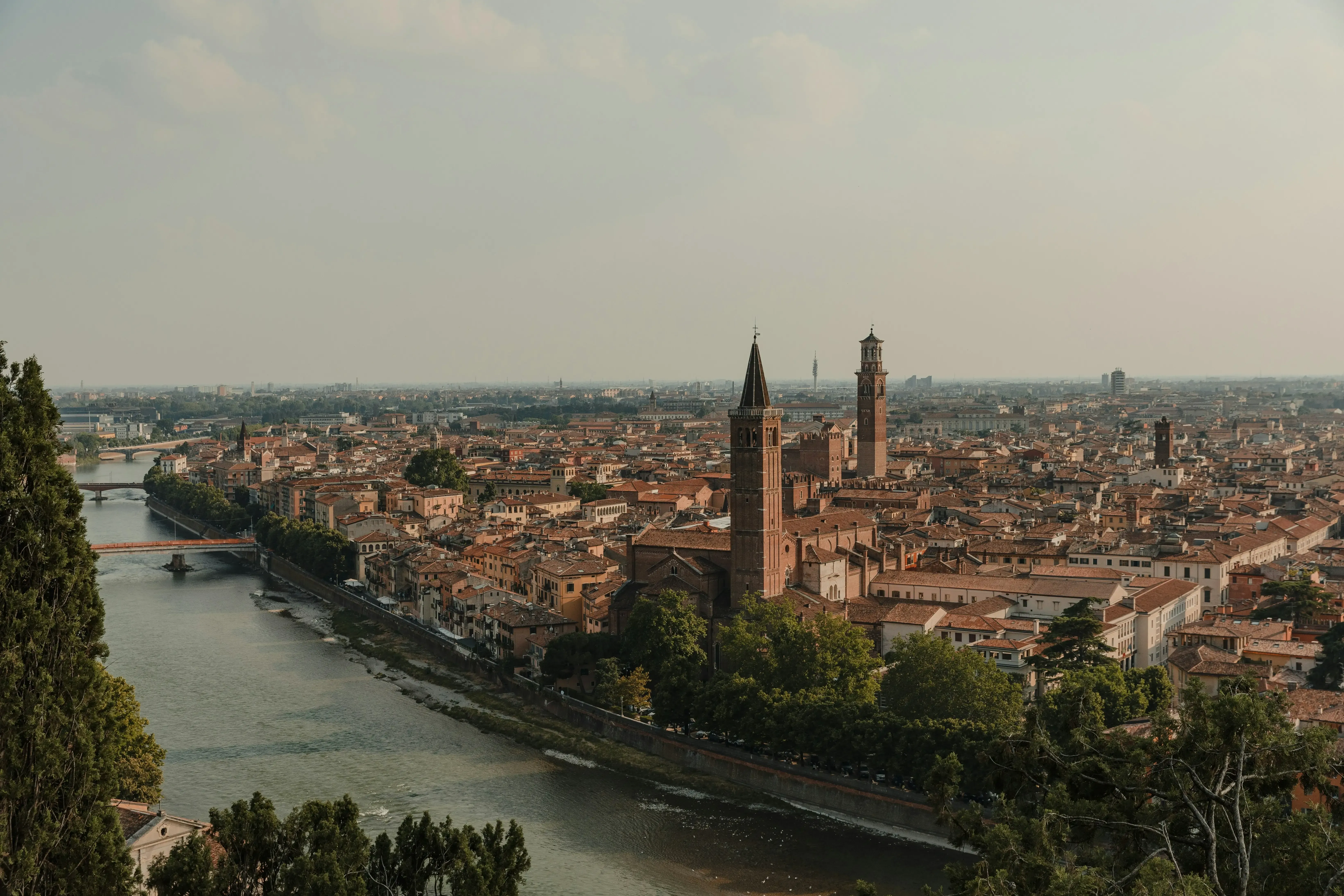
Verona is a UNESCO World Heritage Site not because of a Shakespearean balcony but because its 2,000 years of continuous urban history are unusually visible, unusually intact, and unusually beautiful. Roman gates open onto medieval squares. Renaissance frescoes cover baroque church walls. The river Adige curves around the historic center in a wide horseshoe, as if trying to keep it safe.
Two days here are enough to see the headlines. Three days lets you stop rushing. And the position — an hour from Venice, 90 minutes from Milan, 20 minutes from Lake Garda — makes it one of the finest bases for northern Italy that most travelers underestimate.

Getting to Verona
By Air
Verona Villafranca Airport (VRN), officially named Valerio Catullo Airport, sits 12 km southwest of the city center and handles direct flights from across Europe. Ryanair, easyJet, Wizz Air, and Lufthansa operate the most frequent routes. The airport is compact and quick to clear — baggage claim typically takes 15–20 minutes after landing.
The Verona Airlink Shuttle connects the airport to Porta Nuova train station in 15 minutes, with departures every 20 minutes from 5:35 AM to 11:10 PM. Tickets cost €7 one way. Note that the shuttle drops you at the train station, not the historic center — from there it's either a further 15-minute walk or a quick taxi.
For door-to-door arrivals without the two-stage journey, a Kiwitaxi private transfer from VRN covers the full 12 km directly to any address in Verona with fixed pricing, meet and greet, and no timetable to catch.
By Train
Verona Porta Nuova is the city's main rail station, sitting just south of the historic center. Fast Frecciarossa trains reach Milan in 65 minutes and Venice in 70 minutes — which makes Verona easy to slot into a broader Italian itinerary without any sense of compromise. Bologna is 1 hour 20 minutes away; Florence around 2 hours; Rome under 3 hours on the fastest services. Regional trains serve Brescia, Mantua, Trento, and the Lake Garda towns on regular schedules.
By Road
Verona sits at the intersection of the A4 (Milan–Venice) and A22 (Brenner Pass–Modena) motorways — one of the most important road junctions in northern Italy. Arriving by car is straightforward; parking in or near the historic center is limited and charged.
For intercity transfers by private vehicle, Kiwitaxi covers routes from Milan, Venice, Bologna, and other northern Italian cities directly to Verona.
Arriving in Verona: What to Expect
The historic center is compact and almost entirely car-restricted. Once inside, everything moves on foot. The walk from Porta Nuova station to Piazza Bra — the main square — takes around 15 minutes along Corso Porta Nuova, a wide boulevard that delivers you directly to the Arena.
Traffic restrictions mean taxis drop off at the edge of the ZTL (restricted traffic zone), typically on Viale Roma or Corso Porta Nuova, from where most central hotels are within a 5–10 minute walk. Drivers who don't know the city well can fall into ZTL fines — Kiwitaxi drivers are briefed on drop-off points and navigate around the restrictions cleanly.

Getting Around Verona
The honest answer is: you walk. Verona's historic center is small enough that almost everything of interest sits within a 20-minute walk of everything else. The Arena, Juliet's House, Piazza delle Erbe, Castelvecchio, the Roman Theatre, and San Zeno Basilica can all be reached on foot without anything resembling effort.
City buses serve the wider neighborhoods and the train station. A single ticket costs €1.50, valid for 90 minutes. The network is reliable but rarely necessary for visitors staying within the historic center.
Taxis are available at ranks on Piazza Bra and at the train station, metered and typically affordable within the city. For day trips into the surrounding region — Lake Garda, Valpolicella, Mantua — the options narrow quickly. Trains serve the main cities; the countryside and smaller wine towns require either a rental car or a private transfer. Kiwitaxi's Chauffeur Hire covers the full region with a dedicated vehicle, fixed pricing, and the freedom to build the day around what you actually want to see.
Best Time to Visit Verona
Verona rewards visits in every season, but the character of the city shifts dramatically between summer and the rest of the year.
April to June is the finest time for first-time visitors. Temperatures sit between 18–25°C, the city isn't yet at summer capacity, and the Vinitaly wine fair in April — one of the world's largest wine exhibitions — draws producers from across Italy into the city. The Piazza delle Erbe market is at its most photogenic in morning light. Hotel prices are reasonable; the Arena hasn't yet filled with opera crowds.
July and August brings the Arena di Verona Opera Festival — the main reason many visitors choose summer specifically. Performances run almost nightly under open skies in a Roman amphitheatre, with some of the world's leading companies and soloists. It is a genuinely extraordinary experience. The city is at its busiest and hottest (30–35°C), accommodation books out months in advance for opera nights, and Piazza Bra in peak season requires patience. Book everything early if opera is the purpose.
September and October is Verona at its most balanced — the opera season winds down, temperatures drop to 20–25°C, the Valpolicella harvest fills the surrounding hills with activity, and the city regains something of its everyday rhythm. Wine tourism peaks in autumn; the Heurigen equivalent here is the osteria, and they are busy from September onward.
November to March is quieter, cooler, and occasionally underrated. Verona's Christmas markets are among the best in northern Italy — the market in Piazza dei Signori runs through December and the nativity scenes exhibition is a local institution. Winter light on the pink Verona marble of the historic center is something specific and worth seeing.

Where to Stay in Verona
Città Antica (Historic Center) is where most first-time visitors anchor — Piazza Bra, Piazza delle Erbe, and the Arena are all within walking distance of virtually any address here. It is the most atmospheric choice and prices reflect it; some streets near bars get loud on weekend nights.
San Zeno is the neighborhood west of the center along the Adige, anchored by the Romanesque basilica of the same name. Quieter and more residential than the center, with good independent restaurants and a genuinely local feeling. Accessible by a pleasant riverside walk from the historic core.
Veronetta sits across the Adige on the eastern bank — the university neighborhood, younger and more informal, with affordable trattorias, street art, and easy access to Castel San Pietro and the Roman Theatre. A short walk across the bridge from Piazza Bra.
Borgo Trento is the quietest option — a residential neighborhood of Liberty-style villas north of the river, preferred by returning visitors who want to be close without being in the middle of it. A 10-minute walk across the Ponte della Vittoria reaches the center.
Near Porta Nuova offers practical, well-priced hotels for early trains and late arrivals, with direct access to the rail station and bus connections to the airport.

Best Things to Do in Verona
Watch Opera at the Arena di Verona The Verona Arena was built in 30 AD and holds 15,000 spectators. It has been used continuously ever since — gladiatorial contests, medieval tournaments, public markets, and since 1913, opera. The summer festival runs July through September with productions of Aida, Carmen, Nabucco, and the great Verdi and Puccini canon performed on a stage that occupies the full arena floor, with sets of operatic scale. Watching the sun set over the Roman stonework while the orchestra tunes is one of those travel experiences that doesn't require any interest in opera to be extraordinary. Bring a cushion — the stone seats are original.
Wander Piazza delle Erbe The elongated piazza that was Verona's Roman forum for two thousand years is now its daily market, surrounded by medieval towers, baroque palaces, and Renaissance frescoes in various states of faded glory. A column topped with the Lion of Saint Mark stands at one end — a reminder that Venice controlled Verona for nearly four centuries. The market stalls in the center sell produce, flowers, and tourist goods in roughly equal measure; the surrounding buildings are worth looking up at constantly. The Torre dei Lamberti at the north end can be climbed for views across the city.
Cross Ponte Pietra Verona's oldest bridge — partially Roman, partially medieval, partially rebuilt after German forces blew it up in 1945 (the Veronese fished the original Roman stones from the river bed and rebuilt it block by block) — is the finest viewpoint in the city. Cross it at golden hour and look back at the curve of the Adige, the Roman Theatre rising above the eastern bank, and the old city beyond. The climb to Castel San Pietro above the theatre adds a higher panorama over the full sweep of the historic center.
Visit the Roman Theatre and Archaeological Museum Considerably less visited than the Arena but no less impressive, the Roman Theatre on the north bank of the Adige dates from the 1st century BC and is built directly into the hillside below Castel San Pietro. The attached archaeological museum fills the former convent above the theatre with mosaics, bronzes, and finds from Verona's Roman period. In summer, the theatre hosts the Estate Teatrale Veronese — a festival of theatre, dance, and jazz that runs June through August as a quieter alternative to the Arena crowds.
See Juliet's House — Then Move On Via Cappello 23 is genuinely medieval, the courtyard genuinely atmospheric, and the bronze Juliet statue genuinely worn smooth by decades of hands on her right breast (a tradition of debated origin and uncertain efficacy for love). The balcony is 14th century but was not connected to Shakespeare, Juliet, or anyone named Capulet — the family named Dal Cappello lived here, which was apparently close enough. See it, appreciate the theater of it, and then walk two minutes to Piazza delle Erbe and remember that Verona has 2,000 years of history that doesn't require literary footnotes.
Walk to Castelvecchio The 14th-century fortress of the Scaligeri lords sits on the Adige west of the historic center, its crenellated walls and the elegant Castelvechio Bridge (Ponte Scaligero) reflected in the river below. The museum inside houses Verona's finest art collection — Pisanello, Mantegna, Tintoretto, Veronese — in a building that was renovated by Carlo Scarpa in the 1960s in one of the great architectural interventions of the 20th century. The interplay between medieval stonework and Scarpa's modernist insertions is worth the visit even before considering the paintings.
Drink Amarone in a Historic Enoteca Verona is the capital of one of Italy's most serious wine regions. Amarone della Valpolicella — made from partially dried Corvina grapes, aged a minimum of two years, typically much longer — is a wine of genuine weight and complexity that retails in Verona for a fraction of what it costs abroad. The Osteria del Bugiardo on Corso Porta Borsari, the Enoteca Segreta in Vicolo Samaritana, and the wine bars of the historic center pour by the glass from cellars that take the region seriously. Order a Ripasso if Amarone is more than the budget allows — it uses the Amarone pomace for a second fermentation and is one of Italy's finest value wines.
Visit San Zeno Basilica The Romanesque church dedicated to Verona's patron saint sits in the western neighborhood of the same name, slightly removed from the tourist center and considerably less crowded for it. The bronze doors — 48 panels cast between the 11th and 12th centuries depicting scenes from the Old and New Testaments — are among the finest Romanesque metalwork in Italy. The interior triptych above the altar is by Mantegna. The crypt beneath the altar contains the remains of San Zeno himself, allegedly still smiling — a detail the Veronese mention with more affection than solemnity.

Day Trips from Verona with Kiwitaxi Chauffeur Service
Verona's position in the northeastern corner of the Po Valley puts some of northern Italy's most compelling destinations within an easy drive.
For travelers who want to move through the region without timetables, connections, or the constraint of a single destination, Kiwitaxi's Chauffeur Hire offers a dedicated vehicle, a professional driver, and the freedom to shape the day around what actually interests you.
The model is straightforward: fixed pricing confirmed at booking, flexibility to stop wherever the journey earns it, a driver who knows the routes and can suggest where to turn off. Below are the day trips that work best with a dedicated vehicle.
Lake Garda — 30 minutes from Verona
Italy's largest lake sits 20 km west of Verona and could absorb a full week without exhausting its inventory of things to do. The southern shore — Sirmione on its narrow peninsula, with Roman ruins, a medieval castle rising from the water, and thermal springs operating since antiquity — is the most visited and most justified. The western shore climbs dramatically through Limone and Gargnano toward Riva del Garda at the northern tip, where the lake narrows between cliffs and takes on an almost Alpine character. The eastern shore through Bardolino and Garda town is quieter and more local.
With a Kiwitaxi chauffeur, you can move between shores, stop at a lemon grove terrace above the lake, spend an hour in Sirmione without worrying about the ferry back, and return to Verona in time for dinner. By public transport, the same day requires three buses and significant scheduling. The lake rewards the vehicle.
Valpolicella Wine Country — 20 minutes from Verona
The hills immediately northwest of Verona produce Amarone, Ripasso, and Valpolicella Classico — wines of international standing made in a landscape of terraced vineyards, small villages, and family estates that have been here for centuries. The classic Valpolicella Classico zone covers the valleys of Sant'Ambrogio, Fumane, Marano, Negrar, and San Pietro in Cariano. Most of the best producers receive visitors by appointment — something a Kiwitaxi chauffeur can coordinate around.
A day in Valpolicella typically combines a morning winery visit with lunch in one of the valley's agriturismi, an afternoon at a second estate, and a return to Verona by evening. The combination of wine, landscape, and the absence of any driving responsibility makes the Chauffeur Hire service particularly suited to this route.
Mantua (Mantova) — 45 minutes from Verona
Mantua is one of the most undervisited cities in northern Italy and one of the most rewarding. The former capital of the Gonzaga dynasty sits encircled by three artificial lakes formed by the Mincio river — an improbable, beautiful setting for a city of ducal palaces, frescoed chambers, and Renaissance architecture that rivals anything in Lombardy or the Veneto. The Palazzo Ducale and its Camera degli Sposi — Mantegna's masterpiece of trompe l'oeil fresco painting — is the centerpiece, but the smaller Palazzo Te outside the historic center, built as a pleasure residence for Federico II Gonzaga, runs it close. Mantua is reachable by train in about 40 minutes from Verona, but the station is 2 km from the center and the city is best approached directly.
Venice — 70 minutes from Verona
Venice by private transfer offers something the train cannot: a drop-off directly at the Piazzale Roma or the Tronchetto parking island, from where the city's water transport takes over, without the crowds of Santa Lucia station. The journey by Frecciarossa is faster and often preferable for solo travelers, but for groups of three or more, the private transfer calculates favorably and removes the luggage problem. A day in Venice from Verona — San Marco, the Rialto, Dorsoduro — works with an early start and an honest focus on one or two neighborhoods rather than a comprehensive sweep.
Brescia — 50 minutes from Verona
Lombardy's second city is consistently overlooked by travelers moving between Verona and Milan, which is precisely why it rewards a visit. Roman ruins of unexpected scale — a forum, a capitolium, a theatre — sit in the city center alongside a medieval castle and the Pinacoteca Tosio Martinengo, which houses Raphael's Angel and works by Moretto, Romanino, and Savoldo. Brescia is easily reached by train but benefits from a vehicle for combining it with a Lake Garda stop on the return.
Book your Verona day trip with Kiwitaxi Chauffeur Hire — fixed pricing, flexible scheduling, and a professional driver who knows where the best views are.

Verona on a Practical Note
Verona uses the euro. Card payment is accepted at most restaurants and hotels; smaller bars and market stalls tend toward cash. Carry €20–30 for coffee, market purchases, and the occasions where the card reader is mysteriously unavailable.
The Verona Card (€20 for 24 hours, €25 for 48 hours) covers entry to the Arena, Castelvecchio, the Roman Theatre, San Zeno, and several other churches and museums. It calculates favorably if you plan to visit more than three or four paid attractions; it comes with a city bus pass included.
The Arena books up weeks in advance for opera season — visit arena.it directly and book as soon as dates are announced, typically in January for the summer season. Timed entry is increasingly required at Juliet's House; purchase online to avoid queues.
The ZTL (restricted traffic zone) covers the entire historic center and is enforced by cameras. Accommodation in the center typically provides a ZTL permit for check-in and check-out — confirm with your hotel before arriving by car.
Restaurants in Verona take lunch seriously: kitchens open at 12:30 and close firmly at 2:30. Dinner starts at 7:30 PM and continues until 10:30 or later. Arriving at 6 PM expecting a table is a characteristically non-Italian misunderstanding.
Verona was here long before Shakespeare arrived. It will be here long after the last visitor leaves a note on Juliet's courtyard wall. It doesn't need the story — but it has learned to tell it beautifully.
Explore Italy
Milan to Verona Day Trip with a Chauffeur

Best Wine Tours from Milan: Franciacorta, Valpolicella & Chauffeur Hire
A Taste of Florence: Your Complete Food Guide

Best Day Trips from Milan with a Private Driver: Lake Como, Verona & Beyond

10 Unforgettable Day Trips from Rome, Italy: Ancient Towns, Best Beaches & Countryside Escapes

Traveling with kids? We've got everything covered.
Child seats, luggage, and a driver who knows your flight lands late. Kiwitaxi takes care of everything so your family trip starts the way it should - with excitement, not chaos.
Book a family transfer