'%3e%3cpath%20d='M43.073%200.00649261H15.0943V3.94346H43.073V0.00649261Z'%20fill='url(%23kiwitaxi-grad)'%20/%3e%3cpath%20d='M15.0828%203.94346C16.1928%203.94346%2017.0512%203.06513%2017.0512%201.97497C17.0512%200.874164%2016.1822%200.00649261%2015.0828%200.00649261C14.0362%200.00649261%2013.1379%200.851916%2013.1379%201.97497C13.1379%203.10916%2014.0478%203.94346%2015.0828%203.94346Z'%20fill='white'%20/%3e%3cpath%20d='M43.0614%203.94346C44.1715%203.94346%2045.0299%203.06513%2045.0299%201.97497C45.0299%200.874164%2044.1609%200.00649261%2043.0614%200.00649261C42.0149%200.00649261%2041.1166%200.851916%2041.1166%201.97497C41.1166%203.10916%2042.0265%203.94346%2043.0614%203.94346Z'%20fill='white'%20/%3e%3cpath%20d='M19.5921%2038.5052V39.828H23.1471V26.0491H19.5921V27.3446C18.895%2026.5789%2017.4549%2025.8841%2015.7339%2025.8841C11.8502%2025.8841%208.78975%2028.7578%208.78975%2032.939C8.78975%2037.1374%2011.8702%2039.9935%2015.7339%2039.9935C17.4938%2039.9935%2018.932%2039.2691%2019.5921%2038.5052ZM12.2892%2032.939C12.2892%2030.5715%2013.929%2029.1912%2015.9819%2029.1912C18.0106%2029.1912%2019.5647%2030.5845%2019.5647%2032.939C19.5647%2035.2579%2017.9768%2036.6869%2015.9823%2036.6869C13.9596%2036.6869%2012.2892%2035.264%2012.2892%2032.939Z'%20fill='white'%20/%3e%3cpath%20d='M44.7174%2026.0496H41.4289V39.8281H44.7174V26.0496Z'%20fill='white'%20/%3e%3cpath%20d='M32.2183%2035.7001L29.3455%2039.8281H24.94L30.044%2032.8552L25.1624%2026.0496H29.7075L32.3295%2029.8985L35.035%2026.0496H39.4405L34.5599%2032.7435L39.6361%2039.8281H35.1189L32.2183%2035.7001Z'%20fill='white'%20/%3e%3cpath%20d='M3.34504%2022.9604V26.0496H7.4039V29.0939H3.34504V34.2781C3.34504%2035.9866%204.33971%2036.7008%205.955%2036.7008C6.54504%2036.7008%207.16659%2036.5766%207.63241%2036.235V39.4341C7.04237%2039.7757%206.14133%2039.9931%204.89915%2039.9931C1.8243%2039.9931%200.0226746%2038.1293%200.0226746%2034.9298V22.96H3.34504Z'%20fill='white'%20/%3e%3cpath%20d='M36.2094%208.57428L33.307%2016.8723L30.43%208.57428H27.7621L24.8597%2016.8723L21.9828%208.57428H18.4884L23.2157%2021.4188H26.5037L29.084%2014.4093L31.6629%2021.4188H34.951L39.6782%208.57428H36.2094Z'%20fill='white'%20/%3e%3cpath%20d='M44.7174%208.57381H41.4289V21.4188H44.7174V8.57381Z'%20fill='white'%20/%3e%3cpath%20d='M16.7387%208.57381H13.4502V21.4188H16.7387V8.57381Z'%20fill='white'%20/%3e%3cpath%20d='M11.7001%208.57382L6.07922%2014.1326L12.1622%2021.4188H8.05929L3.92163%2016.28L3.3455%2016.8538V21.4188H0.0226746V3.94299H3.3455V12.7574L7.59764%208.57382H11.7001Z'%20fill='white'%20/%3e%3c/g%3e%3cdefs%3e%3clinearGradient%20id='kiwitaxi-grad'%20x1='15.0945'%20y1='1.97497'%20x2='43.073'%20y2='1.97497'%20gradientUnits='userSpaceOnUse'%3e%3cstop%20stop-color='%2300D2CD'%20stop-opacity='0'%20/%3e%3cstop%20offset='1'%20stop-color='%2300D2CD'%20/%3e%3c/linearGradient%3e%3cclipPath%20id='kiwitaxi-clip'%3e%3crect%20width='46'%20height='40'%20fill='white'%20/%3e%3c/clipPath%3e%3c/defs%3e%3c/svg%3e)

Tbilisi: The City That Learned to Love Being Itself
There's a specific moment that gets most visitors. It usually happens on the second day, somewhere between the sulfur bath and the third glass of amber wine, when the Old Town's wooden balconies are catching the evening light and someone at the next table in the open-air restaurant has started playing the panduri without anyone asking them to. And you think: this city is genuinely, uncomplicatedly alive in a way that very few places are.
Tbilisi doesn't perform for tourists. It's too busy being itself.
The name comes from the Georgian word tbili — warm — a reference to the natural sulfur springs that bubbled up along the Mtkvari River and prompted the 5th-century King Vakhtang I Gorgasali to shift his kingdom's capital here. Legend has it that the king was out hunting when his falcon chased a pheasant into a hot spring and both birds emerged cooked. He took this as a sign. Fourteen centuries later, the sulfur baths are still there, still operating, still steaming through domed rooftops in Abanotubani, and still one of the first things any self-respecting visitor does on arrival.
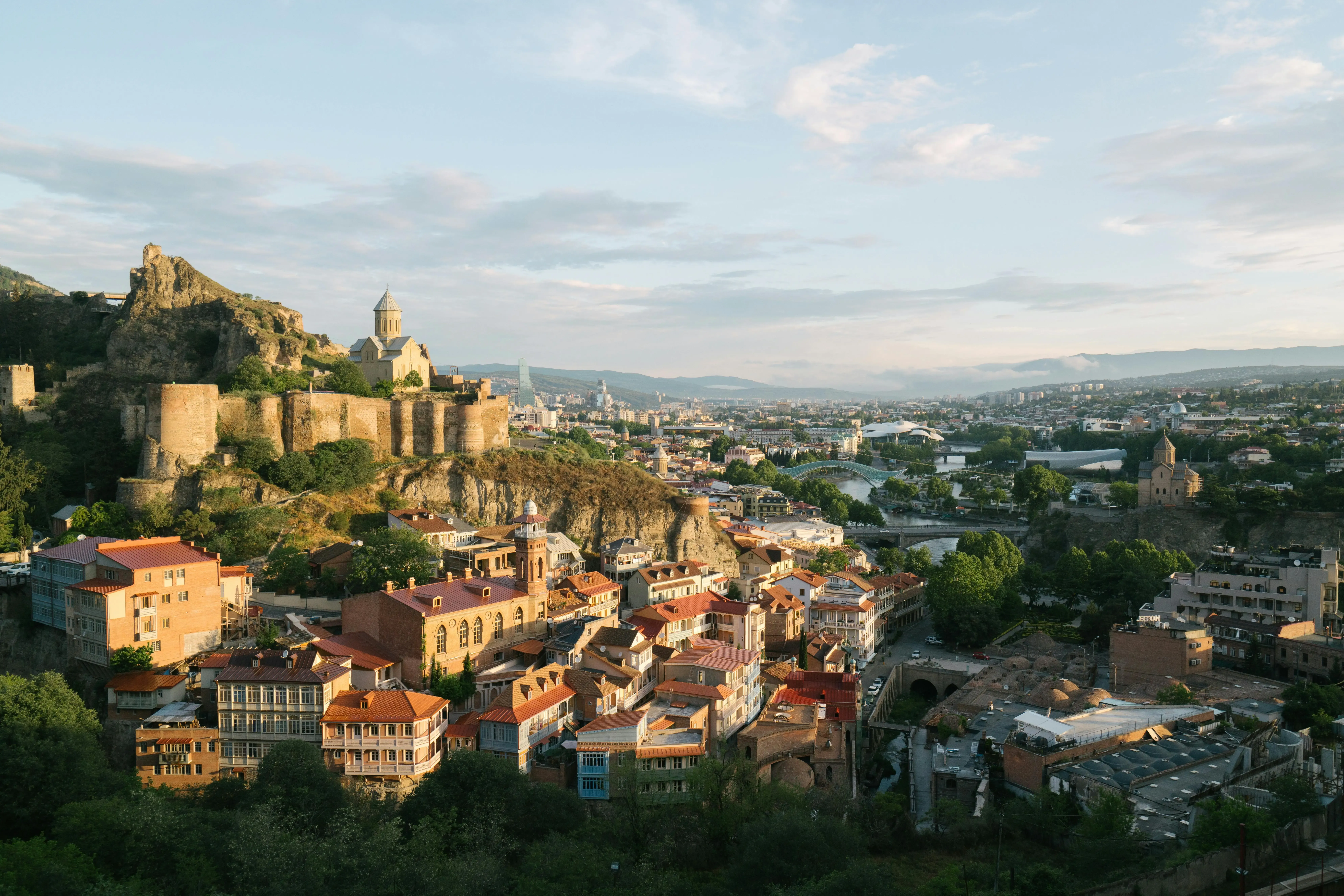
Tbilisi has been conquered by Persians, Arabs, Byzantines, Mongols, Ottomans, and Russians. It's been burned to the ground at least once by each of them. It's been rebuilt every time, and each occupation left something behind in the architecture, the cuisine, the music, the faces. The result is a city with no consistent style and total coherent character — Orthodox churches and Moorish-revival baths and Soviet-era modernist sculpture and Art Nouveau mansions and brutalist government buildings all coexisting in a valley carved by a river that turns the color of copper at dusk.
Georgia has been making wine for 8,000 years — longer than anywhere else on Earth. Tbilisi pours it generously. Come with curiosity and comfortable shoes.

Getting to Tbilisi
By Air
Tbilisi International Airport (TBS) sits about 18 km east of the city center and handles direct flights from across Europe, the Middle East, Central Asia, and Russia. Turkish Airlines, Wizz Air, FlyDubai, Pegasus, LOT Polish Airlines, Air Arabia, and Georgian Airways operate the most frequent routes. From Western Europe, common connections run through Istanbul, Warsaw, Vienna, or Riga. From the Middle East, Dubai and Abu Dhabi connect directly. Direct flights from major US cities don't exist yet — most American travelers connect through Istanbul or Amsterdam.
Worth knowing: Georgia introduced a highly permissive visa-free policy that covers most of Europe, the Americas, and many Asian countries for stays up to one year. Check the Georgian Ministry of Foreign Affairs website for your specific nationality — for the majority of Western travelers, no visa is required at all.
By Train
Tbilisi connects by overnight train to Yerevan, Armenia (approximately 8–9 hours) and to Baku, Azerbaijan (roughly 12 hours) — a classic Caucasus travel corridor for regional travelers. Domestic trains connect to Kutaisi (2.5 hours), Batumi (4.5 hours), and Zugdidi. The main station, Tbilisi Central Railway Station, sits northwest of the Old Town.
By Road
Marshrutkas (shared minibuses) and private taxis connect Tbilisi with destinations across Georgia and into neighboring Armenia and Azerbaijan. The Georgian Military Highway north toward the mountains is the most scenic road approach — a spectacular entry if you're coming from the Kazbegi direction.
Arriving at Tbilisi Airport: What to Expect
TBS has one main terminal and clears relatively quickly. ATMs in arrivals dispense Georgian lari (GEL) — get some here as cash remains essential throughout the country, especially outside Tbilisi. SIM cards from Magti or Geocell are available just outside arrivals for around 15–20 GEL including data — pick one up immediately.
By Bus: The №37 express bus runs from the airport to the city center (Station Square / Samgori metro station) in approximately 40–50 minutes depending on traffic. Cost: 0.50 GEL with a Metromoney card. The most economical option for solo travelers with manageable luggage. From Samgori you pick up the metro into the center.
By Private Transfer: For families, groups, late-night arrivals, or anyone who wants a confirmed vehicle with a fixed price and meet and greet in arrivals, a Kiwitaxi private transfer covers the full 18 km from TBS door to door. Flight tracking and child seats on request.
Getting Around Tbilisi
Metro: The two-line Tbilisi Metro is clean, efficient, and covers the main arteries from the city's east to west. The red and yellow lines intersect at Rustaveli and Station Square. Single fare: 1 GEL with the Metromoney card. Runs until midnight.
Taxi Apps: Taxi apps are the essential. Fixed pricing quoted upfront, reliable drivers, generally safe. Street taxis exist but require negotiation — the apps eliminate this entirely and usually cost 5–15 GEL for most city journeys.
Walking: The Old Town, Abanotubani, Metekhi, and Sololaki are best explored on foot. The geography is hilly — the city tumbles down from Narikala Fortress and the surrounding ridges toward the river — and the streets reward walking with the kind of incidental discoveries that no app can plan for. Comfortable shoes are essential; parts of Old Tbilisi are cobblestone and uneven.
Cable Car: The Narikala cable car connects Rike Park on the riverbank to the fortress hill above Abanotubani in about three minutes. Cost: 2.5 GEL each way. Beyond its practical function, the ride itself is one of the finest views of the Old Town available.

Best Time to Visit Tbilisi
Tbilisi is genuinely rewarding year-round, but the seasons differ significantly.
April to June is the finest time for a first visit. Temperatures settle at 20–26°C, the city's parks and hillsides are green after winter, spring festivals fill the calendar, and the surrounding countryside — particularly the wine regions of Kakheti to the east — is at its most photogenic. The Tbilisi Open Air Festival in late May is one of the city's best musical events.
July and August is hot — 30–35°C — and Tbilisi fills with regional tourists, particularly from the Middle East and former Soviet states. The city's café courtyards and rooftop bars justify every degree of heat; evenings are long and social.
September and October is arguably the best time. Temperatures drop to 22–28°C, the Kakheti harvest fills wineries and local tables with new wine, the Gombori Pass road turns gold, and the energy of the city is at a pleasant peak without peak-season prices. October especially: the rtveli (grape harvest) turns the whole eastern wine region into a working festival. The Tbilisoba city festival in the fall (usually October) draws the whole city into street celebrations of food, wine, and Georgian culture.
November to March brings cold (2–10°C) and occasional snow in the higher surrounding areas. The city's indoor culture intensifies — the wine bars, the theaters, the Georgian polyphonic choral performances that happen in churches and concert halls with startling frequency. Gudauri ski resort (a Kiwitaxi Chauffeur trip away) opens for winter from December through March. January is a popular time because Georgian Orthodox Christmas falls on January 7th, observed with ceremony and celebration.
Where to Stay in Tbilisi
Old Tbilisi (Kala) is the historic center — the maze of narrow streets, wooden balconied houses, courtyard restaurants, and ancient churches that constitute the postcard version of the city. Staying here means waking up inside the architecture. It's the most atmospheric neighborhood and the starting point for almost every walk worth taking in Tbilisi.
Abanotubani (Bath District) is the sulfur bath quarter in the southeastern corner of the Old Town — domed brick bathhouses, the Persian-influenced architecture of the bathhouse facades, and the Metekhi Church on the cliff above the river. The most sensory and distinctive part of the city to sleep in.
Sololaki is the 19th-century neighborhood of eclectic and Art Nouveau architecture that spreads west from the Old Town — broad streets lined with elaborate facades, wine bars in restored merchant houses, independent galleries, and the Tbilisi funicular up to Mtatsminda Park from its western edge. Preferred by returning visitors and longer-stay travelers.
Rustaveli Avenue is the city's main boulevard — the National Museum, the Parliament, the Opera House, and a line of hotels and restaurants. More central and commercial than atmospheric, but well-connected and practical for first-timers.
Vera and Vake are the residential neighborhoods west of Rustaveli — quieter, greener, with excellent independent restaurants and cafés, and the large Vake Park. Preferred by digital nomads and long-stay visitors. Less immediately historic, more genuinely livable.

Best Things to Do in Tbilisi
Soak at the Abanotubani Sulfur Baths The sulfur springs that gave Tbilisi its name still flow through the domed bathhouses of Abanotubani. The natural hot springs reach 37–43°C and are rich in hydrogen sulfide — which smells like eggs, feels extraordinary on the skin, and has been considered therapeutic since antiquity. Both public and private bath options exist; the private rooms (bookable by the hour) let you soak in a stone-lined pool with a domed ceiling and, if you want it, the services of a kisi — a scrub-down with a rough glove by a bath attendant who takes their work very seriously. The experience takes 45–90 minutes and costs 50–100 GEL for a private room. Do this on arrival.
Wander Old Tbilisi Without a Map The best version of Old Tbilisi is the accidental one. The formal sights — Metekhi Church on the cliff, Anchiskhati Basilica (the city's oldest surviving church, 6th century), Sioni Cathedral, the Shardeni Street wine bar corridor — are all worth finding. But they're connected by lanes and courtyards and unexpected stairways that are themselves the point. The wooden balconies carved with geometric patterns and sagging under vines, the courtyard where someone has hung washing between two rooms that are technically separate apartments, the bakery where a woman is pulling shoti flatbread from a tone oven with her bare hands — these aren't attractions, they're just Tbilisi. Walk without a destination and it finds you.
Take the Cable Car to Narikala Fortress The 4th-century fortress above Abanotubani occupies the ridge that divides the Mtkvari River valley from the Tsavkisistskali gorge. It's been expanded by Arabs, Mongols, and Persians, ruined by a Russian gunpowder magazine explosion in 1827, and partially restored — the walls and towers that remain give you the city's best panoramic view, particularly in the late afternoon when the light comes low over the rooftops. The cable car from Rike Park takes three minutes; the walk up through the fortress gardens is steeper but passes the Kartlis Deda — the aluminum 20-meter Mother of Georgia statue holding a bowl of wine in one hand and a sword in the other. The wine is for friends. The sword is for everyone else. Both are entirely in character.
Drink Wine You've Never Heard Of Georgia doesn't just grow grapes — it invented the process of making wine. The 8,000-year-old tradition of fermenting grape juice in qvevri (large clay vessels buried in the earth for temperature control) produces wines unlike anything from any other wine culture. Amber wine — made from white grapes fermented with their skins for extended periods, a method Georgia pioneered and the rest of the world is still catching up with — has a texture and tannin structure that surprises everyone who tries it for the first time. The indigenous grape varieties — Rkatsiteli, Mtsvane, Saperavi, Tsolikouri — exist nowhere else on Earth. Tbilisi's wine bars take this seriously. G.Vino in Sololaki, the wine shop-bars along Shardeni Street, the natural wine scene in Fabrika — these are not tourist attractions. They are where Georgians drink. Join them.
Eat Khinkali Properly Georgian dumplings — khinkali — are filled with spiced meat (traditionally lamb and pork with coriander and onion), sealed with a twisted knob at the top that you hold and discard, never eat. The entire dumpling goes into the mouth in one bite because the filling is liquid — a spiced broth that has rendered out during cooking. Bite the bottom, drink the broth, eat the dumpling, leave the knob. The number of discarded knobs on your plate is a mild form of score-keeping. Khinkali with mushrooms, with potato and cheese, with nettle — all exist and are good. The original spiced meat version is the standard. Eat them at a khinkali house (not a fancy restaurant), standing or sitting at a plain table, with beer or mineral water and no pretense. This is lunch.
See the Chronicle of Georgia On a hill above the Tbilisi Reservoir north of the city, the Chronicle of Georgia is a monument that looks like it arrived from another dimension — 16 massive stone columns standing 35 meters high, carved with figures from Georgian history in a style that fuses early Christian iconography with Soviet-era scale and ambition. Completed in 1985 by the sculptor Zurab Tsereteli, it depicts Georgian kings, saints, biblical scenes, and national heroes in dense, layered relief. It's extraordinary, strange, and almost completely ignored by guidebooks. There's no ticket booth, no museum, no café — just the columns on the hill above the water, with the city and the mountains in the distance. Take a taxi.
Spend an Evening at Fabrika A former Soviet sewing factory converted into Tbilisi's most successful creative hub — hostel, food court, music venue, vintage market, wine bar, and general gathering point for the city's young, international, and artistic population. The courtyard fills from 7 PM onward; the food stalls offer everything from Georgian classics to Korean and Indian; the music might be jazz or electronic or something that doesn't have a name yet. It's not trying to be cool. That's why it is.
Climb Mtatsminda at Night The funicular from the Sololaki district climbs Mtatsminda Mountain (727 meters) to an amusement park, TV tower, and restaurant terrace that looks out over the entire city after dark. Tbilisi at night from this height — the river reflecting the bridge lights, the Old Town's churches lit up on their hilltops, the Soviet apartment blocks giving way to the newer glass towers, the whole valley of it — is one of those urban views that makes you understand why people live here.
Day Trips from Tbilisi with Kiwitaxi Chauffeur Service
Georgia is a small country with an extraordinary density of things to see within two hours of its capital. The problem isn't options — it's logistics. The marshrutka network is cheap but inflexible, covering the main towns without the stops between them that make the journey worth taking. For any day trip that involves multiple destinations, mountain roads, or the kind of flexibility to stop when the view demands it, Kiwitaxi's Chauffeur Hire covers the full region with a dedicated English-speaking driver, fixed pricing, and an itinerary built around what you actually want to do.
Mtskheta — 30 minutes from Tbilisi
The easiest day trip from Tbilisi is also, arguably, the most important one in Georgia. Mtskheta was the capital of the ancient Georgian kingdom until the 5th century and remains the spiritual heart of the country — the place where Georgia adopted Christianity in 337 AD, making it one of the first nations on Earth to do so. The town is small, walkable, and so historically layered that the UNESCO inscription barely begins to cover it.
Svetitskhoveli Cathedral is the centerpiece — an 11th-century stone church on the site of Georgia's first place of Christian worship, where Georgian kings were crowned and buried for centuries. The name translates as "the living pillar," a reference to a local legend that Christ's robe is buried beneath the church and that a pillar planted in the spot grew leaves. The interior is relatively austere — rough stone, faded frescoes, the tombs of kings under carved stone slabs — but carries a weight of accumulated history that much grander buildings lack.
Jvari Monastery sits on a cliff above the town at the confluence of the Mtkvari and Aragvi rivers — the view from here, looking down over the rivers meeting and the town below, is one of the most painted and photographed landscapes in Georgia. The 6th-century church itself is small, architecturally significant (it's the definitive early example of the Georgian cross-in-square plan that influenced church design for centuries), and usually approached via a winding road that requires either a taxi from the town or a moderately steep uphill walk. Worth every step.
Mtskheta is 30 minutes from Tbilisi. It makes a natural half-day trip, easily combined on the same day with the Chronicle of Georgia monument (on the return route) or with Gori and Uplistsikhe further west.

Kazbegi and the Georgian Military Highway — 2.5–3 hours from Tbilisi
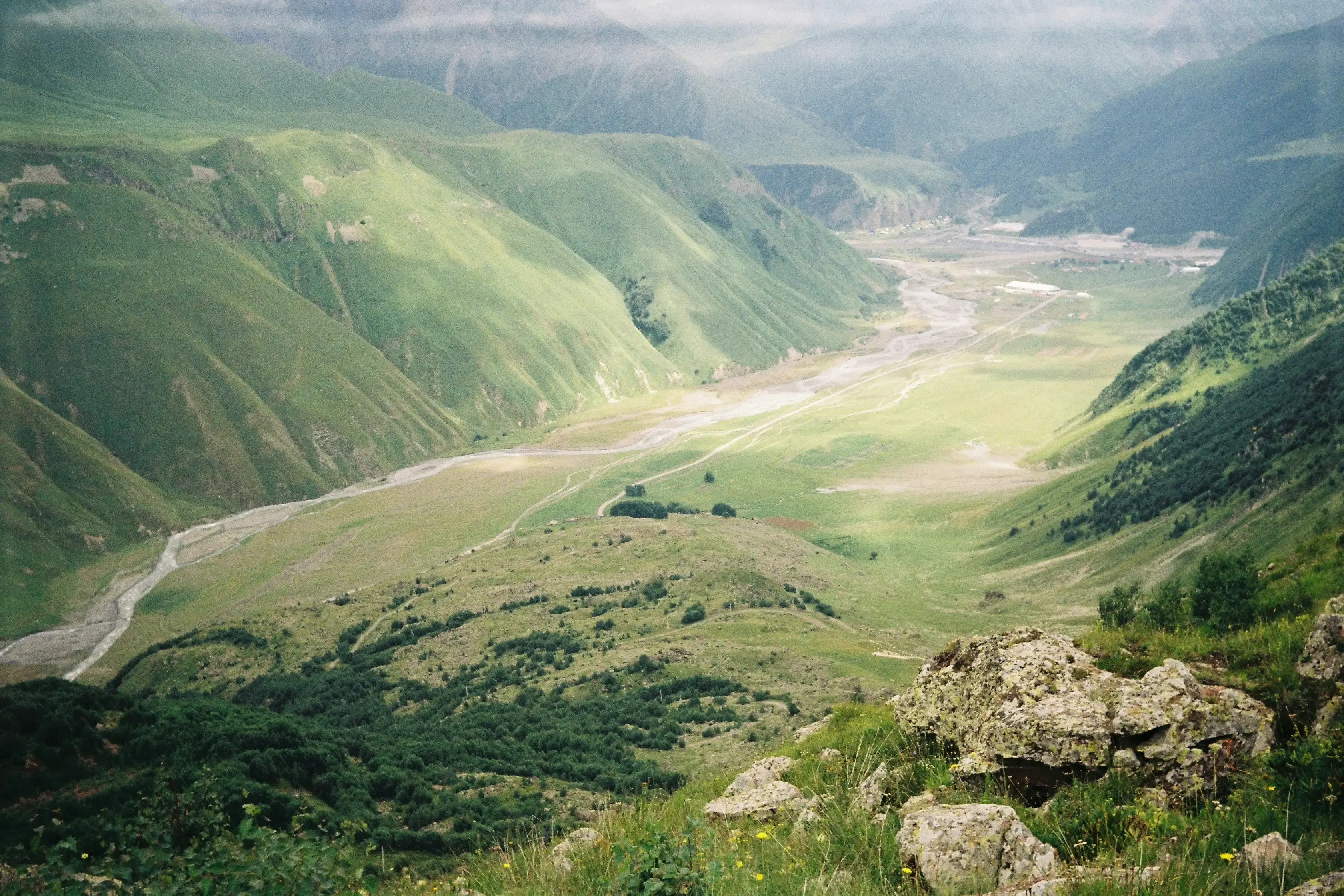
This is the day trip everyone talks about and everyone is right about. The Georgian Military Highway is 150 km of the most dramatic mountain road in the region — a route that has been used by conquerors, traders, pilgrims, and Soviet tourists for two thousand years and that now serves as the most spectacular drive in the Caucasus.
The route north from Tbilisi passes the Ananuri Fortress Complex — a 17th-century fortified church complex dramatically positioned above the turquoise Jinvali Reservoir, its towers reflected in the water below. An hour further north, the Gudauri ski resort appears at 2,000 meters, and above it, the Jvari Pass at 2,379 meters where a Soviet-era Russia-Georgia Friendship Monument marks the historic route — the mosaic murals inside are extraordinary time capsules of late Soviet iconography.
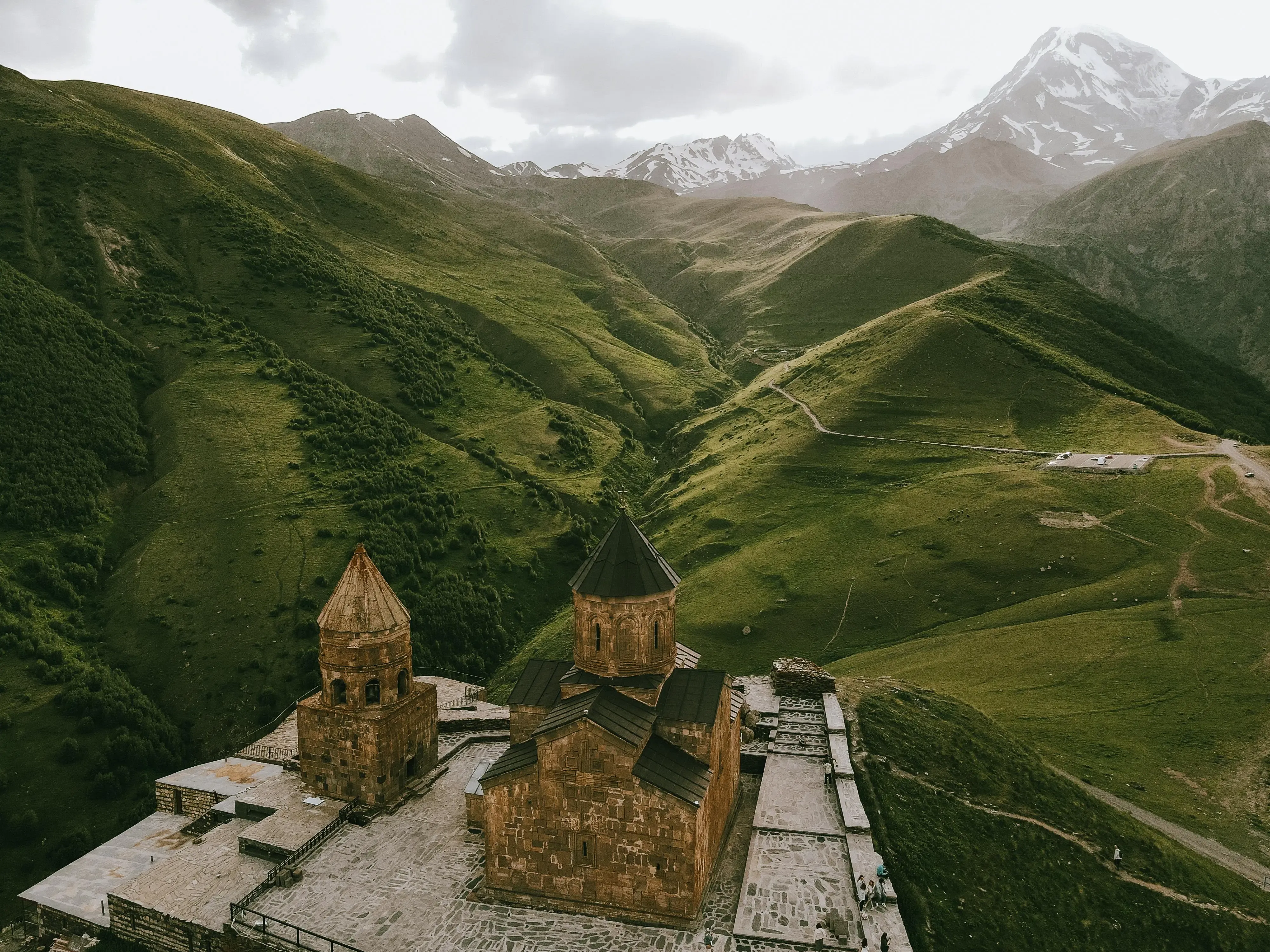
At the end of the road: Stepantsminda (formerly Kazbegi), a mountain town at 1,740 meters with the 5,054-meter Mount Kazbek — one of the highest peaks in Georgia — rising behind it, and above the town on a hill at 2,170 meters, the Gergeti Trinity Church. The 14th-century church is an hour's hike from the town or a 4WD taxi ride to the ridge below — and the view from up there, with Kazbek filling the sky and the valley dropping away in every direction, is the photograph that convinces people to book flights to Georgia in the first place.
The full round trip from Tbilisi is a long day — leave early, budget 10–11 hours — but it's the most concentrated dose of Caucasus mountain landscape available as a day trip from any capital city in the region. A Kiwitaxi Chauffeur covers the route with stops calibrated to what you want to linger at: Ananuri for the fortress and reservoir views, Gudauri for the altitude and the monument, Stepantsminda for the church and the mountain.
Kakheti Wine Region — 1.5–2 hours from Tbilisi
Georgia invented wine. Kakheti perfected it. The region east of Tbilisi — a long valley of vineyards and river orchards backed by the Greater Caucasus to the north — produces about 70% of Georgia's wine output and contains the wineries, family cellars, and maranis (traditional wine-making spaces) that represent 8,000 years of unbroken viticulture.
Sighnaghi is the most visually compelling town — a hilltop fortified settlement with 18th-century stone walls still encircling the town, cobblestone streets, and panoramic views of the Alazani Valley and the Caucasus range beyond. The town is small and very walkable; the Bodbe Monastery just outside holds the tomb of Saint Nino, the woman who brought Christianity to Georgia in the 4th century. The registry office in Sighnaghi operates 24 hours a day and has done since 2007, earning the town the informal title of Georgia's marriage capital — couples from across the country come to marry here because of the location and the availability.
Telavi is the regional capital and a working town rather than a tourist one — the Batonis Tsikhe fortress, the 900-year-old plane tree in the main square that is one of the oldest living trees in the Caucasus, and access to the great wineries of the region including Tsinandali Estate (Georgia's oldest winery, operating since 1886) and the monastery winery of Alaverdi. Wine tasting at family estates in the villages between Telavi and Sighnaghi — where a farmer opens his cellar, pulls out a clay jug, and pours from the qvevri buried in the earth — is the experience that no organized tour can fully replicate and that a Kiwitaxi Chauffeur with local knowledge can actually find.
Gori and Uplistsikhe — 1.5 hours from Tbilisi
Two very different stops that pair naturally into a single day. Gori is Stalin's birthplace — the Soviet dictator who was born here in 1878 as Ioseb Jughashvili. The Stalin Museum in the center of town is one of the most disorienting museum experiences in the former Soviet space: a full Soviet-era hagiographic museum still operating more or less as built, displaying the dictator's personal effects, death mask, and bullet-proof railway carriage while navigating the obvious contradictions of celebrating a man responsible for millions of deaths in the country that commemorates him. It is genuinely fascinating and the honest reaction to it changes from room to room. The adjacent Gori Fortress on the hill above town predates Stalin by several centuries.
Uplistsikhe, 15 km east of Gori, is a 3,000-year-old cave city carved into a sandstone cliff above the Mtkvari River — a settlement that flourished from the early Iron Age through the medieval period and held at its peak a population of 20,000. The carved chambers include a pagan temple, a royal hall with carved vine columns, a pharmacy, and what may be the oldest theater in Georgia. Walking through the hollowed-out city in the rock, with the river below and the steppe spreading in every direction, you understand why Georgia's history is so much older and stranger than its position on most mental maps suggests.
David Gareja Monastery — 2 hours from Tbilisi
The most otherworldly day trip available from Tbilisi sits on the semi-desert plateau of the Gareja Ridge on the border with Azerbaijan — a cave monastery complex cut into the cliffs by the 6th-century monk David Gareja and expanded by his followers over eight centuries. The main complex of Lavra and Udabno monasteries contains frescoes dating from the 9th through 17th centuries in a state of preservation that is simultaneously beautiful and precarious. The landscape around it — the Georgian steppe turning into something approaching desert, with wide views into Azerbaijan — looks unlike anything else in the country.
The road is partially unpaved and requires a vehicle with reasonable clearance. The remoteness is entirely part of the experience. Go in spring (April to May) when the steppe is briefly green, or in autumn — summer is brutally hot and the exposed terrain offers no shade. Not suitable for combining with other destinations; this is a full-day commitment.
Book your Tbilisi day trip with Kiwitaxi Chauffeur Hire — fixed pricing, English-speaking drivers who know the mountain roads, and the flexibility to stop when the landscape earns it.
Tbilisi on a Practical Note
Georgian lari (GEL) is the currency. The exchange rate hovers around 2.7–2.8 GEL to the euro; ATMs are widespread in the city. Cash remains essential outside Tbilisi, at local restaurants, and at markets — carry enough before heading on a day trip. The TBC Bank and Bank of Georgia ATMs are the most reliable for foreign cards.
The Georgian language uses its own unique alphabet — mkhedruli — which looks unlike any other writing system on Earth. Almost no street signs are in Latin characters outside tourist areas. Google Maps works well and is your most useful navigation tool. English is spoken widely in the tourist industry, hotels, and by younger Georgians; outside this context, Russian serves as a functional second language with older residents.
Food and meals operate on generous Georgian timing. Breakfast runs until noon. Lunch can be 1–4 PM. Dinner rarely begins before 8 PM and frequently continues until 1 AM. The concept of a rushed meal is culturally foreign — Georgian hospitality (supra, the traditional feast) treats the table as a ceremonial space where the tamada (toastmaster) leads a sequence of toasts that can go on for hours. Being invited to a Georgian home for dinner is one of the finest things that can happen to you in this country.
Tbilisi nightlife is genuine and runs late — the clubs in the Fabrika complex, along Akhvlediani Street, and in the former factory spaces of the Isani district draw a crowd that doesn't peak until 1 AM. The city has developed a legitimate electronic music scene over the past decade. The Bassiani club, housed in the basement of the Dinamo arena, is considered one of the best clubs in the world by the communities that take these things seriously.
Safety in Tbilisi is generally very good for tourists. Petty theft in crowded tourist areas exists but is not rampant. The taxi app-versus-street-taxi distinction matters: apps are metered and accountable; street taxis require negotiation and some drivers will significantly overcharge first-time visitors. Use Bolt or Yandex Go for any taxi journey.
Currency exchange at the airport is at inferior rates. The best rates are at exchange offices (obmenniki) in the center — Liberty Square area and the Old Town have multiple options. Never exchange at hotels.
Tbilisi is one of those cities that people visit for three days and end up researching flight prices to return for three weeks. The sulfur baths, the wine, the mountains visible from the rooftops at dawn — none of it translates into a reason to leave. You stay until you run out of excuses not to.
Best Picks for True Adventurers

The Best Places to Visit in Tbilisi - A Local’s Very Personal Guide

How to Get from Baku to Tbilisi: Train, Bus, Flight & Car
How to Get from Tbilisi to Kazbegi (Stepantsminda): All Transport Options in 2026

Day Trip from Tbilisi to Kazbegi and the Kakheti Wine Region

How to Get from Tbilisi to Yerevan: Flight, Shared Minivan, Train & Private Transfer

How to Get from Kutaisi Airport to Tbilisi: Bus, Marshrutka, Train & Private Transfer
Landing in Tbilisi? Your Ride Is Ready
Pre-book your private driver, skip the taxi line, and get to your hotel with a fixed price and no surprises.
Book nowExplore All Guides
Barcelona Neighborhoods Guide: Where to Stay & What to Expect in Each Barrio

Discover Paris: A Guide to Iconic Landmarks, Historic Cafés & Legendary Stores

Osaka Travel Guide: Top Things to Do & Food Spots

First-Timer's Japan Handbook: 10 Essential Travel Tips + Etiquette FAQ

Rome in a Day & 3 Days in Rome: The Ultimate Itineraries for Every Traveler

Barcelona Airport to Gothic Quarter: Fastest Transfer Options, Prices & Travel Tips

Ultimate Japan Itineraries: Discover the Best of Japan in 7 or 14 Days

More than the Eiffel Tower: Best Things to Do In Paris

Best hotels in Albania: Tirana, Saranda, Vlorë & Durres

Rome: La Dolce Vita in Every Corner — travel guide by Olivia (@doinglifewithliv)

Barcelona Airport to Sagrada Família: Best Transfer Options, Prices & Travel Times

Paris Food Guide: Eiffel Tower View Restaurants & Rooftop Dining

18 Things You Need to Know Before Visiting Croatia

10 Unforgettable Day Trips from Rome, Italy: Ancient Towns, Best Beaches & Countryside Escapes
A Taste of Florence: Your Complete Food Guide

Best Day Trips from Milan with a Private Driver: Lake Como, Verona & Beyond

10 Best Holiday Alternatives to the Middle East for Spring 2026

Best Things to Do Around the Colosseum: Rome Attractions, Tours & Insider Tips

Barcelona vs Madrid: Which City Is Better to Visit in Spain?

Barcelona: Hidden Bites, Secret Sips & Sunshine Tips by Nancy Sevilla

Best eSIM for Japan 2026

Budapest Travel Tips: Beyond the Obvious

Best Hotels in Rome for Every Budget: Luxury, Boutique & Budget Stays

Cinque Terre Travel Guide: Best Villages & Trails

Best Wine Tours from Milan: Franciacorta, Valpolicella & Chauffeur Hire
Milan to Verona Day Trip with a Chauffeur

South Korea Travel Guide: Best Cultural, Beauty & Wellness Experiences in Seoul, Busan & Jeonju

Best Things to Do in Singapore: Food, Views & Hidden Gems

Free eSIM Trial: Where to Get Free Data

Hoi An Travel Guide: Hidden Gems, Spas & Local Experiences

Santorini Travel Guide: Sunsets, Cruises & Wine

3 Days in Northern Spain: Bilbao, the Cantabrian Coast & Santander

Best eSim for Europe: One Card for 30+ Countries

Best eSim for Mexico: Stay Connected on Your Trip

How to Get from Lisbon to Porto (2026): Train, Bus, Car, or Flight?

How to Get from London to Madeira: Complete Guide (2026)

How to Get from Beauvais Airport to Paris

Paris on a Budget: Affordable Hotels, Shopping & Free Things to Do

Top 12 Things to Do in Albania: Ultimate Travel Guide

Where to Stay in the Albanian Riviera: Best Hotels & Areas
Kyoto Travel Guide: Journey to the Heart of Old Japan

The Ultimate Hanoi Travel Guide: Local Tips, Street Food & Hidden Gems in Vietnam’s Capital

Private Chauffeur Service for Day Trips & Sightseeing
Your own driver, by the hour. No fixed routes. No surprises. Just a professional driver at your disposal - from 3 hours to multiple days.
Book a chauffeur