'%3e%3cpath%20d='M43.073%200.00649261H15.0943V3.94346H43.073V0.00649261Z'%20fill='url(%23kiwitaxi-grad)'%20/%3e%3cpath%20d='M15.0828%203.94346C16.1928%203.94346%2017.0512%203.06513%2017.0512%201.97497C17.0512%200.874164%2016.1822%200.00649261%2015.0828%200.00649261C14.0362%200.00649261%2013.1379%200.851916%2013.1379%201.97497C13.1379%203.10916%2014.0478%203.94346%2015.0828%203.94346Z'%20fill='white'%20/%3e%3cpath%20d='M43.0614%203.94346C44.1715%203.94346%2045.0299%203.06513%2045.0299%201.97497C45.0299%200.874164%2044.1609%200.00649261%2043.0614%200.00649261C42.0149%200.00649261%2041.1166%200.851916%2041.1166%201.97497C41.1166%203.10916%2042.0265%203.94346%2043.0614%203.94346Z'%20fill='white'%20/%3e%3cpath%20d='M19.5921%2038.5052V39.828H23.1471V26.0491H19.5921V27.3446C18.895%2026.5789%2017.4549%2025.8841%2015.7339%2025.8841C11.8502%2025.8841%208.78975%2028.7578%208.78975%2032.939C8.78975%2037.1374%2011.8702%2039.9935%2015.7339%2039.9935C17.4938%2039.9935%2018.932%2039.2691%2019.5921%2038.5052ZM12.2892%2032.939C12.2892%2030.5715%2013.929%2029.1912%2015.9819%2029.1912C18.0106%2029.1912%2019.5647%2030.5845%2019.5647%2032.939C19.5647%2035.2579%2017.9768%2036.6869%2015.9823%2036.6869C13.9596%2036.6869%2012.2892%2035.264%2012.2892%2032.939Z'%20fill='white'%20/%3e%3cpath%20d='M44.7174%2026.0496H41.4289V39.8281H44.7174V26.0496Z'%20fill='white'%20/%3e%3cpath%20d='M32.2183%2035.7001L29.3455%2039.8281H24.94L30.044%2032.8552L25.1624%2026.0496H29.7075L32.3295%2029.8985L35.035%2026.0496H39.4405L34.5599%2032.7435L39.6361%2039.8281H35.1189L32.2183%2035.7001Z'%20fill='white'%20/%3e%3cpath%20d='M3.34504%2022.9604V26.0496H7.4039V29.0939H3.34504V34.2781C3.34504%2035.9866%204.33971%2036.7008%205.955%2036.7008C6.54504%2036.7008%207.16659%2036.5766%207.63241%2036.235V39.4341C7.04237%2039.7757%206.14133%2039.9931%204.89915%2039.9931C1.8243%2039.9931%200.0226746%2038.1293%200.0226746%2034.9298V22.96H3.34504Z'%20fill='white'%20/%3e%3cpath%20d='M36.2094%208.57428L33.307%2016.8723L30.43%208.57428H27.7621L24.8597%2016.8723L21.9828%208.57428H18.4884L23.2157%2021.4188H26.5037L29.084%2014.4093L31.6629%2021.4188H34.951L39.6782%208.57428H36.2094Z'%20fill='white'%20/%3e%3cpath%20d='M44.7174%208.57381H41.4289V21.4188H44.7174V8.57381Z'%20fill='white'%20/%3e%3cpath%20d='M16.7387%208.57381H13.4502V21.4188H16.7387V8.57381Z'%20fill='white'%20/%3e%3cpath%20d='M11.7001%208.57382L6.07922%2014.1326L12.1622%2021.4188H8.05929L3.92163%2016.28L3.3455%2016.8538V21.4188H0.0226746V3.94299H3.3455V12.7574L7.59764%208.57382H11.7001Z'%20fill='white'%20/%3e%3c/g%3e%3cdefs%3e%3clinearGradient%20id='kiwitaxi-grad'%20x1='15.0945'%20y1='1.97497'%20x2='43.073'%20y2='1.97497'%20gradientUnits='userSpaceOnUse'%3e%3cstop%20stop-color='%2300D2CD'%20stop-opacity='0'%20/%3e%3cstop%20offset='1'%20stop-color='%2300D2CD'%20/%3e%3c/linearGradient%3e%3cclipPath%20id='kiwitaxi-clip'%3e%3crect%20width='46'%20height='40'%20fill='white'%20/%3e%3c/clipPath%3e%3c/defs%3e%3c/svg%3e)
Amsterdam has always understood two things better than almost any city in Europe: how to live with water, and how to enjoy life without appearing to rush through it.
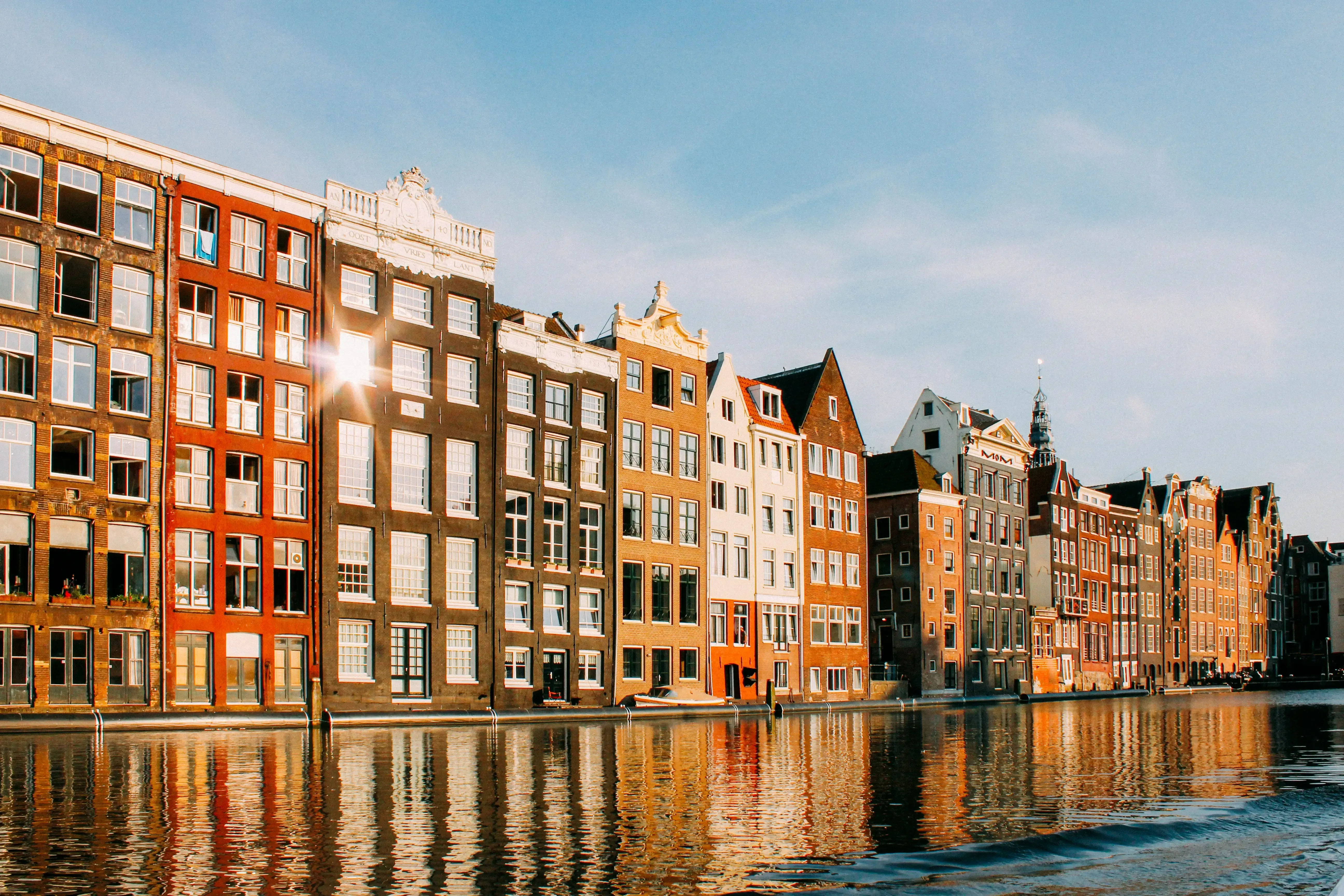
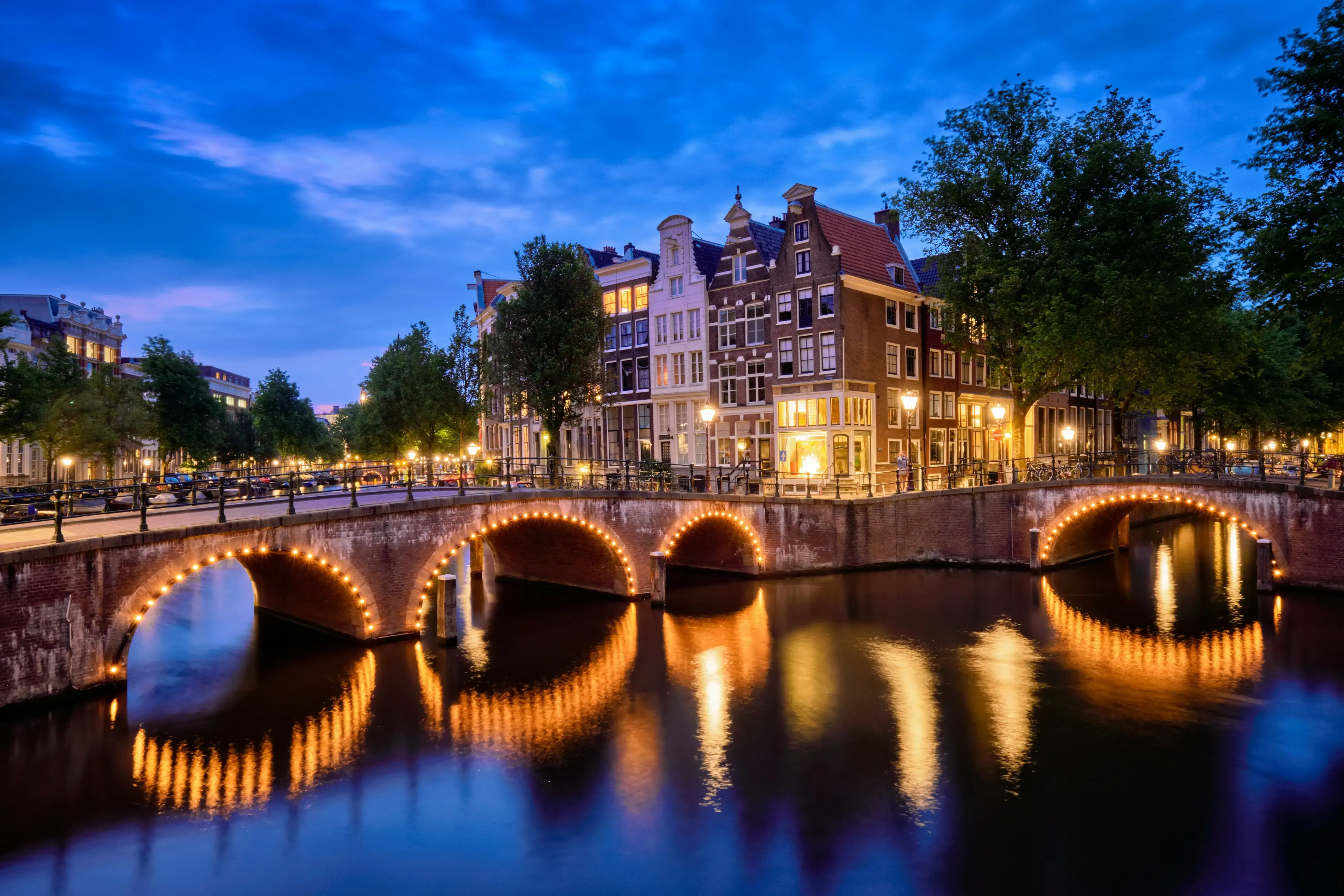
Most first-time visitors arrive expecting canals, bicycles, and postcard-perfect townhouses leaning gently over the water. All of that exists, of course. But Amsterdam reveals itself properly in smaller moments — sunlight reflecting off canal bridges after rain, locals balancing flowers and groceries on bicycles without looking remotely stressed, cafés filling slowly at golden hour while boats drift past beneath strings of lights.
Built on reclaimed land and trade wealth, Amsterdam became one of the world’s most powerful cities during the Dutch Golden Age of the 17th century. Merchants, explorers, artists, and mapmakers transformed what was once a small fishing settlement into the center of a global trading empire. The canals that now define the city were originally an infrastructure project — elegant, practical, and astonishingly ambitious for their time. Four centuries later, they remain one of the most beautiful urban landscapes anywhere in Europe.
But Amsterdam’s appeal isn’t only historical. It’s a city that feels intensely lived in. The museums are world-class, the architecture almost unfairly photogenic, and the cycling culture so complete that cars sometimes feel like temporary guests. Yet despite its popularity, the city still rewards slowing down. Wander through Jordaan in the morning before the boutiques open. Eat warm stroopwafels from a market stall while rain threatens briefly overhead. Sit beside a canal at dusk with absolutely nowhere urgent to be.
And then there’s the atmosphere — open-minded, creative, slightly chaotic in places, but deeply comfortable with itself.
Two days in Amsterdam covers the icons. Four days gives the city time to become personal.

Getting to Amsterdam
By Air
Amsterdam Airport Schiphol (AMS) is one of Europe’s busiest and best-connected airports, located approximately 20 km southwest of the city center. Schiphol functions as a major international hub with direct flights across Europe, North America, Asia, and the Middle East.
The airport is efficient, easy to navigate, and unusually well-connected to central Amsterdam. Travelers arriving from London, Paris, Rome, Berlin, New York, Dubai, Singapore, and dozens of other cities can reach the center within 20–30 minutes after landing.
Worth knowing: Schiphol is large but extremely organized — signage is excellent, and English is spoken everywhere.
By Train
Amsterdam is one of Europe’s easiest capitals to reach by rail. High-speed trains connect the city with Paris, Brussels, London, Berlin, and Cologne. Amsterdam Centraal sits directly beside the historic center and within walking distance of many major neighborhoods.
Arriving by train feels particularly cinematic — canals, bicycles, and narrow historic buildings appear almost immediately outside the station.
Arriving at Schiphol Airport: What to Expect
Immigration and baggage handling are generally efficient, though peak summer and holiday periods can become busy.
By Train
The fastest and easiest option for most travelers. Direct trains from Schiphol reach Amsterdam Centraal in approximately 15–20 minutes with frequent departures throughout the day.
By Taxi
Official taxis are available outside arrivals and provide direct service into the city center. Travel time typically ranges from 25–40 minutes depending on traffic.
By Private Transfer
A Kiwitaxi private transfer from Schiphol Airport offers fixed pricing, flight monitoring, and direct hotel drop-off — particularly convenient for families, travelers with luggage, or late-night arrivals unfamiliar with Amsterdam’s narrow streets and canal-side hotels.
Getting Around Amsterdam
Amsterdam is one of Europe’s most walkable cities. Much of the historic center is compact enough to explore entirely on foot.
Walking
The best way to understand Amsterdam is simply to wander. The canal belt, Jordaan, De Pijp, and Nine Streets all reveal themselves gradually — bridges, cafés, flower boxes, bookstores, bakeries, and quiet courtyards appearing between busier streets.
Cycling
Bicycles dominate Amsterdam life. Locals cycle everywhere and at considerable speed, often carrying groceries, flowers, children, or all three simultaneously. Renting a bike is one of the best ways to experience the city, though visitors should remain aware that cycle lanes operate like real traffic.
Trams & Metro
Amsterdam’s tram network is reliable, clean, and extremely useful for longer distances between neighborhoods. The metro mainly serves outer districts and suburban connections.
Canal Cruises
Seeing Amsterdam from the water changes your perspective entirely. Evening canal cruises are particularly beautiful when the bridges illuminate and reflections begin to shimmer across the canals.

Best Time to Visit Amsterdam
April to May
Spring is peak postcard season. Tulips bloom across the Netherlands, café terraces fill again, and temperatures become comfortable for walking and cycling. This is one of the busiest but also most beautiful periods to visit.
June to August
Summer brings long daylight hours, outdoor festivals, busy canals, and lively nightlife. Parks fill with locals, boats crowd the waterways, and the city remains active late into the evening.
September to October
Arguably the best balance between atmosphere and crowds. The summer intensity softens, temperatures remain pleasant, and Amsterdam becomes moodier in the best possible way — golden leaves beside canals, quieter museum mornings, candlelit cafés after rain.
November to March
Winter in Amsterdam is colder, quieter, and deeply atmospheric. Christmas lights reflect across canals, museums become calmer, and cafés feel even more inviting after dark. Rain is common year-round, so an umbrella is never wasted luggage.
Where to Stay in Amsterdam
Canal Belt (Grachtengordel)
The classic first-time base — historic canal houses, central location, postcard views, and walking access to major sights.
Jordaan
Amsterdam’s most charming neighborhood. Once working-class, now filled with boutiques, cafés, galleries, and narrow residential streets that feel quieter than the tourist-heavy center.
De Pijp
A lively multicultural district known for cafés, restaurants, and the famous Albert Cuyp Market. Younger, more local, and excellent for food lovers.
Museum Quarter
Home to Amsterdam’s major museums and elegant wide boulevards. A calmer, more polished area with excellent hotel options.

Best Things to Do in Amsterdam
Walk the Canal Belt at Golden Hour
Amsterdam’s UNESCO-listed canals are the city’s defining feature — narrow bridges, bicycles crossing constantly, flower-filled houseboats, and reflections that shift with the changing weather.
Golden hour transforms the canals completely, especially in Jordaan and the Nine Streets area.
Explore Jordaan & Nine Streets
Jordaan remains one of Amsterdam’s most loved neighborhoods — independent boutiques, vintage stores, small galleries, hidden courtyards, and cafés tucked beside canals.
Nearby, De Negen Straatjes (Nine Streets) offers some of the city’s best shopping and café culture without feeling overly polished.
Visit Albert Cuyp Market
Albert Cuyp Market in De Pijp is Amsterdam at full sensory volume — fresh stroopwafels, herring stands, spices, flowers, street food, cheeses, fabrics, and locals navigating the market with practiced efficiency.
Arrive hungry.
See the Rijksmuseum
Rijksmuseum houses masterpieces from the Dutch Golden Age including works by Rembrandt and Vermeer. The building itself — arches, courtyards, galleries, and enormous library interiors — deserves as much attention as the art.
Visit the Anne Frank House
Anne Frank House remains one of the city’s most important and emotionally powerful sites. Visiting the preserved secret annex where Anne Frank wrote her diary brings history into devastating proximity.
Tickets should be booked well in advance.
Cruise the Canals at Night
Amsterdam becomes quieter and more cinematic after sunset. Bridges illuminate, canal houses glow softly through tall windows, and boats move slowly beneath reflections across the water.
A nighttime canal cruise remains touristy for a reason — it’s genuinely beautiful.
Try an Indonesian Rijsttafel
Amsterdam’s colonial history shaped its food culture in lasting ways. Indonesian rijsttafel — a table filled with numerous small dishes combining spices, rice, meats, vegetables, and sauces — became part of Dutch culinary tradition during the colonial era.
It’s one of the most uniquely Amsterdam dining experiences you can have.

Food & Drink in Amsterdam
Dutch cuisine is far better than its reputation suggests, particularly when approached through markets, bakeries, cafés, and local comfort food.
Fresh stroopwafels eaten warm from market stalls are essential. So is raw herring from a traditional fish stand, preferably with onions and pickles if you want the full local experience.
Brown cafés — traditional Dutch pubs with dark wood interiors and candlelit atmospheres — remain one of Amsterdam’s best cultural experiences after dark.
Coffee culture is serious here, brunch culture even more so.
Day Trips from Amsterdam with Kiwitaxi
Amsterdam works perfectly as a base for exploring the Netherlands beyond the capital.
Zaanse Schans
Traditional windmills, wooden houses, cheese farms, and canal landscapes just outside the city — postcard Netherlands brought to life.
Haarlem
A smaller, elegant Dutch city with canals, boutique shopping, excellent cafés, and significantly fewer crowds than Amsterdam.
Keukenhof Gardens (Spring)
One of the world’s most famous flower gardens, filled with millions of tulips during spring bloom season.
Utrecht
A university city with canals, historic towers, and a noticeably more local atmosphere than Amsterdam.
Kiwitaxi chauffeur hire service make combining multiple Dutch towns into a single day considerably easier, especially for travelers wanting flexibility beyond train schedules.

Practical Notes for Visiting Amsterdam
The euro is the local currency. Card payment is accepted almost everywhere — in some cafés and shops, cards are preferred over cash entirely.
English is spoken fluently across the city.
Cyclists always have priority. Looking both ways before stepping into bike lanes is not optional.
Weather changes quickly. A sunny morning can become windy rain within an hour and return to sunshine by afternoon.
Amsterdam rewards slower travel. The city is less about rushing between landmarks and more about noticing details between them — reflections in canals, tiny leaning houses, hidden gardens, candlelit windows, bicycles stacked impossibly against bridges. That, more than any single attraction, is what people remember most.
Best Picks for True Adventurers


Landing in Amsterdam? Your Ride Is Ready
Pre-book your private driver, skip the taxi line, and get to your hotel with a fixed price and no surprises.
Book a transferExplore All Guides
Barcelona Neighborhoods Guide: Where to Stay & What to Expect in Each Barrio

Discover Paris: A Guide to Iconic Landmarks, Historic Cafés & Legendary Stores

Osaka Travel Guide: Top Things to Do & Food Spots

First-Timer's Japan Handbook: 10 Essential Travel Tips + Etiquette FAQ

Rome in a Day & 3 Days in Rome: The Ultimate Itineraries for Every Traveler

Barcelona Airport to Gothic Quarter: Fastest Transfer Options, Prices & Travel Tips

Ultimate Japan Itineraries: Discover the Best of Japan in 7 or 14 Days

More than the Eiffel Tower: Best Things to Do In Paris

Best hotels in Albania: Tirana, Saranda, Vlorë & Durres

Rome: La Dolce Vita in Every Corner — travel guide by Olivia (@doinglifewithliv)

Barcelona Airport to Sagrada Família: Best Transfer Options, Prices & Travel Times

Paris Food Guide: Eiffel Tower View Restaurants & Rooftop Dining

18 Things You Need to Know Before Visiting Croatia

10 Unforgettable Day Trips from Rome, Italy: Ancient Towns, Best Beaches & Countryside Escapes
A Taste of Florence: Your Complete Food Guide

Best Day Trips from Milan with a Private Driver: Lake Como, Verona & Beyond

10 Best Holiday Alternatives to the Middle East for Spring 2026

Best Things to Do Around the Colosseum: Rome Attractions, Tours & Insider Tips

Barcelona vs Madrid: Which City Is Better to Visit in Spain?

Barcelona: Hidden Bites, Secret Sips & Sunshine Tips by Nancy Sevilla

Best eSIM for Japan 2026

Budapest Travel Tips: Beyond the Obvious

Best Hotels in Rome for Every Budget: Luxury, Boutique & Budget Stays

Cinque Terre Travel Guide: Best Villages & Trails

Best Wine Tours from Milan: Franciacorta, Valpolicella & Chauffeur Hire
Milan to Verona Day Trip with a Chauffeur

South Korea Travel Guide: Best Cultural, Beauty & Wellness Experiences in Seoul, Busan & Jeonju

Best Things to Do in Singapore: Food, Views & Hidden Gems

Free eSIM Trial: Where to Get Free Data

Hoi An Travel Guide: Hidden Gems, Spas & Local Experiences

Santorini Travel Guide: Sunsets, Cruises & Wine

3 Days in Northern Spain: Bilbao, the Cantabrian Coast & Santander

Best eSim for Europe: One Card for 30+ Countries

Best eSim for Mexico: Stay Connected on Your Trip

How to Get from Lisbon to Porto (2026): Train, Bus, Car, or Flight?

How to Get from London to Madeira: Complete Guide (2026)

How to Get from Beauvais Airport to Paris

Paris on a Budget: Affordable Hotels, Shopping & Free Things to Do

Top 12 Things to Do in Albania: Ultimate Travel Guide

Where to Stay in the Albanian Riviera: Best Hotels & Areas
Kyoto Travel Guide: Journey to the Heart of Old Japan
