'%3e%3cpath%20d='M43.073%200.00649261H15.0943V3.94346H43.073V0.00649261Z'%20fill='url(%23kiwitaxi-grad)'%20/%3e%3cpath%20d='M15.0828%203.94346C16.1928%203.94346%2017.0512%203.06513%2017.0512%201.97497C17.0512%200.874164%2016.1822%200.00649261%2015.0828%200.00649261C14.0362%200.00649261%2013.1379%200.851916%2013.1379%201.97497C13.1379%203.10916%2014.0478%203.94346%2015.0828%203.94346Z'%20fill='white'%20/%3e%3cpath%20d='M43.0614%203.94346C44.1715%203.94346%2045.0299%203.06513%2045.0299%201.97497C45.0299%200.874164%2044.1609%200.00649261%2043.0614%200.00649261C42.0149%200.00649261%2041.1166%200.851916%2041.1166%201.97497C41.1166%203.10916%2042.0265%203.94346%2043.0614%203.94346Z'%20fill='white'%20/%3e%3cpath%20d='M19.5921%2038.5052V39.828H23.1471V26.0491H19.5921V27.3446C18.895%2026.5789%2017.4549%2025.8841%2015.7339%2025.8841C11.8502%2025.8841%208.78975%2028.7578%208.78975%2032.939C8.78975%2037.1374%2011.8702%2039.9935%2015.7339%2039.9935C17.4938%2039.9935%2018.932%2039.2691%2019.5921%2038.5052ZM12.2892%2032.939C12.2892%2030.5715%2013.929%2029.1912%2015.9819%2029.1912C18.0106%2029.1912%2019.5647%2030.5845%2019.5647%2032.939C19.5647%2035.2579%2017.9768%2036.6869%2015.9823%2036.6869C13.9596%2036.6869%2012.2892%2035.264%2012.2892%2032.939Z'%20fill='white'%20/%3e%3cpath%20d='M44.7174%2026.0496H41.4289V39.8281H44.7174V26.0496Z'%20fill='white'%20/%3e%3cpath%20d='M32.2183%2035.7001L29.3455%2039.8281H24.94L30.044%2032.8552L25.1624%2026.0496H29.7075L32.3295%2029.8985L35.035%2026.0496H39.4405L34.5599%2032.7435L39.6361%2039.8281H35.1189L32.2183%2035.7001Z'%20fill='white'%20/%3e%3cpath%20d='M3.34504%2022.9604V26.0496H7.4039V29.0939H3.34504V34.2781C3.34504%2035.9866%204.33971%2036.7008%205.955%2036.7008C6.54504%2036.7008%207.16659%2036.5766%207.63241%2036.235V39.4341C7.04237%2039.7757%206.14133%2039.9931%204.89915%2039.9931C1.8243%2039.9931%200.0226746%2038.1293%200.0226746%2034.9298V22.96H3.34504Z'%20fill='white'%20/%3e%3cpath%20d='M36.2094%208.57428L33.307%2016.8723L30.43%208.57428H27.7621L24.8597%2016.8723L21.9828%208.57428H18.4884L23.2157%2021.4188H26.5037L29.084%2014.4093L31.6629%2021.4188H34.951L39.6782%208.57428H36.2094Z'%20fill='white'%20/%3e%3cpath%20d='M44.7174%208.57381H41.4289V21.4188H44.7174V8.57381Z'%20fill='white'%20/%3e%3cpath%20d='M16.7387%208.57381H13.4502V21.4188H16.7387V8.57381Z'%20fill='white'%20/%3e%3cpath%20d='M11.7001%208.57382L6.07922%2014.1326L12.1622%2021.4188H8.05929L3.92163%2016.28L3.3455%2016.8538V21.4188H0.0226746V3.94299H3.3455V12.7574L7.59764%208.57382H11.7001Z'%20fill='white'%20/%3e%3c/g%3e%3cdefs%3e%3clinearGradient%20id='kiwitaxi-grad'%20x1='15.0945'%20y1='1.97497'%20x2='43.073'%20y2='1.97497'%20gradientUnits='userSpaceOnUse'%3e%3cstop%20stop-color='%2300D2CD'%20stop-opacity='0'%20/%3e%3cstop%20offset='1'%20stop-color='%2300D2CD'%20/%3e%3c/linearGradient%3e%3cclipPath%20id='kiwitaxi-clip'%3e%3crect%20width='46'%20height='40'%20fill='white'%20/%3e%3c/clipPath%3e%3c/defs%3e%3c/svg%3e)
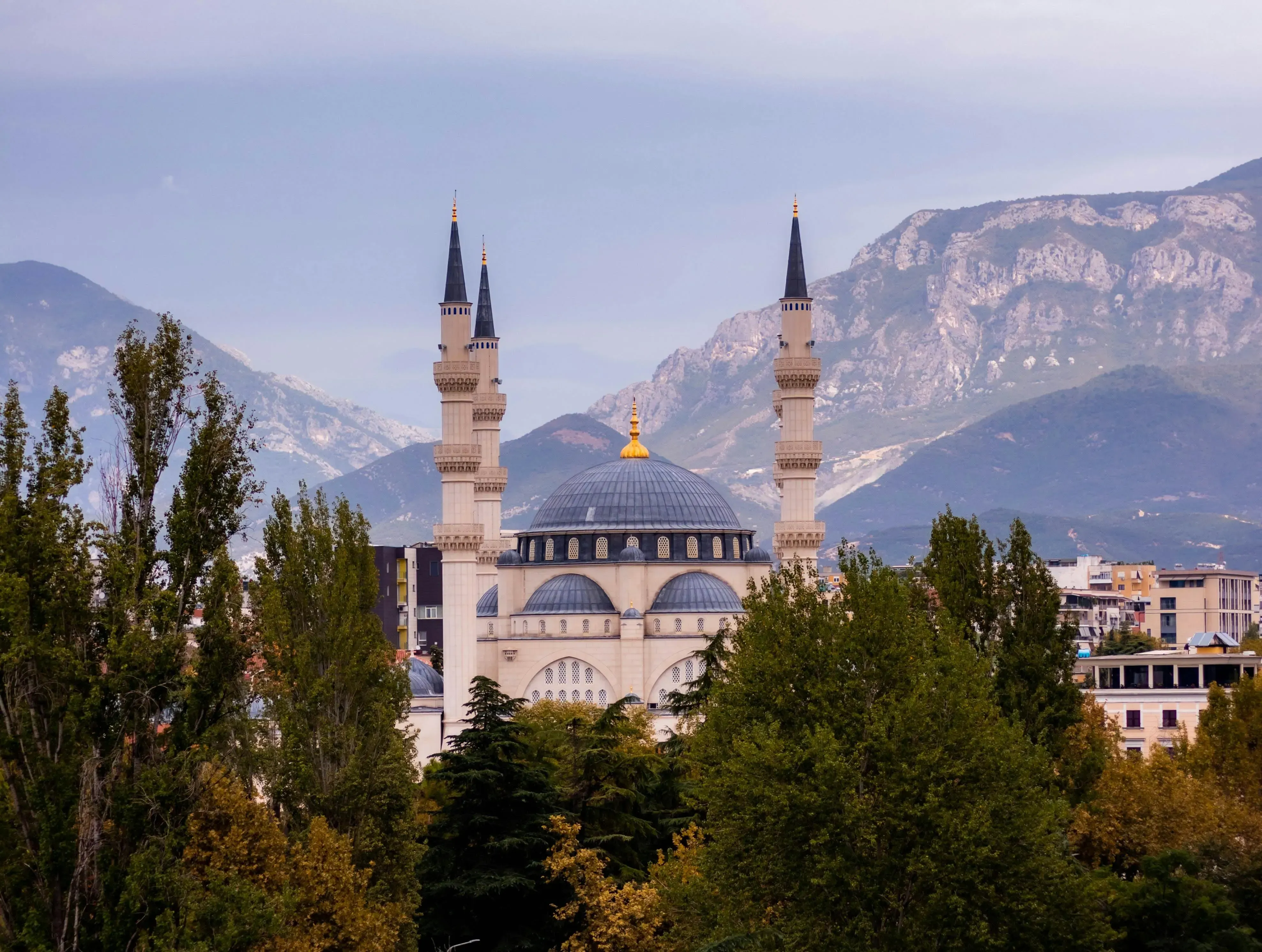
Tirana: The Capital Nobody Saw Coming
Albania spent nearly half a century sealed off from the rest of the world. Under Enver Hoxha's regime — one of the most isolationist communist dictatorships in history — no foreign newspapers, no outside travel, no religion, no private cars, and somewhere north of 170,000 concrete bunkers poured across a country the size of Maryland. When communism collapsed in 1992, Albania emerged blinking into a world it hadn't seen in fifty years.
Tirana in the decades since has done something remarkable. It hasn't just recovered — it has reinvented. The man who led that reinvention was Edi Rama, an artist who became the city's mayor in 2000 and started painting the grey communist housing blocks in bright, wild colors. Not as decoration. As a statement that a city could decide what it wanted to be and then become it. Rama eventually became prime minister. The buildings stayed colorful. The city kept changing.
Today Tirana is one of Europe's most genuinely surprising capitals. Coffee culture that rivals anything in Vienna. Nightlife in Blloku — a neighborhood that was literally forbidden to ordinary citizens until 1991 — that goes until dawn. Museums built inside nuclear bunkers that confront decades of surveillance and paranoia with honesty and grace. Excellent food at prices that make Western European travelers feel briefly but intensely wealthy. Mountains visible from the city center. The Adriatic coast less than an hour away.
It's not a city that shows you everything immediately. But give it a day, and it starts to reveal itself. Give it three, and you'll already be researching flights back.

Getting to Tirana
By Air
Tirana International Airport Nënë Tereza (TIA) — named after the Skopje-born Albanian Catholic nun the world knows as Mother Teresa — sits about 17 km northwest of the city center in the municipality of Rinas. It's a manageable, mid-sized airport handling a growing number of European routes. Ryanair, Wizz Air, easyJet, Austrian Airlines, Turkish Airlines, and ITA Airways operate regular services from major European hubs including London, Rome, Vienna, Istanbul, Amsterdam, and Berlin. Most routes are within Europe; travelers coming from North America, Asia, or Australia will connect through a European city.
One practical note: some routes to Tirana operate seasonally, with fewer options in winter. If you're traveling between November and March, check schedules earlier than you normally would.
By Road and Bus
Albania connects by road to Kosovo (Pristina, 3 hours), North Macedonia (Skopje, 4 hours), Montenegro (Podgorica, 3.5 hours), and Greece (Thessaloniki, 5 hours). Coaches and furgons (shared minibuses) run international routes from Tirana's bus terminals. If you're doing a broader Balkans trip, Tirana slots naturally into a regional route — it's one of those places that rewards not being the only stop.
Arriving at Tirana Airport: What to Expect
The airport is straightforward — one main terminal, clear signage, ATMs in arrivals for getting Albanian lek (do this at the airport; the lek is a closed currency you can't get before arriving). Taxi and rideshare options wait outside arrivals.
By Airport Shuttle: The Rinas Express bus runs between the airport and the city center (Sheshi Skënderbej, the main square) for around 250 lek (€2.50), taking 30–40 minutes with traffic. It's reliable and cheap, though not convenient with heavy luggage.
By Taxi: Official metered taxis operate from the airport rank and cost approximately 2,000–2,500 lek (€18–22) to the city center. Agree on the fare before getting in or confirm the meter is running — a precaution worth taking with any unmarked car.
By Private Transfer: For the cleanest arrival experience — a driver with your name, fixed price, and no currency fumbling on the sidewalk — a Kiwitaxi private transfer from Tirana Airport covers the journey door to door. Useful for late arrivals, families with luggage, and anyone who'd rather start the trip relaxed rather than negotiating in a language they don't speak.

Getting Around Tirana
The good news: Tirana's center is very walkable. The main attractions — Skanderbeg Square, the National History Museum, Bunk'Art 2, the Et'hem Bey Mosque, the Pyramid, and Blloku — are all within a 20-minute walk of each other, and most of the city's interesting streets are concentrated in this compact core.
On Foot: The default and usually the best option for anywhere central. The city has invested significantly in pedestrian infrastructure in recent years — Skanderbeg Square itself is now one of Europe's largest pedestrian plazas, cleared of the traffic that used to choke it.
Street Taxis: Available but require negotiation. Always agree on the fare before getting in. Most drivers are straightforward; the airport is the main place where overcharging is a risk.
Bikes and E-Scooters: Rentable at various points around the city for 25–50 lek per 10 minutes. Good for the riverside paths and the wider boulevards. Less practical on older streets where the pavement can be uneven.

Best Time to Visit Tirana
Tirana has warm, dry summers and mild winters, and the city itself is worth visiting year-round. What changes is the context.
April to June is the finest time for first visits. Temperatures sit at a comfortable 18–25°C, the city's outdoor café culture is in full swing, day trips to the mountains and coast are easy to combine, and tourist volumes haven't yet peaked. Spring also brings some of the most dramatic mountain scenery within day-trip distance — Bovilla Lake and Mount Dajti are particularly striking in late May.
July and August are hot (30–35°C), and much of the city's younger population migrates south to the Albanian Riviera for the summer. Some Blloku restaurants and bars close for August or open satellite locations on the coast. That said, the city remains lively, prices are reasonable compared to the Riviera, and for anyone interested in combining Tirana with a beach week further south, the timing works well.
September and October is arguably the sweet spot — temperatures drop to a very comfortable 20–27°C, the summer crowds on the Riviera thin, the mountains are still accessible, and the city's cultural season picks back up. A strong second choice to spring.
November to March is quiet and occasionally chilly (5–12°C) but far from closed. Fewer tourists means more room to move in the museums, shorter waits at Bunk'Art, and a more honest sense of what the city is on a regular Tuesday. December brings modest Christmas decorations around Skanderbeg Square. The mountains above Tirana can see snow from November onward, which makes the Dajti cable car a genuinely dramatic ride.
Where to Stay in Tirana
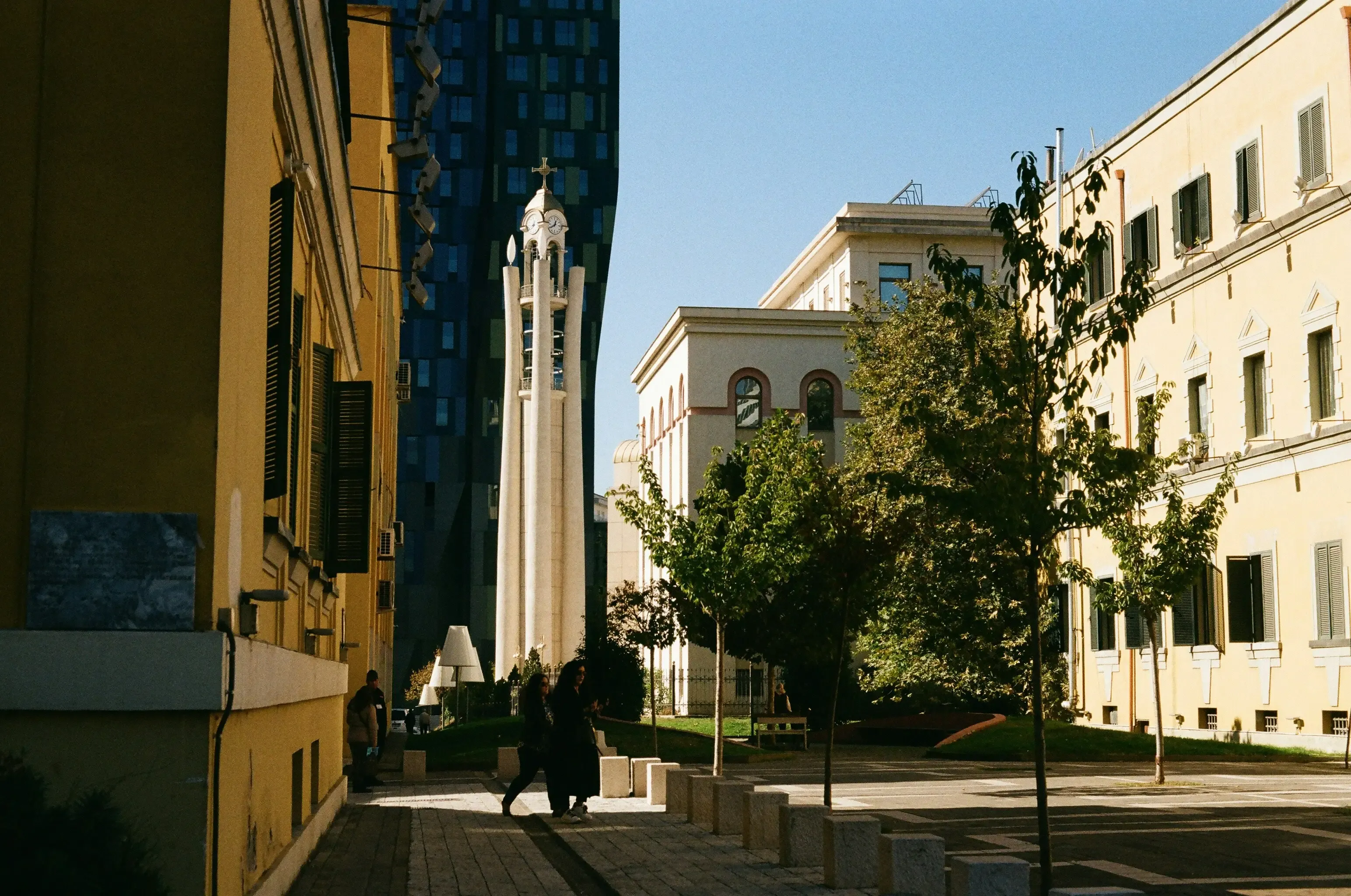
Around Skanderbeg Square is the best base for first-time visitors — central, walkable to virtually everything, and positioned right at the historical and cultural heart of the city. Hotels here range from international chains to characterful boutique options, and the main square's energy at any hour of the day or evening is its own form of entertainment.
Blloku is where you stay if nightlife and social energy matter more than proximity to museums. The neighborhood's compact grid of streets is full of cafés, bars, and restaurants, and the atmosphere after 9 PM is the most vivid expression of how thoroughly modern Tirana has shed its communist-era identity. Slightly further from the major sights but a short taxi ride from anywhere.
Pazari i Ri (New Bazaar area) is the local alternative — colorful, market-oriented, less polished than Blloku, and more representative of everyday Tirana. Good independent restaurants and the feeling of being somewhere slightly off the tourist trail.
Near the Airport / Lapraka is purely practical — useful only for very early departures or very late arrivals. Not atmospheric in any way, but if the flight leaves at 6 AM, it makes the morning considerably less stressful.
Best Things to Do in Tirana
Start at Skanderbeg Square The heart of Tirana is named after Gjergj Kastrioti Skënderbeu — Skanderbeg — the 15th-century Albanian nobleman who defected from the Ottoman court, returned to lead the Albanian resistance, and held off the Ottoman Empire for 25 years until his death in 1468. The 11-meter bronze equestrian statue in the center of the square represents him in full armor, helmet topped with a goat's head — the symbol of the Kastrioti family. The square itself covers 40,000 square meters of pedestrian space and is lined with fountains, institutional buildings, and the Et'hem Bey Mosque on its eastern edge. It's the best place to begin any Tirana visit, not because it's the most dramatic thing you'll see but because it orients you physically and historically to everything that follows.
Visit Bunk'Art 1 and Bunk'Art 2 These two museums are among the most extraordinary historical experiences in the Balkans and the main reason Tirana deserves more than a day-trip stopover. Bunk'Art 1 occupies a massive nuclear-proof bunker built in the 1970s beneath Mount Dajti at a cost equivalent to building a medium-sized city — 106 rooms, reinforced concrete six meters thick, designed to house 300 government officials in the event of a nuclear strike that Hoxha was absolutely certain was coming. The museum inside uses this paranoid, labyrinthine structure to document Albania's communist period, the Secret Police, and the regime's relationship with its own people. Bunk'Art 2, in the city center beneath the Ministry of Internal Affairs, is smaller and more focused — specifically on the Sigurimi (the Albanian secret police), their surveillance methods, and the ordinary Albanians who were imprisoned, tortured, or killed. Both are essential. Both will stay with you.
Climb the Tirana Pyramid Built in 1988 as a museum to Enver Hoxha — at the time one of the most expensive construction projects in Albanian history — the Pyramid has had a remarkable afterlife. It served as a NATO communications center during the Kosovo War, a nightclub, a conference center, and then sat abandoned for years while Albania debated what to do with it. In 2023 it reopened as a youth technology and education center called TUMO, with the concrete exterior left intentionally climbable — the slopes on the sides are designed to be scaled, and the roof offers a wide view across the city. It is simultaneously a monument to megalomaniacal communist ambition, a symbol of democratic reinvention, and a very good place to watch the sunset.
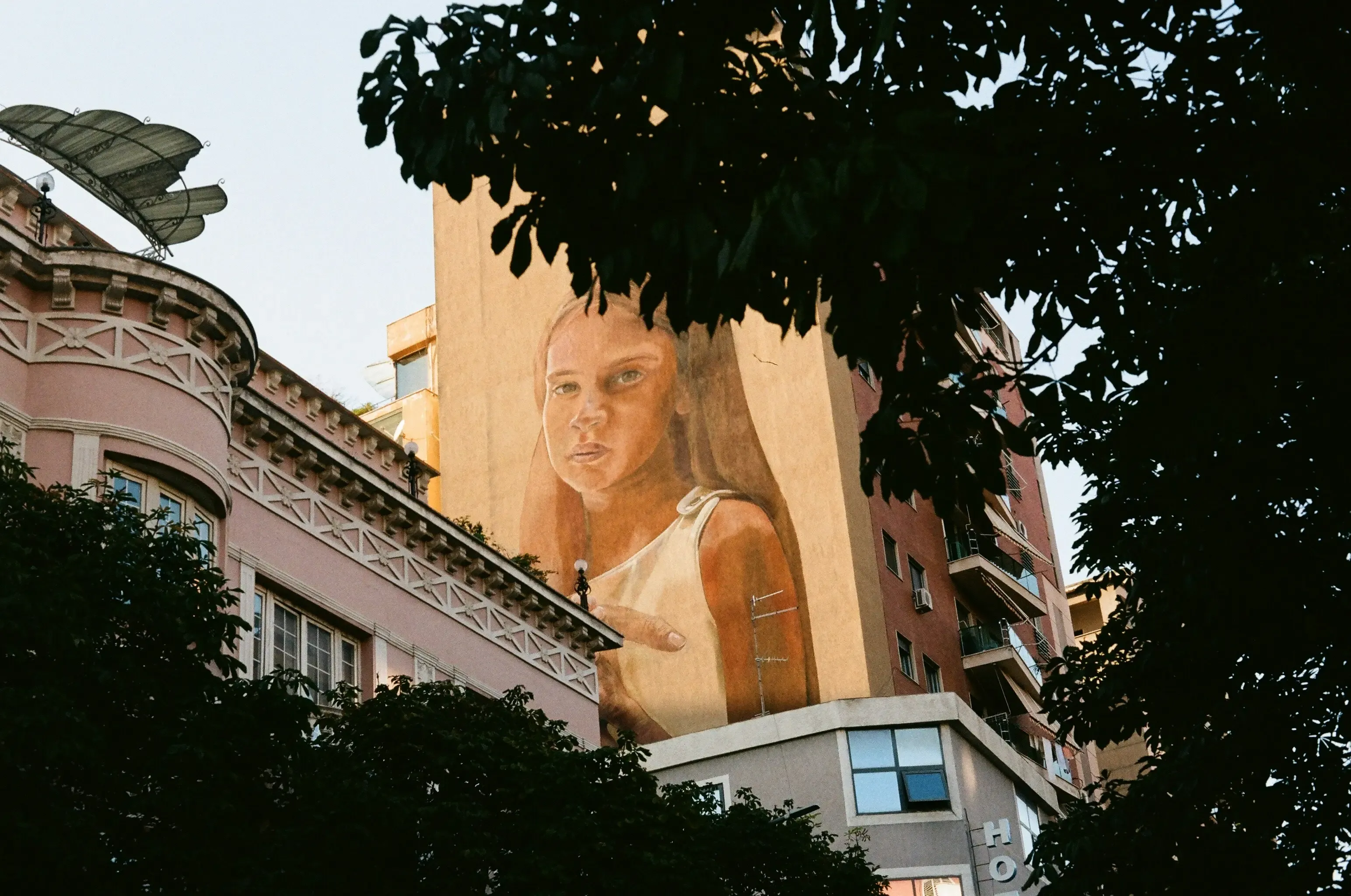
Spend an Afternoon in Blloku There is no neighborhood in Europe with a more complete story of transformation than Blloku. For four decades under communism it was a walled, guarded residential enclave for the party elite — ordinary Albanians were turned away at the perimeter. Hoxha's personal villa, still standing on Rruga Dëshmorët e 4 Shkurtit, sits today in a neighborhood of café terraces, cocktail bars, boutique shops, street murals, and what might be the highest concentration of third-wave coffee shops per square kilometer outside Seoul. The villa is not open to the public but you can look through the fence. The juxtaposition of that shuttered, oddly modest house against the thriving street around it tells the whole Albanian story in a single glance.
Go to the Pazari i Ri (New Bazaar) The covered market in the center of Tirana was renovated and reopened in 2016 and now functions as both a working food market and one of the city's most atmospheric neighborhoods. Fresh produce, cheese, olives, dried fruits, honey, and local wines fill the market hall. The surrounding streets are dense with small restaurants serving Albanian food at prices that would seem impossible in Western Europe — a full lunch rarely exceeds €6–8. Come on a weekend morning when it's fullest, buy some local cheese and bread, and wander the adjoining streets where street art turns every second wall into something worth stopping for.
Visit the National History Museum The largest museum in Albania occupies a prominent position on Skanderbeg Square behind a famous socialist realist mosaic facade depicting Albanian history from ancient Illyrians to communist-era workers. The interior is more interesting than the building suggests — a serious walk through Albanian history from prehistoric times through the Ottoman period, the national awakening, the independence declaration of 1912, and the communist decades. The communist history rooms are among the most candid state museum accounts of a dictatorship you'll find anywhere, partly because enough time has passed and partly because Albania has chosen to reckon honestly with what happened. Allow 90 minutes.
Ride the Dajti Ekspres Cable Car Mount Dajti rises behind Tirana's eastern edge, and the Dajti Ekspres cable car climbs 4.2 km to the summit in about 15 minutes — one of the longer cable car rides in the region. The city drops away fast and the view from the top, on a clear day, extends to the Adriatic. The summit has a rotating restaurant (one full revolution takes 45 minutes), hiking trails into the national park, and temperatures 10°C cooler than the city below in summer. In winter with snow on the trees, it's a completely different and quietly spectacular experience. The cable car operates daily; buy tickets at the lower station.
Eat Your Way Through Albanian Cuisine Albanian food is genuinely underrated and genuinely cheap. The national dish, tavë kosi — lamb baked in yogurt with eggs — is rich, slightly tangy, and nothing like anything you've eaten elsewhere. Fergese is cottage cheese cooked with peppers and olive oil, served with bread, and available in every traditional restaurant. Byrek is the flaky pastry filled with cheese, spinach, or meat that appears at breakfast, lunch, and every point between. Lakror is a similar layered pie, particular to certain regions. Local wine from the Berat and Përmet regions is excellent and costs almost nothing. Raki — Albanian grape brandy — is presented as a gift, a greeting, and an aperitif simultaneously. Politely declining is acceptable; enthusiastically accepting is better.
Day Trips from Tirana with Kiwitaxi Chauffeur Service
Albania is a country where the journey between places is often as interesting as the destination itself. Mountain roads with improbable views, Ottoman bazaars, Roman ruins half-buried under medieval villages, a coastline that rivals anything on the Adriatic. Public transport connects the main towns but on its own schedule and with the kind of logistics that can absorb half your day in coordination. Kiwitaxi's Chauffeur Hire service gives you a dedicated vehicle, a driver who knows the roads, and the freedom to stop when something earns stopping — which in Albania is often.
Kruja — 45 minutes from Tirana
Kruja is where Albania's national myth lives. The mountain town was the fortress of Skanderbeg during his 25-year resistance against the Ottoman Empire, and the castle on the hillside above the town still carries that weight. The Skanderbeg Museum inside the castle is housed in a building designed by his daughter and built in the 1980s — dramatic, slightly over-the-top in the best way, and full of weaponry and historical material that treats the subject with appropriate seriousness. Below the castle, the Ottoman bazaar (pazari i vjetër) is one of the most atmospheric in the Balkans — wooden-fronted shops selling handmade carpets, copper goods, and traditional crafts in a setting that hasn't changed structurally in 400 years. Bargaining is normal and expected. Above the castle, a steep road climbs to the Bektashi shrine of Sari Salltik, built into a mountain cave with views across the valley toward the Adriatic. The views from up here, on a clear day, are extraordinary. By road from Tirana, 45 minutes each way.
Berat — 2 hours from Tirana
Berat is Albania's most beautiful town and one of the most beautiful in the Balkans, full stop. A UNESCO World Heritage Site since 2008, it sits on both banks of the Osum River in a valley of limestone mountains, with Ottoman-era white houses stacked up the hillsides so densely that the rows of windows give it the name it's had for centuries: the City of a Thousand Windows. The castle neighborhood (Kalaja) on the hilltop above the town is still inhabited — residents live among the Byzantine churches, small icons museums, and stone walls that have been here since the 4th century BC. The riverside neighborhoods of Mangalem and Gorica face each other across the water in a composition that looks like an architect designed it and five centuries of history refined it. Slow-cooked lamb, local wine from the Berat vineyards, and a lunch in one of the restaurants near the river complete the day properly. Allow a full day; two hours each way by road is the reality and worth every minute of it.
Durrës — 40 minutes from Tirana
Albania's main port city and the country's beach capital sits close enough to Tirana for an easy half-day. Most visitors come for the Roman Amphitheatre — the largest in the Balkans, built in the 2nd century AD with capacity for 20,000 spectators, and partially excavated from beneath modern apartment buildings in a way that creates one of the stranger archaeological experiences in the region. You can walk through the original stone tunnels. The nearby Venetian Tower and castle remnants, the Archaeological Museum, and a walk along the seafront promenade fill the rest of a comfortable morning. In summer, the beaches are crowded and lively; outside of July and August they're calm and reasonably scenic. Combining Durrës with Kruja in a single day with a Kiwitaxi Chauffeur — mountains in the morning, coast in the afternoon — is one of the most efficient ways to see two completely different sides of Albania in a single day.
Shkodra — 1 hour 45 minutes from Tirana
Albania's second city and its most culturally layered sits near the border with Montenegro at the southern end of Lake Shkodra — the largest lake in the Balkans, shared between Albania and Montenegro and surrounded by mountains. Rozafa Castle on the hill above the city is the visual centerpiece — a fortification with Illyrian, Roman, Byzantine, and Ottoman layers visible in the stonework, and views across the lake and river junction that explain exactly why every conqueror who passed through wanted to hold this position. The city below is artistic, lively, and home to the Marubi National Photography Museum — a collection of Albanian photography dating from the 1850s that is one of the finest photography museums in the entire region and almost completely unknown outside Albania. Allow a full day for Shkodra; it rewards the time.
Bovilla Lake — 30 minutes from Tirana
Just 20 km from the city center, Lake Bovilla is a turquoise reservoir in a dramatic mountain canyon that looks like it belongs in the Swiss Alps rather than a short drive from a capital city. The water color comes from the limestone geology of the Gamti and Maja e Dajtit mountains that frame it. Swimming is possible from the shores in summer; the hiking trail to the Gamti summit adds a more serious option for those with the legs for it. It's the most accessible nature escape from Tirana and a sharp visual reminder that Albania's landscapes are the country's least-known and most underrated asset. Best reached by private transfer — there's no public transport that gets you close.
Book your Tirana day trip with Kiwitaxi Chauffeur Hire — fixed pricing, English-speaking drivers, and the freedom to stop when the view earns it.

Tirana on a Practical Note
The Albanian lek (ALL) is the local currency and cannot be purchased outside Albania — get it from ATMs at the airport or in the city center (7-Eleven doesn't exist here, but bank ATMs are widespread). Many restaurants, hotels, and some shops accept euros, but the exchange rate in those cases is rarely favorable. Carry lek for markets, smaller cafés, taxis, and museum entry.
Cards are increasingly accepted in Tirana's hotels, larger restaurants, and Blloku establishments, but cash remains essential for markets, street food, smaller cafés, museum tickets, and essentially anything outside the city center. ATMs in day-trip destinations outside Durrës are unreliable or absent — carry extra cash before leaving Tirana.
English is widely spoken by younger Albanians, especially in the service industry, hotels, and anything tourist-adjacent. Older residents may speak Italian as a second language from decades of receiving Italian TV broadcasts — one of the stranger ways a country absorbed outside culture through a closed border. A translation app handles anything the English doesn't reach.
Safety in Tirana is generally very good. Violent crime targeting tourists is rare, locals are notably warm and hospitable toward visitors, and solo travelers — including solo female travelers — consistently report feeling comfortable. Standard urban awareness applies: keep an eye on bags in crowds, use registered taxis or apps rather than unmarked cars, and exercise the usual common sense.
Tipping is appreciated but not expected in the formal way it is in the US or Western Europe. Rounding up the bill or leaving 10% at a sit-down restaurant is well-received. Café coffee typically costs 150–250 lek (€1.50–2.50); a full restaurant meal for two with wine runs €20–35 in most places in Tirana — budget accordingly and enjoy the feeling while it lasts.
Connectivity: Albanian SIM cards are available at the airport (Vodafone and ALBtelecom both work well across the country). Most hotels, cafés, and restaurants have reliable WiFi. Google Maps works in Tirana and on most Albanian roads, though signage outside major cities can be sparse.
Best Picks for True Adventurers: Albania

Tirana Airport to City Center: Best Transfer Options, Prices & Travel Tips

Where to Stay in the Albanian Riviera: Best Hotels & Areas

Best hotels in Albania: Tirana, Saranda, Vlorë & Durres

Top 12 Things to Do in Albania: Ultimate Travel Guide

10 Best Holiday Alternatives to the Middle East for Spring 2026

Traveling with kids? We've got everything covered.
Child seats, luggage, and a driver who knows your flight lands late. Kiwitaxi takes care of everything so your family trip starts the way it should - with excitement, not chaos.
Book a family transferExplore All Guides
Barcelona Neighborhoods Guide: Where to Stay & What to Expect in Each Barrio

Discover Paris: A Guide to Iconic Landmarks, Historic Cafés & Legendary Stores

Osaka Travel Guide: Top Things to Do & Food Spots

First-Timer's Japan Handbook: 10 Essential Travel Tips + Etiquette FAQ

Rome in a Day & 3 Days in Rome: The Ultimate Itineraries for Every Traveler

Barcelona Airport to Gothic Quarter: Fastest Transfer Options, Prices & Travel Tips

Ultimate Japan Itineraries: Discover the Best of Japan in 7 or 14 Days

More than the Eiffel Tower: Best Things to Do In Paris
Best hotels in Albania: Tirana, Saranda, Vlorë & Durres

Rome: La Dolce Vita in Every Corner — travel guide by Olivia (@doinglifewithliv)

Barcelona Airport to Sagrada Família: Best Transfer Options, Prices & Travel Times

Paris Food Guide: Eiffel Tower View Restaurants & Rooftop Dining

18 Things You Need to Know Before Visiting Croatia

10 Unforgettable Day Trips from Rome, Italy: Ancient Towns, Best Beaches & Countryside Escapes
A Taste of Florence: Your Complete Food Guide

Best Day Trips from Milan with a Private Driver: Lake Como, Verona & Beyond
10 Best Holiday Alternatives to the Middle East for Spring 2026

Best Things to Do Around the Colosseum: Rome Attractions, Tours & Insider Tips

Barcelona vs Madrid: Which City Is Better to Visit in Spain?

Barcelona: Hidden Bites, Secret Sips & Sunshine Tips by Nancy Sevilla

Best eSIM for Japan 2026

Budapest Travel Tips: Beyond the Obvious

Best Hotels in Rome for Every Budget: Luxury, Boutique & Budget Stays

Cinque Terre Travel Guide: Best Villages & Trails

Best Wine Tours from Milan: Franciacorta, Valpolicella & Chauffeur Hire
Milan to Verona Day Trip with a Chauffeur

South Korea Travel Guide: Best Cultural, Beauty & Wellness Experiences in Seoul, Busan & Jeonju

Best Things to Do in Singapore: Food, Views & Hidden Gems

Free eSIM Trial: Where to Get Free Data

Hoi An Travel Guide: Hidden Gems, Spas & Local Experiences

Santorini Travel Guide: Sunsets, Cruises & Wine

3 Days in Northern Spain: Bilbao, the Cantabrian Coast & Santander

Best eSim for Europe: One Card for 30+ Countries

Best eSim for Mexico: Stay Connected on Your Trip

How to Get from Lisbon to Porto (2026): Train, Bus, Car, or Flight?

How to Get from London to Madeira: Complete Guide (2026)

How to Get from Beauvais Airport to Paris

Paris on a Budget: Affordable Hotels, Shopping & Free Things to Do
Top 12 Things to Do in Albania: Ultimate Travel Guide
Where to Stay in the Albanian Riviera: Best Hotels & Areas
Kyoto Travel Guide: Journey to the Heart of Old Japan

The Ultimate Hanoi Travel Guide: Local Tips, Street Food & Hidden Gems in Vietnam’s Capital

Private Chauffeur Service for Day Trips & Sightseeing
Your own driver, by the hour. No fixed routes. No surprises. Just a professional driver at your disposal - from 3 hours to multiple days.
Book a chauffeur