'%3e%3cpath%20d='M43.073%200.00649261H15.0943V3.94346H43.073V0.00649261Z'%20fill='url(%23kiwitaxi-grad)'%20/%3e%3cpath%20d='M15.0828%203.94346C16.1928%203.94346%2017.0512%203.06513%2017.0512%201.97497C17.0512%200.874164%2016.1822%200.00649261%2015.0828%200.00649261C14.0362%200.00649261%2013.1379%200.851916%2013.1379%201.97497C13.1379%203.10916%2014.0478%203.94346%2015.0828%203.94346Z'%20fill='white'%20/%3e%3cpath%20d='M43.0614%203.94346C44.1715%203.94346%2045.0299%203.06513%2045.0299%201.97497C45.0299%200.874164%2044.1609%200.00649261%2043.0614%200.00649261C42.0149%200.00649261%2041.1166%200.851916%2041.1166%201.97497C41.1166%203.10916%2042.0265%203.94346%2043.0614%203.94346Z'%20fill='white'%20/%3e%3cpath%20d='M19.5921%2038.5052V39.828H23.1471V26.0491H19.5921V27.3446C18.895%2026.5789%2017.4549%2025.8841%2015.7339%2025.8841C11.8502%2025.8841%208.78975%2028.7578%208.78975%2032.939C8.78975%2037.1374%2011.8702%2039.9935%2015.7339%2039.9935C17.4938%2039.9935%2018.932%2039.2691%2019.5921%2038.5052ZM12.2892%2032.939C12.2892%2030.5715%2013.929%2029.1912%2015.9819%2029.1912C18.0106%2029.1912%2019.5647%2030.5845%2019.5647%2032.939C19.5647%2035.2579%2017.9768%2036.6869%2015.9823%2036.6869C13.9596%2036.6869%2012.2892%2035.264%2012.2892%2032.939Z'%20fill='white'%20/%3e%3cpath%20d='M44.7174%2026.0496H41.4289V39.8281H44.7174V26.0496Z'%20fill='white'%20/%3e%3cpath%20d='M32.2183%2035.7001L29.3455%2039.8281H24.94L30.044%2032.8552L25.1624%2026.0496H29.7075L32.3295%2029.8985L35.035%2026.0496H39.4405L34.5599%2032.7435L39.6361%2039.8281H35.1189L32.2183%2035.7001Z'%20fill='white'%20/%3e%3cpath%20d='M3.34504%2022.9604V26.0496H7.4039V29.0939H3.34504V34.2781C3.34504%2035.9866%204.33971%2036.7008%205.955%2036.7008C6.54504%2036.7008%207.16659%2036.5766%207.63241%2036.235V39.4341C7.04237%2039.7757%206.14133%2039.9931%204.89915%2039.9931C1.8243%2039.9931%200.0226746%2038.1293%200.0226746%2034.9298V22.96H3.34504Z'%20fill='white'%20/%3e%3cpath%20d='M36.2094%208.57428L33.307%2016.8723L30.43%208.57428H27.7621L24.8597%2016.8723L21.9828%208.57428H18.4884L23.2157%2021.4188H26.5037L29.084%2014.4093L31.6629%2021.4188H34.951L39.6782%208.57428H36.2094Z'%20fill='white'%20/%3e%3cpath%20d='M44.7174%208.57381H41.4289V21.4188H44.7174V8.57381Z'%20fill='white'%20/%3e%3cpath%20d='M16.7387%208.57381H13.4502V21.4188H16.7387V8.57381Z'%20fill='white'%20/%3e%3cpath%20d='M11.7001%208.57382L6.07922%2014.1326L12.1622%2021.4188H8.05929L3.92163%2016.28L3.3455%2016.8538V21.4188H0.0226746V3.94299H3.3455V12.7574L7.59764%208.57382H11.7001Z'%20fill='white'%20/%3e%3c/g%3e%3cdefs%3e%3clinearGradient%20id='kiwitaxi-grad'%20x1='15.0945'%20y1='1.97497'%20x2='43.073'%20y2='1.97497'%20gradientUnits='userSpaceOnUse'%3e%3cstop%20stop-color='%2300D2CD'%20stop-opacity='0'%20/%3e%3cstop%20offset='1'%20stop-color='%2300D2CD'%20/%3e%3c/linearGradient%3e%3cclipPath%20id='kiwitaxi-clip'%3e%3crect%20width='46'%20height='40'%20fill='white'%20/%3e%3c/clipPath%3e%3c/defs%3e%3c/svg%3e)
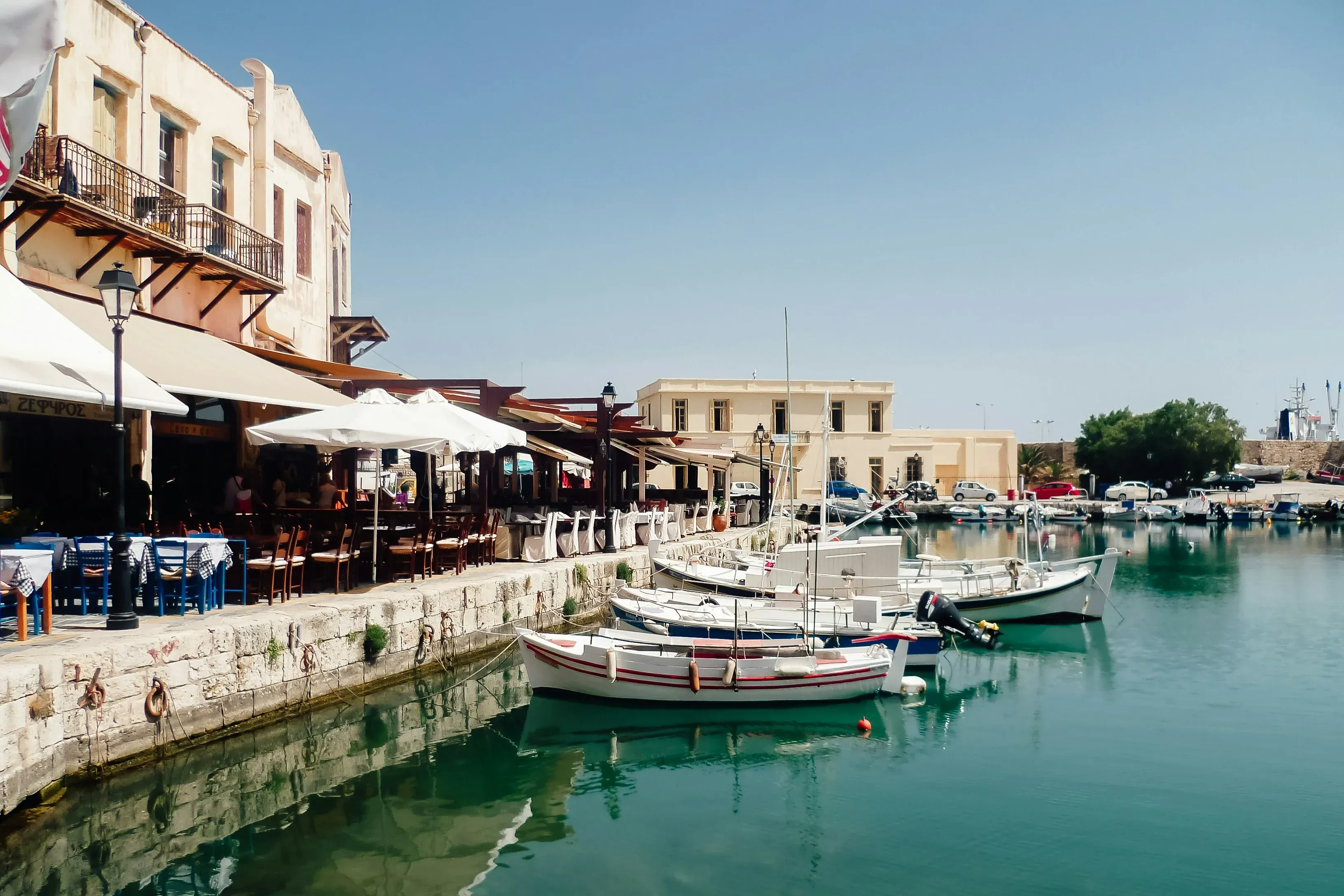

Crete is a big island. Big enough that its three main cities each have a distinct personality, distinct history, and distinct reasons to choose one over the others as a base. Heraklion has Knossos and the archaeological muscle. Chania has the Venetian harbor and the photogenic old town that makes every photographer look talented. Rethymno has something less easily defined — a depth of layered history that no single photograph captures, a size that feels exactly right for actually living in rather than visiting, and a position in the center of the island that gives it access to both coasts, both mountain ranges, and both of Crete's major cities within an hour in either direction.
Rethymno was occupied by the Minoans, the Dorians, the Romans, the Byzantines, the Venetians for four centuries, the Ottomans for another two and a half, and the Greeks for the century since. Each left something. The Venetian lighthouse at the harbor entrance, the Fortezza fortress rising above the old town, the Renaissance fountain in the main square, the minaret of a converted mosque rising above the lanes — these are not reconstructions or museums. They are the actual things, still standing, still in context, still making the spatial argument that this city has been continuously and meaningfully inhabited since before the first millennium.
It is also, almost incidentally, one of the finest places in Crete to eat, drink, swim, and do nothing in particular with the specific competence of someone who has planned nothing and is content about it.

Getting to Rethymno
Rethymno has no airport of its own. It sits roughly equidistant between Crete's two airports and is accessed via one of them.
Via Heraklion Airport (HER) — 80 km, approximately 1 hour by road
Heraklion Nikos Kazantzakis Airport is Crete's main international hub, handling the most routes and the highest passenger volumes. Direct flights connect Heraklion with Athens (45 minutes, multiple daily departures on Aegean, Olympic, and Sky Express), and from May through October, direct flights arrive from London, Amsterdam, Frankfurt, Berlin, Warsaw, Vienna, Tel Aviv, and most major European cities. From North America and other long-haul origins, connections run through Athens.
The airport sits 4 km east of Heraklion's city center. From arrivals, taxis to Rethymno cost approximately €80–100 and take about 1 hour. The KTEL intercity bus connects Heraklion to Rethymno hourly for €8.30 (buy tickets at the airport bus stop directly across from arrivals, then change at Heraklion's main bus terminal for the westbound service).
A Kiwitaxi private transfer from Heraklion Airport directly to your Rethymno hotel or any address in the region takes approximately 1 hour with fixed pricing, meet and greet, and no intermediate changes.
Via Chania Airport (CHQ) — 60 km, approximately 40–50 minutes by road
Chania's Ioannis Daskalogiannis Airport is actually slightly closer to Rethymno than Heraklion's airport, and in many cases has equally good European route options. Ryanair, easyJet, Wizz Air, Aegean, and various charter carriers serve Chania. From the airport, a taxi to Rethymno runs approximately €70–85 and takes 40–50 minutes. The KTEL bus from Chania city to Rethymno (€6.80, hourly service) requires getting from the airport into Chania city first (bus line or taxi, approximately €2.50–15).
A Kiwitaxi private transfer from Chania Airport directly to Rethymno is approximately 40–50 minutes door to door — often the most practical option for direct arrival.
By Ferry
Rethymno has its own ferry port with seasonal direct connections to Piraeus (Athens port). The overnight ferry (Anek Lines, approximately 9 hours) arrives early morning. A summer-only option for travelers who want a scenic approach or who are island-hopping from Athens. Ferries operate less frequently than from Heraklion or Chania; check current schedules at openseas.gr.
By KTEL Bus (Intercity)
The E-KTEL Chanion network runs hourly services connecting Rethymno with both Heraklion (€8.30, 1h 30min) and Chania (€6.80, 1h 15min) from early morning to late evening. The main Rethymno KTEL station sits on the seafront road west of the old town. Reliable, economical, and the correct choice for travelers moving between Cretan cities without luggage logistics.

Getting Around Rethymno
The old town is compact and car-free in its heart — everything within the Venetian walls is pedestrian territory. From the Fortezza at the top of the hill to the Venetian harbor at the waterfront to the Rimondi Fountain in the center, the walking distances are short and the lanes reward slow movement. Rethymno is one of those towns that is genuinely best experienced on foot, particularly in the early morning when the lanes are quiet.
Walking: The default and correct choice for the old town, the waterfront, and the beaches immediately adjacent. From the Venetian harbor to the town beach, from the Fortezza to the main square — everything is within 15 minutes' walk of everything else.
Rental Car: Essential for exploring the Rethymno region beyond the city — Preveli Beach, the Kourtaliotiko Gorge, Arkadi Monastery, Spili, the south coast. Multiple rental agencies operate on and near the seafront road. Rates from approximately €25–45 per day in shoulder season, significantly higher in August. The roads in the Rethymno regional unit range from excellent (the E75 coastal highway) to narrow mountain lanes that require attention and a small vehicle. Many rental agreements exclude the track to Balos Beach in Chania — check the terms before venturing off-road.
Taxis: Available at stands on the main seafront road. Useful for reaching the beach strip east of the old town, the bus station, or accessing trailheads and monasteries without a rental car. Fixed fare negotiations apply for longer journeys — agree before departure.
City Bus: Local lines serve the beach hotels east of the old town and the surrounding neighborhoods. Infrequent enough that a rental car or taxi is more practical for most day trip purposes.
Best Time to Visit Rethymno
May to June and September to October is the consistent answer from everyone who has been more than once. The Mediterranean is warm (22–24°C in the sea), temperatures are 22–28°C onshore, the old town is comfortably walkable without July's heat, and the region's beaches are accessible without August's crowds.
July and August is peak season — temperatures reach 32–35°C, the beach hotels fill completely, and the cobblestones of the old town retain heat well into the evening. The upside: the sea is at its warmest, the old town's restaurants and bars are fully operational, the evening volta along the harbor is at its most social, and the specific summer energy of a Greek coastal town at full tilt has its own genuine appeal. Book accommodation 2–3 months ahead for August.
April is early season — most beach hotels are opening, water temperature is 18–20°C (cold for prolonged swimming but not impossible), and the town is quiet in a way that lets you see its actual character rather than its tourist-season face. Wild flowers cover the hillsides inland; the landscape around Arkadi and the mountain villages is at its most beautiful.
October and November is genuinely underrated. The sea retains summer warmth through October (22–23°C), temperatures onshore are 20–25°C, the summer crowds are gone, and the quality of light on the Venetian architecture in the old town is specific and extraordinary. November is quieter still — many beach hotels close — but the town itself remains open, and a November afternoon in an old town taverna with local wine and dakos (Cretan barley rusk with tomato and mizithra cheese) is one of those travel experiences that justifies off-season travel entirely.
Winter (December through March) is slow — some restaurants close, beach hotels are shut, and Rethymno runs at the pace of its 40,000 permanent residents. Worth considering for travelers who want to understand the place rather than use it; prices are extremely low.
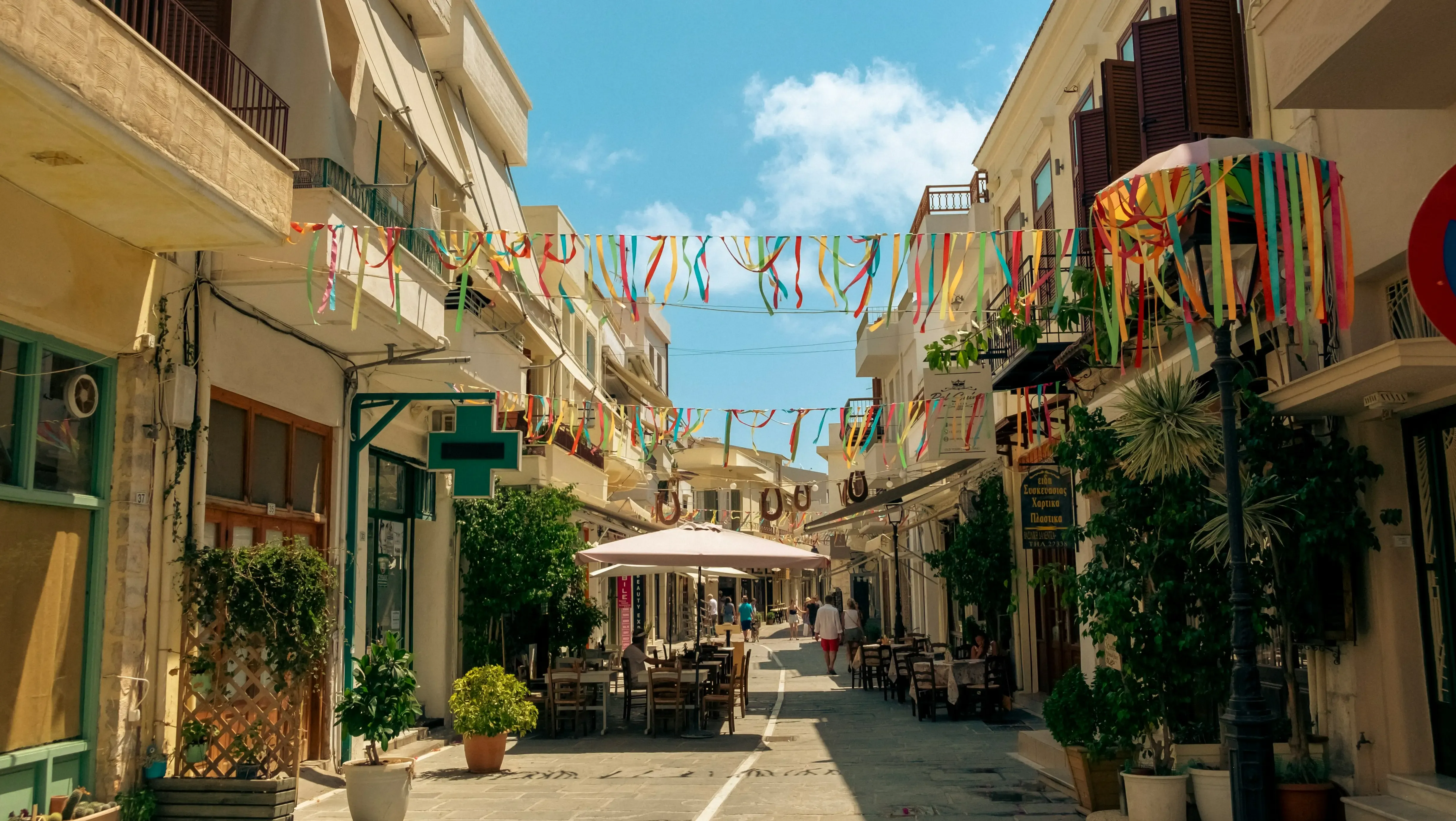
Where to Stay in Rethymno
The Old Town is where to stay if atmosphere and character matter more than beach access. Boutique hotels and suites in restored Venetian buildings, many with rooftop terraces over the old town roofscape, some with views to the Fortezza, all within walking distance of the harbor and the town beach. Some lanes require carrying luggage on foot from the nearest vehicle access point — clarify this with your hotel before arrival. The finest addresses in Rethymno are concentrated here.
The Venetian Harbor Area is the most desirable address for the classic Rethymno experience — tables under Ottoman-era minarets, the lighthouse at the harbor entrance visible from the breakfast terrace, the old town lanes a 3-minute walk away. Pricier per square meter than anywhere else in the city.
The Beach Strip (East of Old Town) is where most large resort hotels and apartments operate — modern buildings stretching east along the long sandy beach, well-equipped with pools, beach access, and restaurants. Less atmospheric than the old town but practical for families with children for whom beach access from the door is the priority. A 15–20 minute walk from the old town along the waterfront.
Adele and Platanes are the inland villages immediately south of Rethymno, quieter and slightly cooler than the coast, with local tavernas and easy car access to both the city and the regional sites. Preferred by travelers self-catering or renting villas.
Best Things to Do in Rethymno
Walk the Old Town Before Breakfast
The single best thing to do in Rethymno is the one that costs nothing and requires only the willingness to set an alarm for 7:30 AM. The old town before 9 AM — before the shops open, before the day-trippers arrive from the resort hotels, before the lanes fill — is one of the finest urban walking experiences in Greece. The Ottoman minaret of the Neratzes Mosque rising above a lane of Venetian arched doorways. The carved stone fountains at unexpected corners. The Renaissance loggia that is now a café with its shutters still closed. The cat that has clearly decided this particular staircase belongs to it. Walk without a map, let the lanes take you wherever they go, and find your way back by the Fortezza or the harbor when you're ready.
Climb the Fortezza
The Venetian fortress above the old town was built between 1573 and 1587 in response to a devastating Ottoman raid that destroyed the city in 1571 — the fastest major fortification project in Venetian colonial history, born of genuine urgency. The walls enclose a large plateau at the top of the hill containing the Ibrahim Han Mosque (the domed structure built by the Ottomans after they captured the city in 1646), the ruins of the Venetian governor's residence, a Byzantine church, ammunition stores, and the best panoramic view in Rethymno — the old town, the harbor, the beach strip stretching east, and on clear days, the Psiloritis massif (Mount Ida, at 2,456 meters the highest point in Crete) to the southeast. Entry approximately €4. Come in the late afternoon when the light comes low over the harbor and the old town below is all red tile and warm stone.
Sit at the Venetian Harbor
The small inner harbor protected by the lighthouse — built by the Egyptians in 1830, reconstructed by the Venetians, and functioning ever since — is Rethymno's most immediately romantic space. The arc of tavernas and cafés lining the harbor wall serves seafood, coffee, and the specific Cretan aperitivo of raki with mezedes from early morning to well past midnight. The Venetian breakwater can be walked to the lighthouse tip in 10 minutes. Come at sunset, when the fishing boats are returning and the light turns the harbor water the color of old copper.
Visit the Rimondi Fountain and the Museum of Contemporary Art
The Rimondi Fountain in the main old town square was built by the Venetian rector Francesco Morosini in 1626 to supply the city with water from the mountains — three lion heads still pour water from its facade. Nearby, the Museum of Contemporary Art of Crete in the old town holds one of the finest collections of Greek contemporary art outside Athens, with rotating exhibitions and a permanent collection that runs from the early 20th century through the present. The combination of a 17th-century fountain and a serious contemporary art museum in a 10-minute walk tells you something about the density of this old town.
Eat and Drink Like a Cretan
The Cretan diet is the Cretan diet — not the "Mediterranean diet" of magazine features, but the actual thing as practiced by people who grew up eating it. Dakos is the foundation: a large barley rusk soaked slightly in olive oil, topped with grated fresh tomato, mizithra (fresh sheep's cheese) or graviera, a few Kalamata olives, a generous pour of locally pressed extra virgin olive oil, and dried oregano from the mountain above the farm where the sheep were grazed. Staka is the Cretan cream that comes from skimming cooked sheep's butter — spread on bread, served alongside tyganites (fried dough), or incorporated into local pastries. Apaki is smoked pork from Cretan mountain pigs, cured with herbs and vinegar. Tsikoudia (also known as raki in the rest of Greece but always tsikoudia to a Cretan) is the grape spirit that arrives uninvited at the beginning and end of every proper Cretan meal. Accept it both times.
Swim at Rethymno Town Beach
The sandy beach beginning immediately east of the old town and stretching for kilometers is organized into a combination of free public sections and balnearia (organized beach sections with sun beds and service). The free sections are accessible and perfectly pleasant; the organized sections cost €8–15 for a sun bed and umbrella and offer beach bar service, showers, and lockers. The water is shallow and calm in the sheltered northern bay, excellent for families with children. The beach at dawn — before 8 AM when the sun bed operators have arrived but the water is already warm — is worth the early start.
Explore the Byzantine and Post-Byzantine Museum
The collection housed in the converted church of the Erimtan Mosque (itself originally a Venetian Catholic church, converted by the Ottomans, and now serving as a museum of the period it covered) holds icons, ecclesiastical objects, and finds from the Byzantine and Venetian periods that provide the cultural context for what you're seeing in the old town streets. Small, undervisited, and genuinely interesting if the history of Cretan Byzantine art is a gap in your knowledge. Entry approximately €3.

Day Trips from Rethymno with Kiwitaxi
Rethymno's position at the center of Crete makes it the island's finest base for regional exploration. Both coasts are accessible in under an hour. The mountain villages of the interior are 20–40 minutes away. The neighboring cities of Heraklion and Chania are each reachable in about 75 minutes. For visitors who want the flexibility to reach beaches, monasteries, gorges, and archaeological sites without the logistics of coordinating bus connections or the expense of renting a car for every day, Kiwitaxi's Chauffeur Hire covers the full Rethymno region with a dedicated vehicle, a professional driver who knows the roads, and the freedom to build the day around what you actually want to see.
Preveli Beach and Kourtaliotiko Gorge — 40 minutes from Rethymno
Preveli is the most extraordinary beach in central Crete and one of the most unusual in Greece — a palm-fringed river delta where the Kourtaliotis River meets the Libyan Sea, creating a lagoon of startlingly clear turquoise water surrounded by Cretan date palms (Phoenix theophrasti, endemic to Crete and a few other Aegean locations) and pink oleander. The river is swimmable upstream from the beach into a narrow palm gorge. The Kourtaliotiko Gorge immediately north of Preveli holds the falls and springs that feed the river — a short stop on the way south adds a dramatic change of landscape.
The descent to Preveli from the upper car park is steep (20–25 minutes each way on an uneven path; wear proper footwear). An alternative approach is by boat from Damnoni Beach or Plakias — a 15–20 minute sea journey that arrives at the beach from the water. Both are worth experiencing on separate visits; the first time, come by boat.
By Kiwitaxi Chauffeur Hire: approximately 40 minutes from Rethymno. Combine with Plakias village for lunch and a second beach. The combination of gorge, Preveli Beach, and Plakias makes an excellent full day on the south coast.
Arkadi Monastery — 25 minutes from Rethymno
The most historically significant monastery in Crete sits on a plateau in the hills 23 km southeast of Rethymno, its elaborate Renaissance church facade — the finest example of Cretan Renaissance architecture on the island — visible at the end of an approach road lined with cypress trees. Arkadi is sacred in Cretan national consciousness because of the events of November 9, 1866: during the great Cretan Revolt against Ottoman rule, hundreds of Cretan fighters and civilians took refuge in the monastery. When Ottoman forces breached the outer walls, the abbot ordered the powder magazine detonated rather than surrender. The explosion killed nearly a thousand people — Cretans and Ottomans alike. The event drew international attention to the Cretan struggle and contributed to the eventual union of Crete with Greece in 1913.
The monastery is still operating, with monks in residence. The church (1587), the ossuary holding the skulls and bones of the 1866 defenders, and the small museum with artifacts from the revolt are all accessible to visitors. Come on a weekday morning when the bus tours haven't arrived. The combination with the pottery village of Margarites (10 minutes north) and the Melidoni Cave (25 minutes northwest, an extraordinary cave with Minoan and Byzantine historical significance) makes a complete half-day circuit of the inland Rethymno region.
Spili and the Mountain Villages — 30 minutes from Rethymno
The village of Spili, directly south of Rethymno on the road toward Plakias and the south coast, is the finest example of a traditional Cretan mountain village accessible without significant effort. The Venetian fountain in the main square — 25 lion heads pouring water from the hillside spring into a long stone trough — is the specific image most people carry away, but the village itself, with its platane-shaded lanes and the kafeneion (traditional café) where older men have been sitting in the same positions for decades, is worth a slow 45 minutes. The road south from Spili passes through increasingly dramatic mountain scenery toward the Kotsifou Gorge, whose sheer walls are visible from the road as it descends toward the south coast.
Further inland, the villages of Anogia (on the lower slopes of Mount Ida/Psiloritis, famous for music, weaving, and a fierce independent character that has been continuous since the Cretan Revolt) and Margarites (a pottery village with working studios and kilns that have been producing Cretan ceramics for centuries) complete a circuit of the Rethymno interior that represents a genuinely different Crete from the coastal experience.
Chania — 75 minutes from Rethymno
Crete's most immediately beautiful city is an hour and fifteen minutes west by road — Venetian harbor, Turkish quarter, the covered market, the Archaeological Museum of Chania, and the specific evening energy of a city large enough to have serious nightlife and small enough that the old town is still the center of gravity. A day trip from Rethymno to Chania allows you to take the E75 coastal highway west and return via the inland route through Georgioupolis, with a lunch stop at one of the harbor restaurants in Chania and time in the afternoon to explore the Venetian district and its museums. By Kiwitaxi Chauffeur: approximately 75 minutes each way, with full flexibility to stop at the Georgioupolis lagoon beach (30 minutes from Rethymno, where the Almyros River meets the sea creating a remarkable shallow lagoon) on the return leg.
Ancient Eleftherna — 30 minutes from Rethymno
The ancient Greek city of Eleftherna, founded in the 9th century BC in the foothills below Mount Ida, has been under systematic excavation by the University of Crete since 1985 and is producing finds of international significance — particularly the warrior aristocratic cremation burials dating from the Geometric and Orientalizing periods (900–600 BC), with grave goods that document Crete's connections to Cyprus, the Near East, and Phoenicia at the height of the Archaic period. The Museum of Ancient Eleftherna, opened in 2016, is purpose-built on the site and holds the excavation finds with exceptional interpretive display. The site itself, on a natural rocky spur with views across the mountain foothills, is archaeologically open and authentically uncrowded. Combine with Arkadi Monastery (15 minutes further) and Margarites pottery village for a full inland day.
Heraklion and Knossos — 80 minutes from Rethymno
The Minoan Palace of Knossos — the largest Bronze Age archaeological site in the Aegean, the political and ceremonial center of the Minoan civilization, and the physical source of the Minotaur legend — is 5 km south of Heraklion and approximately 80 minutes from Rethymno by private transfer. The palace ruins cover 20,000 square meters and include Sir Arthur Evans's early 20th-century reconstructions of the upper floors in reinforced concrete — controversial among archaeologists but genuinely helpful for non-specialists trying to understand the building's three-dimensional complexity. The Heraklion Archaeological Museum in the city center holds the finest collection of Minoan artifacts in existence — the frescoes from Knossos (the Bull Leaper, the Ladies in Blue, the Prince of the Lilies), the Phaistos Disc, the Snake Goddess figurines. Allow the full day for both sites; a Kiwitaxi Chauffeur covers the round trip with flexible timing for each.
Book your Rethymno day trip with Kiwitaxi Chauffeur Hire — fixed pricing, drivers who know the mountain roads and the monastery opening hours, and the freedom to change course when the view earns it.

Rethymno on a Practical Note
The Euro. Card payment is accepted at hotels, larger restaurants, and most tourist-facing businesses. Cash is preferred (and sometimes required) at smaller tavernas, local shops, the ferry port, the KTEL bus station, and the Fortezza ticket window. Carry €40–60 in cash for daily use in the old town.
The ZTL. The old town's cobblestone lanes are mostly inaccessible by vehicle. Hotels within the old town will provide specific instructions for dropping luggage — usually a designated access road or meeting point for vehicles. This is normal and not a problem; clarify with your accommodation before arrival.
Dress code for monasteries. Arkadi and Preveli monasteries are active religious institutions. Shoulders and knees must be covered for entry. Wraps are available at the entrance of both monasteries for those who arrive without appropriate clothing, but carrying a light scarf or sarong avoids the interaction entirely.
The heat. July and August in Rethymno reach 34–36°C at midday. Plan outdoor activities for the morning (before 11 AM) and late afternoon (after 4 PM), and use the midday heat for the museum or the old town's shaded lanes. The beach in the early morning and late afternoon is significantly more comfortable than the midday session.
The raki. Tsikoudia arrives at the end of Cretan meals without being ordered and without additional charge. It is a gesture of hospitality and completion. Drinking it is expected; not finishing it is fine. Requesting more is encouraged. Do not ask for the price — there is none.
Parking. If arriving by rental car, the free parking area near the old town is on and around Plateia Tessaron Martyron (the "Four Martyrs Square") at the western edge of the old town. Paid parking exists along the beach road east of the center.
Rethymno is the city that Venetians built, Ottomans refined, Greeks inherited, and everyone since has understood was somehow already complete. The lanes don't need improving. The harbor doesn't need updating. The mountain behind it has been doing exactly what it does for twenty million years. You just need to show up at the right hour and pay attention.
Best Picks for True Adventurers


Traveling with kids? We've got everything covered.
Child seats, luggage, and a driver who knows your flight lands late. Kiwitaxi takes care of everything so your family trip starts the way it should - with excitement, not chaos.
Book a family transferExplore All Guides
Barcelona Neighborhoods Guide: Where to Stay & What to Expect in Each Barrio

Discover Paris: A Guide to Iconic Landmarks, Historic Cafés & Legendary Stores

Osaka Travel Guide: Top Things to Do & Food Spots

First-Timer's Japan Handbook: 10 Essential Travel Tips + Etiquette FAQ

Rome in a Day & 3 Days in Rome: The Ultimate Itineraries for Every Traveler

Barcelona Airport to Gothic Quarter: Fastest Transfer Options, Prices & Travel Tips

Ultimate Japan Itineraries: Discover the Best of Japan in 7 or 14 Days

More than the Eiffel Tower: Best Things to Do In Paris

Best hotels in Albania: Tirana, Saranda, Vlorë & Durres

Rome: La Dolce Vita in Every Corner — travel guide by Olivia (@doinglifewithliv)

Barcelona Airport to Sagrada Família: Best Transfer Options, Prices & Travel Times

Paris Food Guide: Eiffel Tower View Restaurants & Rooftop Dining

18 Things You Need to Know Before Visiting Croatia

10 Unforgettable Day Trips from Rome, Italy: Ancient Towns, Best Beaches & Countryside Escapes
A Taste of Florence: Your Complete Food Guide

Best Day Trips from Milan with a Private Driver: Lake Como, Verona & Beyond

10 Best Holiday Alternatives to the Middle East for Spring 2026

Best Things to Do Around the Colosseum: Rome Attractions, Tours & Insider Tips

Barcelona vs Madrid: Which City Is Better to Visit in Spain?

Barcelona: Hidden Bites, Secret Sips & Sunshine Tips by Nancy Sevilla

Best eSIM for Japan 2026

Budapest Travel Tips: Beyond the Obvious

Best Hotels in Rome for Every Budget: Luxury, Boutique & Budget Stays

Cinque Terre Travel Guide: Best Villages & Trails

Best Wine Tours from Milan: Franciacorta, Valpolicella & Chauffeur Hire
Milan to Verona Day Trip with a Chauffeur

South Korea Travel Guide: Best Cultural, Beauty & Wellness Experiences in Seoul, Busan & Jeonju

Best Things to Do in Singapore: Food, Views & Hidden Gems

Free eSIM Trial: Where to Get Free Data

Hoi An Travel Guide: Hidden Gems, Spas & Local Experiences

Santorini Travel Guide: Sunsets, Cruises & Wine

3 Days in Northern Spain: Bilbao, the Cantabrian Coast & Santander

Best eSim for Europe: One Card for 30+ Countries

Best eSim for Mexico: Stay Connected on Your Trip

How to Get from Lisbon to Porto (2026): Train, Bus, Car, or Flight?

How to Get from London to Madeira: Complete Guide (2026)

How to Get from Beauvais Airport to Paris

Paris on a Budget: Affordable Hotels, Shopping & Free Things to Do

Top 12 Things to Do in Albania: Ultimate Travel Guide

Where to Stay in the Albanian Riviera: Best Hotels & Areas
Kyoto Travel Guide: Journey to the Heart of Old Japan

The Ultimate Hanoi Travel Guide: Local Tips, Street Food & Hidden Gems in Vietnam’s Capital

Private Chauffeur Service for Day Trips & Sightseeing
Your own driver, by the hour. No fixed routes. No surprises. Just a professional driver at your disposal - from 3 hours to multiple days.
Book a chauffeur