'%3e%3cpath%20d='M43.073%200.00649261H15.0943V3.94346H43.073V0.00649261Z'%20fill='url(%23kiwitaxi-grad)'%20/%3e%3cpath%20d='M15.0828%203.94346C16.1928%203.94346%2017.0512%203.06513%2017.0512%201.97497C17.0512%200.874164%2016.1822%200.00649261%2015.0828%200.00649261C14.0362%200.00649261%2013.1379%200.851916%2013.1379%201.97497C13.1379%203.10916%2014.0478%203.94346%2015.0828%203.94346Z'%20fill='white'%20/%3e%3cpath%20d='M43.0614%203.94346C44.1715%203.94346%2045.0299%203.06513%2045.0299%201.97497C45.0299%200.874164%2044.1609%200.00649261%2043.0614%200.00649261C42.0149%200.00649261%2041.1166%200.851916%2041.1166%201.97497C41.1166%203.10916%2042.0265%203.94346%2043.0614%203.94346Z'%20fill='white'%20/%3e%3cpath%20d='M19.5921%2038.5052V39.828H23.1471V26.0491H19.5921V27.3446C18.895%2026.5789%2017.4549%2025.8841%2015.7339%2025.8841C11.8502%2025.8841%208.78975%2028.7578%208.78975%2032.939C8.78975%2037.1374%2011.8702%2039.9935%2015.7339%2039.9935C17.4938%2039.9935%2018.932%2039.2691%2019.5921%2038.5052ZM12.2892%2032.939C12.2892%2030.5715%2013.929%2029.1912%2015.9819%2029.1912C18.0106%2029.1912%2019.5647%2030.5845%2019.5647%2032.939C19.5647%2035.2579%2017.9768%2036.6869%2015.9823%2036.6869C13.9596%2036.6869%2012.2892%2035.264%2012.2892%2032.939Z'%20fill='white'%20/%3e%3cpath%20d='M44.7174%2026.0496H41.4289V39.8281H44.7174V26.0496Z'%20fill='white'%20/%3e%3cpath%20d='M32.2183%2035.7001L29.3455%2039.8281H24.94L30.044%2032.8552L25.1624%2026.0496H29.7075L32.3295%2029.8985L35.035%2026.0496H39.4405L34.5599%2032.7435L39.6361%2039.8281H35.1189L32.2183%2035.7001Z'%20fill='white'%20/%3e%3cpath%20d='M3.34504%2022.9604V26.0496H7.4039V29.0939H3.34504V34.2781C3.34504%2035.9866%204.33971%2036.7008%205.955%2036.7008C6.54504%2036.7008%207.16659%2036.5766%207.63241%2036.235V39.4341C7.04237%2039.7757%206.14133%2039.9931%204.89915%2039.9931C1.8243%2039.9931%200.0226746%2038.1293%200.0226746%2034.9298V22.96H3.34504Z'%20fill='white'%20/%3e%3cpath%20d='M36.2094%208.57428L33.307%2016.8723L30.43%208.57428H27.7621L24.8597%2016.8723L21.9828%208.57428H18.4884L23.2157%2021.4188H26.5037L29.084%2014.4093L31.6629%2021.4188H34.951L39.6782%208.57428H36.2094Z'%20fill='white'%20/%3e%3cpath%20d='M44.7174%208.57381H41.4289V21.4188H44.7174V8.57381Z'%20fill='white'%20/%3e%3cpath%20d='M16.7387%208.57381H13.4502V21.4188H16.7387V8.57381Z'%20fill='white'%20/%3e%3cpath%20d='M11.7001%208.57382L6.07922%2014.1326L12.1622%2021.4188H8.05929L3.92163%2016.28L3.3455%2016.8538V21.4188H0.0226746V3.94299H3.3455V12.7574L7.59764%208.57382H11.7001Z'%20fill='white'%20/%3e%3c/g%3e%3cdefs%3e%3clinearGradient%20id='kiwitaxi-grad'%20x1='15.0945'%20y1='1.97497'%20x2='43.073'%20y2='1.97497'%20gradientUnits='userSpaceOnUse'%3e%3cstop%20stop-color='%2300D2CD'%20stop-opacity='0'%20/%3e%3cstop%20offset='1'%20stop-color='%2300D2CD'%20/%3e%3c/linearGradient%3e%3cclipPath%20id='kiwitaxi-clip'%3e%3crect%20width='46'%20height='40'%20fill='white'%20/%3e%3c/clipPath%3e%3c/defs%3e%3c/svg%3e)

Prague: The City That Survived Everything and Still Looks Like a Fairy Tale
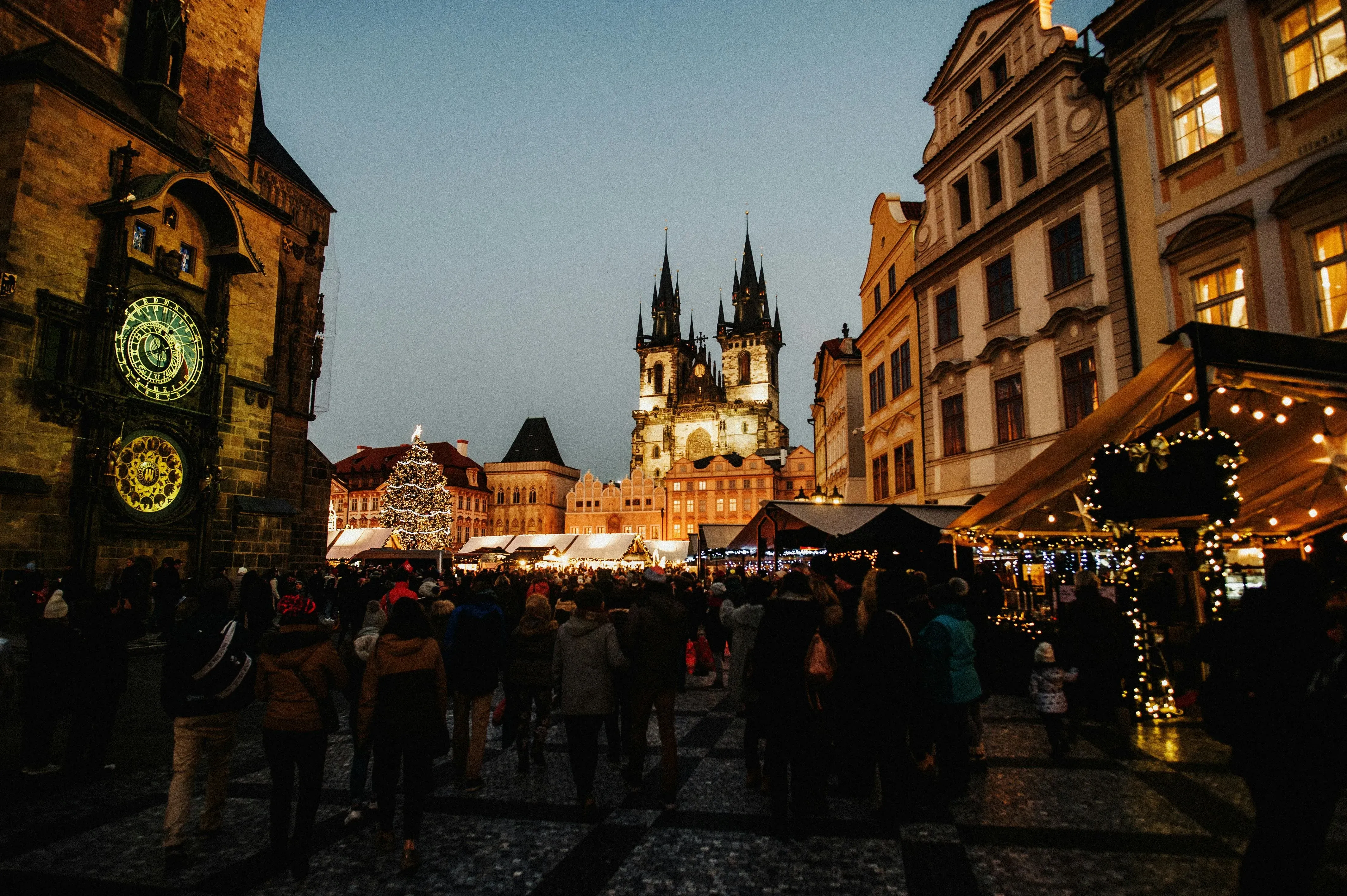
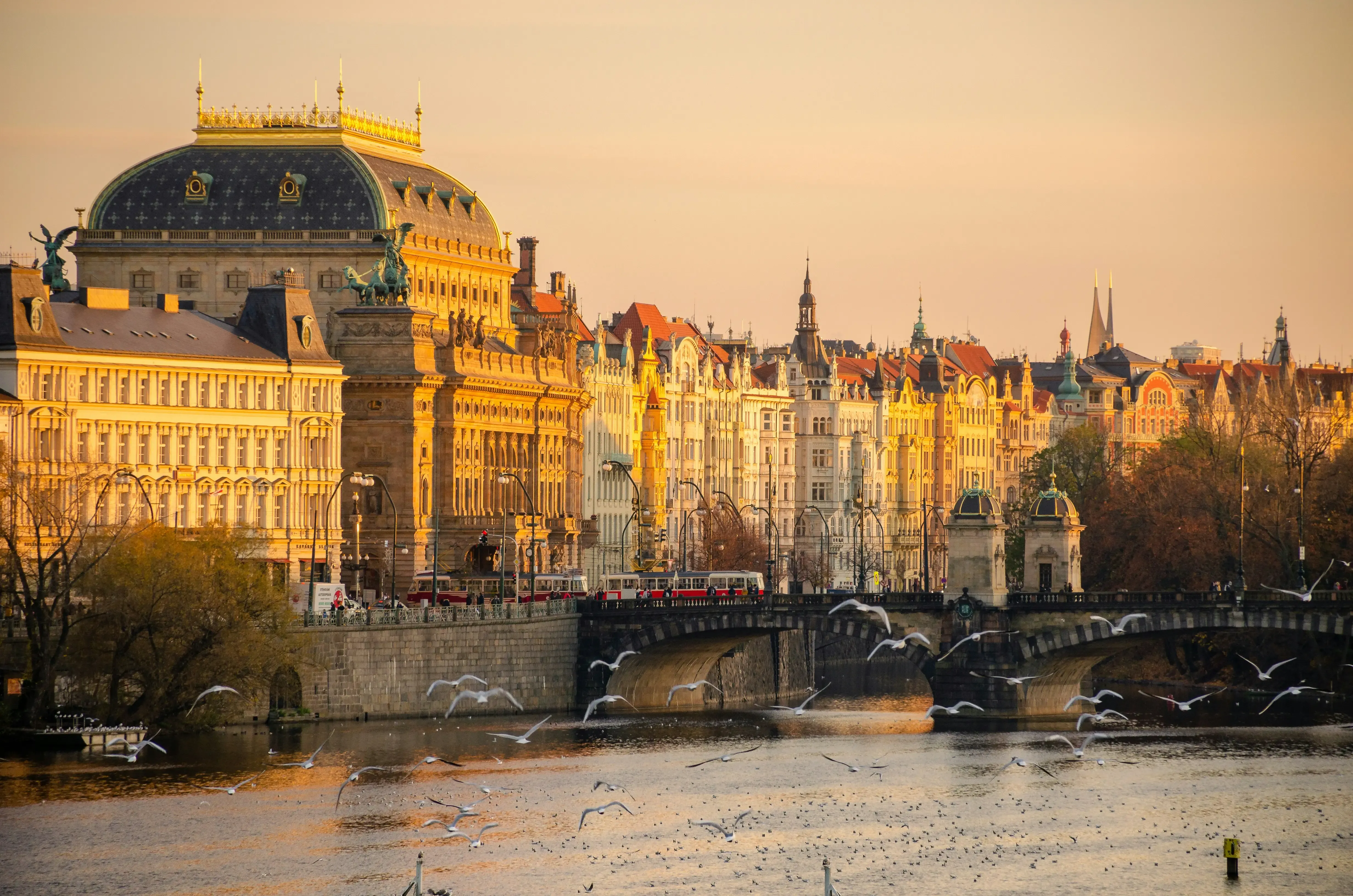
Prague is the kind of city that should have been destroyed several times by now. It was occupied by the Habsburgs, the Nazis, and the Soviets in succession. Its Jewish community — one of the most significant in central Europe — was nearly eliminated during the Second World War. Its most daring political experiment, the Prague Spring of 1968, was crushed by Warsaw Pact tanks on a summer night. And yet the city stands: Gothic towers, Baroque palaces, Art Nouveau facades, and a medieval astronomical clock that has been announcing the hour since 1410, all largely intact, all lined up along the Vltava River in a configuration that makes first-time visitors stop and genuinely disbelieve what they're seeing.
The explanation for Prague's physical survival is largely luck and geography — the Second World War spared it the bombing that flattened Dresden and Warsaw. The explanation for its cultural survival is the Czechs themselves, who have a specific national talent for persistence and irony in combination. Kafka was born here. Václav Havel governed here. The Czech word for good soldier — the comic anti-hero who undermines military authority through cheerful incompetence — entered European literature from a novel written a few tram stops from the Old Town Square.
Prague is currently one of the most visited cities in Europe, which creates a genuine tension between what it is and what tourism does to it. The solution is the same as it is in every heavily visited European city: go early, go off the main routes, stay long enough to find the version of the place that isn't primarily organized for your benefit. That version exists, it's excellent, and the beer is cheaper once you find it.
Getting to Prague
By Air
Václav Havel Airport Prague (PRG) — named after the playwright-president who led the Velvet Revolution and governed the Czech Republic for most of the 1990s — sits approximately 17 km northwest of the city center in the Ruzyně district. It handles direct connections from across Europe, the Middle East, North America, and Asia. Ryanair, Wizz Air, easyJet, Czech Airlines (Smartwings), Lufthansa, British Airways, Emirates, and most major European carriers operate through PRG. From London, the flight takes approximately 2 hours. From New York, connecting through a European hub adds roughly 10–11 hours total.
Two terminals handle all traffic:
Terminal 1 processes non-Schengen flights (UK, USA, Middle East, non-EU European countries);
Terminal 2 handles Schengen zone countries (most EU flights). Both terminals are connected by a covered walkway.
By Train
Prague Hlavní nádraží (Prague Main Station) sits in the New Town, a 10-minute walk from Wenceslas Square and directly on metro Line C. Fast trains reach Berlin in 4 hours, Vienna in 4 hours, Budapest in 6.5 hours, Warsaw in 7 hours, and Munich in 5.5 hours. The new Prague–Berlin high-speed corridor, currently under development, will reduce the Berlin connection to under 2 hours when complete. For travelers combining Prague with Vienna, Bratislava, or Budapest on a Central European circuit, the rail connections make logical, scenic sense.
By Bus
FlixBus and RegioJet run extensive European coach connections into Prague's Florenc bus terminal, with particularly competitive pricing on routes from Berlin, Vienna, Bratislava, Budapest, and Warsaw. RegioJet operates notably high-quality coaches with entertainment and food service on longer routes.
Arriving at Václav Havel Airport: What to Expect
The airport is modern and well-signed. Baggage claim runs 20–35 minutes. A critical first step: buy an integrated transport ticket at the Public Transport desk or yellow vending machines in the arrivals hall — a single 24-hour pass (110 CZK, approximately €4.50) covers the bus and metro combination into the city and any subsequent journeys for the day.
One important note on street taxis at the airport: Prague's unmetered taxi drivers outside the terminals have a well-documented history of overcharging tourists, sometimes dramatically. The official advice from the Prague tourism authority and most experienced visitors is consistent — use the ride-hailing apps, pre-book a private transfer, or take public transport. Walk-up street taxis at PRG are the one Prague transport option to avoid.
By Bus + Metro: The most economical option. Bus 119 runs from both terminals to Nádraží Veleslavín metro station (Line A, green) every 10–15 minutes during the day, taking approximately 15–20 minutes. From Veleslavín, take Metro Line A toward Depo Hostivař — four stops to Staroměstská (Old Town), five to Můstek (Wenceslas Square). Total journey time from terminal to city center: approximately 40–45 minutes. Cost: 32 CZK (approximately €1.30) per person for a 90-minute ticket. Buy tickets at vending machines in the terminal or at the metro station — not from the bus driver if possible (slightly more expensive).
By Airport Express (AE) Bus: Runs every 30 minutes directly from Terminal 1 and 2 to Prague Main Railway Station (Hlavní nádraží) in approximately 35–40 minutes. Cost: approximately 100 CZK (€4). Best option if you're catching a train from the main station or staying in the New Town area. Does not stop at other central points — if you need Metro Line A or B, bus 119 or bus 100 are more practical.
By Private Transfer: For families, groups, late arrivals, or travelers heading to specific addresses in Malá Strana or outer districts not directly served by the metro, a Kiwitaxi private transfer from PRG covers the full journey door to door with fixed pricing, meet and greet in arrivals, and flight monitoring. The transfer takes approximately 25–35 minutes to the city center depending on traffic; the fixed price eliminates any risk of the variable-pricing situation that unmetered airport taxis create.

Getting Around Prague
Prague's public transport network — operated by the Prague Integrated Transport (PID) system — covers trams, metro, buses, and funiculars on a unified ticketing system. For most visitors, the combination of the metro and trams covers every major destination.
Metro Three lines cover the essential city geography. Line A (Green) runs from the airport connection at Veleslavín east through the historic center (Malostranská, Staroměstská, Můstek) to Vinohrady and Žižkov. Line B (Yellow) crosses east-west through the New Town (Náměstí Republiky, Florenc, Muzeum). Line C (Red) runs north-south through the New Town (Hlavní nádraží, Muzeum, Vyšehrad). The three lines intersect at Mustek (A + B), Muzeum (A + C), and Florenc (B + C). Trains run from 5 AM to midnight, every 2–4 minutes at peak hours.
Trams The better way to see the city while moving through it. Tram routes cover the historic areas the metro bypasses — Malá Strana, along the river, through Vinohrady's broad boulevards, and up to Letná and Holešovice. The historic tram 22 route is effectively a sightseeing circuit through Malá Strana and the castle district. Trams run from 4:30 AM to midnight, with night trams on major routes afterward.
Tickets A 24-hour pass costs 110 CZK (approximately €4.50); a 72-hour pass costs 310 CZK (€12.50). These cover unlimited rides on metro, tram, bus, and the Petřín funicular. Single rides cost 30–40 CZK depending on journey length. Tickets must be validated in the yellow machines at metro entrances and on trams before travel — inspectors check regularly and fines run 1,500 CZK for invalid tickets.
Walking The historic center — Staré Město (Old Town), Josefov (Jewish Quarter), Malá Strana (Lesser Town), and the castle district — is best covered on foot. Distances are deceptive on a map but manageable in practice: Old Town Square to Charles Bridge takes 7 minutes; Charles Bridge to Prague Castle takes 20 minutes up the hill. The cobblestones are genuine and beautiful and require footwear with grip.
Best Time to Visit Prague
Prague rewards visits across most of the calendar — but the character of what you get varies considerably.
April to June is the finest season for first-time visitors. Temperatures reach 16–22°C, the city's parks and riverside are in bloom, and tourist volumes haven't yet hit summer peak. May is the sweet spot — warm, green, not yet crowded. The Prague Spring International Music Festival (May–June) is one of Europe's great classical music events, running concerts in concert halls, churches, and historic palaces across the city.
September to October rivals spring as the best time. Temperatures drop pleasantly to 14–20°C, the summer crowds thin after August, the city's cultural season restarts, and the light on Prague's stone facades in autumn is specific and extraordinary. The beer gardens that were full all summer are still functioning through September. October has a melancholy beauty — the Vltava reflects the copper and gold of the hillside trees — that photographers find specifically rewarding.
December is Prague at its most theatrical. The Christmas markets in Old Town Square and Wenceslas Square are among the finest in Europe — the genuine article, with wooden stalls serving svařák (mulled wine), trdelník (chimney cake, properly made and not the abomination sold year-round to tourists), smoked meats, and handmade crafts in a city covered in Gothic decorations and winter light. Hotel prices spike for Christmas week; the markets run from late November through December 23rd.
July and August is peak season — warm (25–30°C), fully crowded, and organizationally demanding. The Charles Bridge reaches uncomfortable densities between 10 AM and 6 PM; the Old Town Square is a sea of tour groups; Wenceslas Square is at its most commercial. Early morning (before 8 AM) and late evening (after 8 PM) are the saving times. The city's outdoor culture — beer gardens, river terraces, evening concerts — is at its best in summer, which compensates.
November through March (excluding Christmas) is cold (0–8°C), occasionally grey, and dramatically less crowded. The city's museums, galleries, concert halls, and jazz clubs are at their best with small, attentive audiences. Hotel prices are significantly lower. Walking the Old Town on a February morning with low fog over the Vltava and no other tourists on Charles Bridge is the version of Prague that locals describe as their favorite.

Prague's Neighborhoods
Prague's historic center divides into a series of historic districts that each carry distinct architecture and character. Understanding them helps you choose where to stay and what each day in the city will feel like.
Staré Město (Old Town) The historic core east of the Vltava — Old Town Square, the Astronomical Clock, the Gothic Church of Our Lady Before Týn, the Jewish Quarter, and a dense maze of medieval lanes connecting them. The most atmospheric and most visited neighborhood in the city. Staying here means the major sights are on your doorstep and the crowds are on your doorstep too, at the same times. Best explored before 9 AM and after 7 PM. The rest of the day, the lanes between the main square and the river are slightly less congested and reward getting lost.
Josefov (Jewish Quarter) The former Jewish ghetto within the Old Town — six synagogues (the oldest, the Old-New Synagogue, has been operating since the 13th century and is the oldest active synagogue in Europe), the Jewish Museum, and the Old Jewish Cemetery, where graves have been layered twelve deep because the community had no room to expand. A neighborhood of remarkable historical weight, deeply moving in the context of its history, and now also home to some of the city's finest luxury retail on Pařížská Street — an Art Nouveau boulevard that feels like it was imported from Paris and sits immediately adjacent to a medieval cemetery. The contrast is very Prague.
Malá Strana (Lesser Town) The neighborhood below Prague Castle on the western bank of the Vltava — Baroque palaces, embassy residences, winding lanes climbing the hillside, and the specific quiet that comes from a district where embassies occupy what were once aristocratic palaces. The Lennon Wall (originally covered with John Lennon graffiti after his assassination in 1980, repainted continuously since), the Baroque Church of St. Nicholas, the Kafka Museum, and the hillside gardens of the Wallenstein and Vrtba palaces are all here. Fewer tourists than the Old Town; more locals eating lunch.
Hradčany (Castle District) The hilltop neighborhood dominated by Prague Castle — the largest ancient castle complex in the world, at 70,000 square meters — and surrounding it: Strahov Monastery and its extraordinary library, the Loreto church with its carillon tower, and the quiet lanes of Nový Svět (New World), one of Prague's most atmospheric streets, where low cottages line a cobblestone alley below the castle walls. Hradčany is worth a morning including the castle, then descend through Malá Strana for lunch.
Nové Město (New Town) "New" since 1348, when Charles IV expanded the city. Wenceslas Square — the long, sloping boulevard that has been the stage for most of Czechoslovakia's and the Czech Republic's defining historical moments — is at the center. The National Museum at its upper end, the National Theatre at its western edge, the Dancing House (Frank Gehry and Vlado Milunić's 1996 building on the river that caused considerable architectural debate and remains one of the finest postmodern buildings in Europe) along the river. The commercial center of the city, less atmospheric than the Old Town, more genuinely functional.
Vinohrady The bourgeois late-19th-century district of Art Nouveau apartment buildings east of the New Town, named for the royal vineyards that covered the hillside before the city expanded. In 2024, Time Out Magazine named Vinohrady one of the coolest neighborhoods in the world — a recognition of what returning visitors have been saying for a decade. Excellent independent restaurants, wine bars, coffee shops, and the weekend farmers' market at Náměstí Míru square. Preferred by expats, creative professionals, and travelers who want good food, good coffee, and calm streets with architectural quality.
Žižkov Immediately east of Vinohrady and its philosophical opposite — working-class, slightly rough around the edges, with more bars per capita than almost any comparable neighborhood in Europe (the ratio is sometimes cited as one bar per 50 residents, which may be apocryphal but feels accurate). The Žižkov Television Tower — a 216-meter brutalist structure covered in crawling bronze baby sculptures by David Černý — is the neighborhood's most visible landmark and one of the most polarizing architectural decisions in Czech history. The nightlife along Bořivojova Street and the surrounding area is the most authentically local in Prague.
Holešovice and Letná The industrial district north of the river that spent the 1990s and 2000s transforming itself into Prague's creative hub. The DOX Centre for Contemporary Art, the Czech National Gallery's Veletržní Palác (Trade Fair Palace), the Manifesto Market in a converted parking garage, and the Letná beer garden above the river with its view of the entire city and the Metronome where the Stalin statue once stood. Increasingly a preferred base for longer-stay visitors.

Best Things to Do in Prague
Walk Charles Bridge at Dawn The 14th-century bridge connecting Old Town to Malá Strana across the Vltava — 30 Baroque statues lining the parapets, the Gothic towers at both ends, Prague Castle rising above the western bank — is one of the finest urban walkways in Europe. It is also genuinely crowded from 9 AM to sunset in every season except deepest winter. The solution is universal and non-negotiable: arrive before 7 AM. In summer, before 6:30 AM. The early morning fog off the river, the castle barely visible through the mist, the statues emerging from the grey — this is the photograph that justifies the alarm. By 10 AM, the same bridge is a different experience entirely.
Explore Prague Castle in the Right Order The largest ancient castle complex in the world requires a strategy. The entrance from the western side (Hradčanské náměstí) is the one tour groups use, arriving with guides from the tourist buses. The entrance from the east (via Jiřská ulice from Malostranská metro) is quieter, deposits you directly at St. George's Basilica, and lets you work your way west through the complex at your own pace. The highlights within the complex: St. Vitus Cathedral (the Gothic nave, the Mucha stained glass windows in the third chapel on the left — designed by Alfons Mucha in 1931 and deliberately Art Nouveau in a Gothic building, creating an extraordinary visual argument), the Old Royal Palace with its Vladislav Hall (the largest secular Gothic interior in Central Europe), and the Golden Lane — a street of tiny houses built into the castle walls where Franz Kafka briefly lived and worked at number 22. The combined castle ticket costs approximately 250–350 CZK depending on which sections you include.
Spend Time at the Old Jewish Cemetery The Old Jewish Cemetery in Josefov is one of the most historically and emotionally significant sites in Europe — graves stacked twelve deep over 900 years because the Jewish community of Prague could only expand vertically within the walls of the ghetto. The oldest legible tombstone dates to 1439; the rabbi Judah Loew ben Bezalel (the "Maharal of Prague," the figure associated with the Golem legend) is buried here, and the stones placed on his grave — the Jewish tradition of leaving a stone rather than flowers — form a permanent, growing mound. The Jewish Museum of Prague (which administers the cemetery and the six synagogues of the quarter) holds one of the most significant collections of Judaica in Europe. Entry to the combined ticket covers all sites; approximately 450 CZK.
Drink Czech Beer in a Pub That Takes It Seriously Czech beer is not a category of beer — it is the original. The pilsner style was invented in Plzeň in 1842 and changed global brewing permanently. The unfiltered tankové pivo (tank beer, served directly from conditioning tanks in the pub rather than kegs) available in traditional Prague pubs is a different product from anything in a bottle and is only available in the country of origin. Lokál (multiple locations, the benchmark for tank Pilsner Urquell in Prague), Pivovarský klub in Žižkov (the finest beer list in the city, 30+ Czech craft and regional options), U Fleků (a Prague institution since 1499, brewing its own dark lager on site — touristy but genuine), and Zly Casy in Nusle (the serious craft beer bar that Czech beer enthusiasts treat as a pilgrimage site). A half-liter of draught beer in a traditional pub: 45–65 CZK (€1.80–2.60). The same drink at a tourist-facing bar on the Old Town Square: 100–150 CZK.
See the Astronomical Clock on the Hour — Then Look Away From It The Orloj on the south tower of the Old Town Hall has been running since 1410 and is the third-oldest astronomical clock still operating. On the hour between 9 AM and 11 PM, a mechanical procession of the Twelve Apostles appears in two windows above the clock face, Death rings a bell, a rooster crows, and the Golden Cockerel appears at the summit. The procession lasts 45 seconds and is genuinely impressive as a medieval engineering feat. The crowd gathered below watching it is considerably larger and less impressed in aggregate. The more interesting thing is the clock face itself — a complex astronomical dial showing the current position of the sun, moon, and planets, the time of sunrise and sunset, and the date of moveable feasts, calibrated to a cosmological understanding of the universe that predates Copernicus by half a century. Read what you're looking at; it's more interesting than the mechanical show.
Visit the Kafka Museum Franz Kafka was born in Prague in 1883, worked in insurance offices a few streets from Old Town Square, and described the city's bureaucratic and spatial labyrinth in novels that gave his name to an adjective the whole world uses. The Kafka Museum in Malá Strana is not the perfunctory birthplace-and-letters collection that municipal literary museums sometimes become — it's a genuinely atmospheric installation of texts, photographs, manuscripts, and spatial design that makes The Trial and The Castle feel like documents of the actual city rather than literary abstractions. The entrance courtyard contains David Černý's sculpture of two men urinating on a map of Kafka — which is either the most Czech thing in Prague or the second most Czech thing after the beer.
Climb Petřín Hill The forested hill immediately south of Malá Strana, accessible by funicular from Újezd tram stop, holds the Petřín Lookout Tower (a scaled-down replica of the Eiffel Tower built in 1891, with views over the whole city from its observation platform), the mirror maze, a small astronomical observatory, and the rose gardens that were formally the city's apple orchards. The funicular itself is part of the integrated transport system — the same ticket covers it. The hilltop in the afternoon, with the city spread below and the castle visible through the trees, is one of the finest free views available.
See Alfons Mucha's Slav Epic The Czech Art Nouveau master Alfons Mucha is internationally known for his Paris poster work — the sinuous, hair-obsessed women advertising Sarah Bernhardt's theatrical productions. Less known is the work he considered his life's project: the Slav Epic, a cycle of 20 monumental canvases depicting the history of the Slavic peoples from mythological origins to national awakening, completed between 1910 and 1928, each painting up to 6 by 8 meters. The cycle is currently displayed in the Veletržní Palác (Trade Fair Palace) in Holešovice after a long period of limited access. Standing inside a room-sized Mucha canvas depicting the introduction of Slavic liturgy is a specific experience that his decorative work doesn't prepare you for.
Explore Vyšehrad at Sunset The second castle district of Prague — less visited than Hradčany, more atmospheric in the evening, with views over the Vltava that are arguably finer than those from Prague Castle. The Vyšehrad fortress contains the Basilica of St. Peter and Paul, the National Cemetery (the Slavín monument where Czech composers, writers, and artists are buried — Dvořák, Smetana, Mucha, Čapek), and the original Baroque fortification walls. The adjacent park fills with families and joggers on weekend evenings. Come for the last 90 minutes of daylight and stay for the moment the castle illuminations come on over the river.

Day Trips from Prague with Kiwitaxi
Bohemia is a historically dense region, and Prague's position at its center puts an extraordinary range of day trips within reach. The national rail network handles most of the main routes efficiently; for destinations where timing flexibility, multiple stops, or the ability to reach smaller sites without bus connections matters, Kiwitaxi's Chauffeur Hire provides a dedicated vehicle, a professional driver, and a fixed price for the full day.
Kutná Hora — 1 hour from Prague
The medieval silver mining city 85 km east of Prague is, in the opinion of most people who have been to both, the finest day trip available from the city. The UNESCO-listed historic center holds two buildings that belong on any Central European itinerary: St. Barbara's Cathedral — a Gothic masterpiece of five-aisled nave and extraordinary ribbed vaulting, begun in 1388 and taking two centuries to complete, rivaling anything in Prague — and the Sedlec Ossuary (the Bone Church), a small Gothic church 2 km north of the city center whose interior decorations were created entirely from the bones of between 40,000 and 70,000 people who died during the Black Death and Hussite Wars. The chandelier alone contains at least one of every bone in the human body. Both buildings are extraordinary. Both require advance mental preparation, but for entirely different reasons. Combined they represent one of the most unusual half-days in Europe.
By train from Prague Hlavní nádraží: approximately 1 hour, trains every hour. By Kiwitaxi Chauffeur from Prague: approximately 1 hour, with flexibility to visit both the cathedral and the ossuary (in different villages) without coordinating local buses.
Český Krumlov — 2.5–3 hours from Prague
The most complete medieval town in the Czech Republic and one of the finest in Central Europe occupies a horseshoe bend of the Vltava River in South Bohemia — a UNESCO World Heritage Site of a Renaissance castle above red-roofed medieval houses in a river valley surrounded by forest that looks, as multiple writers have noted, like someone composed it specifically to be beautiful. The castle complex includes a working Baroque theater (one of the best-preserved in Europe, used for performances during the summer festival season) and gardens reaching up the hillside above the town. The historic center is walkable in 2–3 hours; the castle requires additional time.
Český Krumlov is genuinely better as an overnight destination — the town empties of day-trippers by 5 PM and becomes a different, quieter place. If a day trip is the only option, leave Prague early (7 AM) and arrive before the tour buses.
By Kiwitaxi private driver: approximately 2.5 hours from central Prague, with the option to stop at Hluboka Castle (one of the most dramatic neo-Gothic castles in Bohemia, 45 minutes north of Český Krumlov) on the return journey.
Karlovy Vary — 2 hours from Prague
The grand spa town 125 km west of Prague has been receiving Central Europe's wealthy and unwell since the 14th century — the mineral springs that rise from volcanic fault lines beneath the town were believed to cure everything from gout to existential uncertainty, and the Belle Époque colonnades built to deliver the waters to the guests are among the finest examples of spa architecture in Europe. Peter the Great took the waters here. Goethe visited. Beethoven. Schiller. The Grandhotel Pupp — which appeared in Casino Royale as the Hotel Splendide — defines the aesthetic.
The spa culture is accessible to day visitors through the public spring fountains in the colonnades — bring or buy a traditional lázeňský pohárek (ceramic spa cup with a long spout for sipping directly from the spring), fill it from the sources, and experience the specific chalky-mineral-hot character of the water that has been drawing visitors for 600 years. Moser Glassworks, where the Karlovy Vary crystal that has furnished European royal courts since 1857 is still hand-produced, offers factory tours. The Diana funicular climbs above the town to forested viewpoints. By Kiwitaxi Chauffeur from Prague: approximately 1.5–2 hours, with the option to combine with a stop at Loket Castle (a 12th-century fortress on a granite rock above the Ohře River, 15 minutes from Karlovy Vary) on the return.
Karlštejn Castle — 45 minutes from Prague
The closest major castle to Prague sits 30 km southwest — a Gothic fortress built by Emperor Charles IV in 1348 specifically to house the Imperial Crown Jewels and the relics of the Passion that the Holy Roman Emperor had collected. The castle's exterior, visible from the train and surrounding hills, is the classic Central European castle form — towers, battlements, and wooded hillsides — and makes the short journey from Prague one of the most visually satisfying day trips available for the distance. Interior tours (Chapel of the Holy Cross requires separate advance booking) reveal the extraordinary cycle of devotional paintings and semi-precious stone wall decorations that covered the interior of the holiest spaces. By RegioJet or ČD train from Smíchovské nádraží: 40 minutes, frequent service. The village below the castle is tourist-oriented but charming in late afternoon when day-trip groups have dispersed.
Terezín — 1 hour from Prague
The walled garrison town 60 km north of Prague was used during the Nazi occupation as a transit ghetto for Czech and Central European Jews — approximately 150,000 people passed through Terezín between 1941 and 1945, of whom 35,000 died within its walls and most of the remainder were deported to Auschwitz and other extermination camps. The Terezín Memorial encompasses the Small Fortress (used as a Gestapo prison), the Magdeburg Barracks (where the intellectual and artistic community of the ghetto operated), the Ghetto Museum, and the crematorium. The visit is deliberately somber and the historical documentation is unusually complete — the Nazis used Terezín for a propaganda film intended to demonstrate the "humane" treatment of Jews to the International Red Cross, and the film materials and the reality they concealed are documented in the museum with extraordinary honesty.
Terezín requires emotional preparation and full engagement. It is not a brief visit. Allow 4–5 hours. The ČSAD bus from Florenc in Prague runs directly to Terezín in approximately 1 hour; a Kiwitaxi private transfer covers the same journey with the flexibility to arrive when the memorial opens and leave when the visit is complete rather than the bus schedule.
Bohemian Switzerland National Park — 2 hours from Prague
The sandstone canyon landscape of the national park in northwestern Bohemia, near the border with Germany's Saxon Switzerland National Park, holds the Pravčická brána — the largest natural sandstone arch in Europe at 26.5 meters high and 16 meters wide — and the Edmundova soutěska gorge, where boat trips through the canyon run spring through autumn. The landscape is emphatically unlike Prague or the spa towns — wild, forested, and geologically spectacular. Best combined with a crossing to the Saxon Switzerland side for visitors who have time for a longer day.
Book your Prague day trip with Kiwitaxi Chauffeur Hire — fixed pricing, professional drivers, and the flexibility to stop when the landscape or a castle earns it.

Prague on a Practical Note
Currency: Czech koruna (CZK). The Czech Republic uses its own currency despite being an EU member — a deliberate choice that is not going to change in the near term. Do not accept euros as payment in restaurants or shops (some tourist establishments offer this, always at a significantly unfavorable exchange rate). The best rates are at ATMs or exchange offices displaying "no commission" — avoid exchange offices at the airport and on Wenceslas Square that charge significant commissions. Current rate: approximately 25 CZK per US dollar, 27 CZK per euro.
Prague is no longer cheap by the standards it once held, but it remains significantly more economical than Vienna, Munich, or Paris. A draught beer in a non-tourist pub: 50–65 CZK (€2–2.50). A lunch menu (denní menu — typically soup plus a main course) at a non-tourist restaurant: 150–200 CZK (€6–8). A tramway ride: 30–40 CZK. A museum entry: 200–400 CZK for major sites.
Tipping: 10% at sit-down restaurants is standard. The Czech convention is to tell the server the total you want to pay (including tip) when they bring the bill, rather than leaving cash on the table. Round up taxi fares. Beer at a pub bar: tipping is not mandatory.
The tourist trap geography: The triangle formed by Old Town Square, Charles Bridge, and Wenceslas Square contains the highest concentration of tourist-oriented, price-inflated restaurants in Prague. Walking four streets in any direction reduces prices by 30–50% and improves food quality. The same svíčková (beef sirloin in cream sauce with bread dumplings) that costs 450 CZK on Staroměstské náměstí costs 250 CZK in Žižkov or Vinohrady.
Trdelník: The spiral pastry sold from tourist stalls throughout the Old Town is described on every stall as "traditional Czech." It is not traditional Czech — it originated in Slovakia and Hungary and was introduced to Prague's tourist zones in the 2000s. A genuine Czech pastry worth seeking: větrník (a choux pastry filled with cream, similar to an éclair), medovník (honey cake), or buchty (sweet rolls filled with plum jam or poppy seeds). These are found in bakeries (pekárna), not tourist kiosks.
Language: Czech uses Latin script with diacritic marks that change pronunciation significantly. English is spoken widely in the tourist infrastructure, by most younger Czechs, and at most hotels and restaurants in the center. Beyond the center, a translation app handles most situations. Dobrý den (good day) and Děkuji (thank you) are well-received. The Czech word for "please" when making a request is prosím, also used as "you're welcome" — which sometimes creates brief conversational loops.
Prague survived everything it survived and looks like it was untouched. That is partly geography, partly luck, and partly something about the Czech character that insists on the continuity of things worth continuing. The clock still runs. The beer is still good. The bridge still crosses the river at the same angle it always did. You come here wondering if it can possibly be as beautiful as the photographs suggest and it is, and then some.
Explore Prague Guides


Traveling with kids? We've got everything covered.
Child seats, luggage, and a driver who knows your flight lands late. Kiwitaxi takes care of everything so your family trip starts the way it should - with excitement, not chaos.
Book a family transferExplore All Guides
Barcelona Neighborhoods Guide: Where to Stay & What to Expect in Each Barrio

Discover Paris: A Guide to Iconic Landmarks, Historic Cafés & Legendary Stores

Osaka Travel Guide: Top Things to Do & Food Spots

First-Timer's Japan Handbook: 10 Essential Travel Tips + Etiquette FAQ

Rome in a Day & 3 Days in Rome: The Ultimate Itineraries for Every Traveler

Barcelona Airport to Gothic Quarter: Fastest Transfer Options, Prices & Travel Tips

Ultimate Japan Itineraries: Discover the Best of Japan in 7 or 14 Days

More than the Eiffel Tower: Best Things to Do In Paris

Best hotels in Albania: Tirana, Saranda, Vlorë & Durres

Rome: La Dolce Vita in Every Corner — travel guide by Olivia (@doinglifewithliv)

Barcelona Airport to Sagrada Família: Best Transfer Options, Prices & Travel Times

Paris Food Guide: Eiffel Tower View Restaurants & Rooftop Dining

18 Things You Need to Know Before Visiting Croatia

10 Unforgettable Day Trips from Rome, Italy: Ancient Towns, Best Beaches & Countryside Escapes
A Taste of Florence: Your Complete Food Guide

Best Day Trips from Milan with a Private Driver: Lake Como, Verona & Beyond

10 Best Holiday Alternatives to the Middle East for Spring 2026

Best Things to Do Around the Colosseum: Rome Attractions, Tours & Insider Tips

Barcelona vs Madrid: Which City Is Better to Visit in Spain?

Barcelona: Hidden Bites, Secret Sips & Sunshine Tips by Nancy Sevilla

Best eSIM for Japan 2026

Budapest Travel Tips: Beyond the Obvious

Best Hotels in Rome for Every Budget: Luxury, Boutique & Budget Stays

Cinque Terre Travel Guide: Best Villages & Trails

Best Wine Tours from Milan: Franciacorta, Valpolicella & Chauffeur Hire
Milan to Verona Day Trip with a Chauffeur

South Korea Travel Guide: Best Cultural, Beauty & Wellness Experiences in Seoul, Busan & Jeonju

Best Things to Do in Singapore: Food, Views & Hidden Gems

Free eSIM Trial: Where to Get Free Data

Hoi An Travel Guide: Hidden Gems, Spas & Local Experiences

Santorini Travel Guide: Sunsets, Cruises & Wine

3 Days in Northern Spain: Bilbao, the Cantabrian Coast & Santander

Best eSim for Europe: One Card for 30+ Countries

Best eSim for Mexico: Stay Connected on Your Trip

How to Get from Lisbon to Porto (2026): Train, Bus, Car, or Flight?

How to Get from London to Madeira: Complete Guide (2026)

How to Get from Beauvais Airport to Paris

Paris on a Budget: Affordable Hotels, Shopping & Free Things to Do

Top 12 Things to Do in Albania: Ultimate Travel Guide

Where to Stay in the Albanian Riviera: Best Hotels & Areas
Kyoto Travel Guide: Journey to the Heart of Old Japan

The Ultimate Hanoi Travel Guide: Local Tips, Street Food & Hidden Gems in Vietnam’s Capital

Private Chauffeur Service for Day Trips & Sightseeing
Your own driver, by the hour. No fixed routes. No surprises. Just a professional driver at your disposal - from 3 hours to multiple days.
Book a chauffeur