'%3e%3cpath%20d='M43.073%200.00649261H15.0943V3.94346H43.073V0.00649261Z'%20fill='url(%23kiwitaxi-grad)'%20/%3e%3cpath%20d='M15.0828%203.94346C16.1928%203.94346%2017.0512%203.06513%2017.0512%201.97497C17.0512%200.874164%2016.1822%200.00649261%2015.0828%200.00649261C14.0362%200.00649261%2013.1379%200.851916%2013.1379%201.97497C13.1379%203.10916%2014.0478%203.94346%2015.0828%203.94346Z'%20fill='white'%20/%3e%3cpath%20d='M43.0614%203.94346C44.1715%203.94346%2045.0299%203.06513%2045.0299%201.97497C45.0299%200.874164%2044.1609%200.00649261%2043.0614%200.00649261C42.0149%200.00649261%2041.1166%200.851916%2041.1166%201.97497C41.1166%203.10916%2042.0265%203.94346%2043.0614%203.94346Z'%20fill='white'%20/%3e%3cpath%20d='M19.5921%2038.5052V39.828H23.1471V26.0491H19.5921V27.3446C18.895%2026.5789%2017.4549%2025.8841%2015.7339%2025.8841C11.8502%2025.8841%208.78975%2028.7578%208.78975%2032.939C8.78975%2037.1374%2011.8702%2039.9935%2015.7339%2039.9935C17.4938%2039.9935%2018.932%2039.2691%2019.5921%2038.5052ZM12.2892%2032.939C12.2892%2030.5715%2013.929%2029.1912%2015.9819%2029.1912C18.0106%2029.1912%2019.5647%2030.5845%2019.5647%2032.939C19.5647%2035.2579%2017.9768%2036.6869%2015.9823%2036.6869C13.9596%2036.6869%2012.2892%2035.264%2012.2892%2032.939Z'%20fill='white'%20/%3e%3cpath%20d='M44.7174%2026.0496H41.4289V39.8281H44.7174V26.0496Z'%20fill='white'%20/%3e%3cpath%20d='M32.2183%2035.7001L29.3455%2039.8281H24.94L30.044%2032.8552L25.1624%2026.0496H29.7075L32.3295%2029.8985L35.035%2026.0496H39.4405L34.5599%2032.7435L39.6361%2039.8281H35.1189L32.2183%2035.7001Z'%20fill='white'%20/%3e%3cpath%20d='M3.34504%2022.9604V26.0496H7.4039V29.0939H3.34504V34.2781C3.34504%2035.9866%204.33971%2036.7008%205.955%2036.7008C6.54504%2036.7008%207.16659%2036.5766%207.63241%2036.235V39.4341C7.04237%2039.7757%206.14133%2039.9931%204.89915%2039.9931C1.8243%2039.9931%200.0226746%2038.1293%200.0226746%2034.9298V22.96H3.34504Z'%20fill='white'%20/%3e%3cpath%20d='M36.2094%208.57428L33.307%2016.8723L30.43%208.57428H27.7621L24.8597%2016.8723L21.9828%208.57428H18.4884L23.2157%2021.4188H26.5037L29.084%2014.4093L31.6629%2021.4188H34.951L39.6782%208.57428H36.2094Z'%20fill='white'%20/%3e%3cpath%20d='M44.7174%208.57381H41.4289V21.4188H44.7174V8.57381Z'%20fill='white'%20/%3e%3cpath%20d='M16.7387%208.57381H13.4502V21.4188H16.7387V8.57381Z'%20fill='white'%20/%3e%3cpath%20d='M11.7001%208.57382L6.07922%2014.1326L12.1622%2021.4188H8.05929L3.92163%2016.28L3.3455%2016.8538V21.4188H0.0226746V3.94299H3.3455V12.7574L7.59764%208.57382H11.7001Z'%20fill='white'%20/%3e%3c/g%3e%3cdefs%3e%3clinearGradient%20id='kiwitaxi-grad'%20x1='15.0945'%20y1='1.97497'%20x2='43.073'%20y2='1.97497'%20gradientUnits='userSpaceOnUse'%3e%3cstop%20stop-color='%2300D2CD'%20stop-opacity='0'%20/%3e%3cstop%20offset='1'%20stop-color='%2300D2CD'%20/%3e%3c/linearGradient%3e%3cclipPath%20id='kiwitaxi-clip'%3e%3crect%20width='46'%20height='40'%20fill='white'%20/%3e%3c/clipPath%3e%3c/defs%3e%3c/svg%3e)

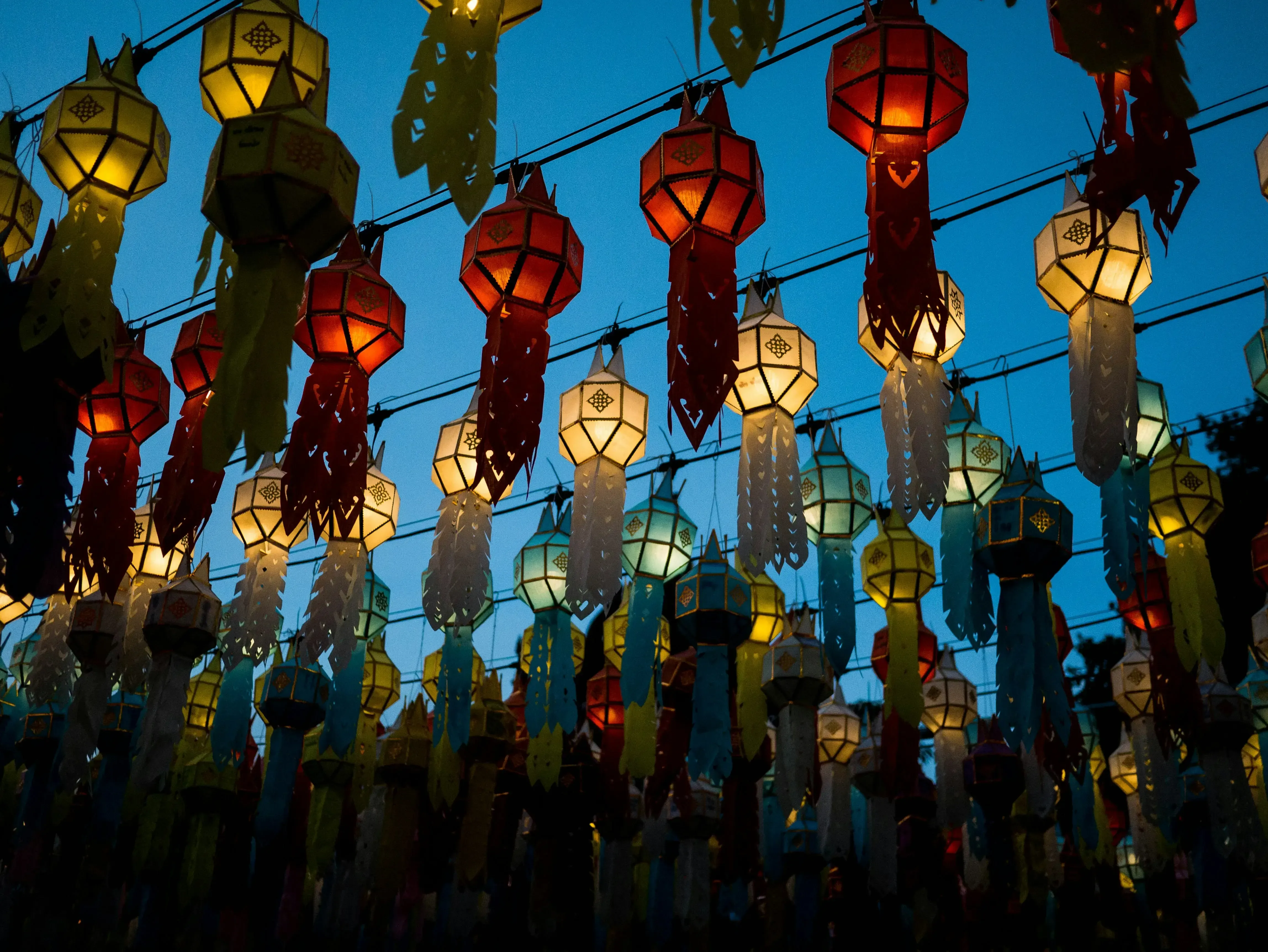
Chiang Mai moves at a different rhythm from Bangkok.
The noise softens first. The traffic thins. Temple bells replace the constant hum of sky trains and motorbikes. Mountains appear beyond the city walls, jungle air drifts through cafés, and mornings begin with monks collecting alms beneath golden temple roofs. After Bangkok’s intensity, Chiang Mai can feel almost meditative — though beneath the calm surface is one of Thailand’s most creative, culturally rich, and quietly addictive cities.
Founded in 1296 as the capital of the ancient Lanna Kingdom, Chiang Mai still carries traces of its independent northern identity. The old city remains surrounded by fragments of medieval walls and moats. Hundreds of Buddhist temples sit between coffee shops, craft stores, markets, and hidden courtyards. Traditional wood-carving workshops coexist beside digital nomad cafés and contemporary art spaces. The result feels less polished than Bangkok and far more intimate.
And then there’s the setting.
Northern Thailand surrounds Chiang Mai with mountains, waterfalls, forests, rice fields, and winding roads leading toward villages near the Myanmar border. The city has become a gateway not only to temples and street food, but to trekking routes, elephant sanctuaries, jungle landscapes, and slower forms of travel increasingly difficult to find elsewhere in Southeast Asia.
For many travelers, Chiang Mai becomes the place they planned to stay three days and accidentally stayed three weeks.
The atmosphere encourages it.
Mornings begin slowly with coffee and mountain air. Afternoons disappear inside temple courtyards or local markets. Evenings fill with lantern-lit streets, night bazaars, jazz bars, and northern Thai food served at plastic tables beneath hanging lights.
Chiang Mai doesn’t overwhelm people the way Bangkok can.
It wins them over gradually instead.

Getting to Chiang Mai
By Air
Chiang Mai International Airport (CNX) sits just 15 minutes southwest of the Old City and serves as northern Thailand’s main aviation hub.
Direct domestic flights connect Chiang Mai with Bangkok, Phuket, Krabi, Koh Samui, and other major Thai destinations. International routes link the city with Singapore, Kuala Lumpur, Seoul, Taipei, Hong Kong, and several Chinese cities.
Worth knowing: Chiang Mai’s airport is compact, efficient, and significantly easier to navigate than Bangkok’s major airports.
By Train
The overnight train from Bangkok to Chiang Mai remains one of Thailand’s classic travel experiences — sleeper cabins, countryside views, and a slower arrival into northern Thailand.
Journey time averages 11–13 hours depending on service type.
By Road
Long-distance buses connect Chiang Mai with Bangkok and surrounding northern provinces, though mountain routes can become winding and slow.
Arriving in Chiang Mai: What to Expect
Chiang Mai Airport is relaxed compared with larger Southeast Asian hubs.
By Taxi & Ride Apps
Taxis and Grab rides are available directly outside arrivals and provide affordable access to most parts of the city.
By Songthaew
The city’s iconic red shared trucks — called songthaews — operate throughout Chiang Mai as informal shared transport.
By Private Transfer
A Kiwitaxi private transfer from Chiang Mai Airport offers fixed pricing, direct hotel drop-off, and an especially smooth arrival for travelers heading toward mountain resorts, wellness retreats, or quieter areas outside the Old City.
Getting Around Chiang Mai
Chiang Mai is manageable, compact, and far easier to navigate than Bangkok.
Walking
The Old City is highly walkable, especially during cooler mornings and evenings.
Scooters
Scooters remain one of the most popular ways to explore Chiang Mai and surrounding countryside, though mountain roads require confidence and caution.
Songthaews
These shared red pickup taxis function almost like Chiang Mai’s unofficial public transport network.
Grab & Private Drivers
Grab operates widely across the city, while private drivers become useful for waterfalls, mountain temples, and countryside day trips.
Best Time to Visit Chiang Mai
November to February
The ideal season — cooler temperatures, dry weather, mountain visibility, and comfortable conditions for outdoor exploration.
March to April
The hottest period and also northern Thailand’s “burning season,” when agricultural smoke can affect air quality significantly.
May to October
Rainy season transforms northern Thailand into vivid green landscapes. Afternoon storms become common, but crowds thin and waterfalls become especially dramatic.
November Festival Season
The Yi Peng and Loy Krathong lantern festivals transform Chiang Mai into one of Southeast Asia’s most visually extraordinary destinations.
Where to Stay in Chiang Mai
Old City
Temples, cafés, markets, and historic streets within the ancient city walls. Ideal for first-time visitors.
Nimmanhaemin (Nimman)
Modern Chiang Mai — specialty coffee, coworking spaces, boutique hotels, restaurants, and younger creative energy.
Riverside
A quieter atmosphere beside the Ping River with boutique hotels and slower evenings.
Mountains & Jungle Retreats
Eco-lodges, wellness resorts, and secluded villas outside the city surrounded by forests and rice fields.

Best Things to Do in Chiang Mai
Visit Wat Phra That Doi Suthep
Wat Phra That Doi Suthep sits high above the city overlooking northern Thailand from forested mountainsides.
The golden stupa, temple bells, jungle surroundings, and panoramic city views make it Chiang Mai’s most iconic temple.
Explore the Old City Temples
Chiang Mai contains hundreds of temples, many hidden quietly between cafés and residential streets.
Wat Chedi Luang and Wat Phra Singh remain among the city’s most important historic sites.
Visit the Night Markets
Chiang Mai’s night markets combine street food, handmade crafts, textiles, lanterns, live music, and local art into some of Thailand’s most atmospheric evening experiences.
Try Northern Thai Cuisine
Northern Thai food differs noticeably from Bangkok cuisine — richer curries, smoky grilled meats, fermented flavors, and dishes influenced by neighboring Myanmar and Laos.
Khao soi — creamy curry noodle soup topped with crispy noodles — is the city’s signature dish and worth trying repeatedly.
Visit an Ethical Elephant Sanctuary
Several sanctuaries outside Chiang Mai focus on rescue and rehabilitation rather than elephant riding.
Choosing responsible sanctuaries carefully matters significantly here.
Explore Doi Inthanon National Park
Doi Inthanon National Park contains Thailand’s highest mountain alongside waterfalls, jungle trails, cloud forests, and hill tribe villages.
Cool mountain air makes it feel entirely different from southern Thailand.
Take a Thai Cooking Class
Cooking schools across Chiang Mai teach visitors how to prepare curries, noodle dishes, herbal soups, and traditional Thai desserts using ingredients sourced from local markets.
Experience Chiang Mai’s Café Culture
The city quietly developed one of Southeast Asia’s strongest café scenes — mountain-grown coffee, minimalist design spaces, jungle cafés, and slower mornings built around coffee culture.
Food & Drink in Chiang Mai
Chiang Mai’s food culture blends northern Thai traditions with modern creative influences.
Khao soi, sai ua sausage, sticky rice, chili dips, grilled pork, herbal soups, and mango sticky rice dominate local menus.
Street food remains central to daily life, especially around markets and temple districts.
Coffee culture has also exploded in recent years thanks to northern Thailand’s growing mountain coffee industry.
Day Trips from Chiang Mai with Kiwitaxi
Chiang Rai & the White Temple
Wat Rong Khun — known as the White Temple — combines surreal contemporary art with Buddhist symbolism unlike anywhere else in Thailand.
Pai
Mountain roads, waterfalls, hot springs, cafés, and backpacker culture define this small northern town approximately three hours from Chiang Mai.
Mae Kampong
A peaceful mountain village surrounded by forests, tea houses, and waterfalls.
Golden Triangle
The historic meeting point of Thailand, Laos, and Myanmar beside the Mekong River.
Kiwitaxi private transfers simplify northern Thailand routes significantly, especially for travelers combining multiple mountain regions or continuing toward Laos.
Practical Notes for Visiting Chiang Mai
The Thai baht (THB) is the local currency. Card payment is common in cafés and hotels, though markets and smaller businesses often prefer cash.
Temples require respectful clothing covering shoulders and knees.
Chiang Mai’s pace is noticeably slower than Bangkok’s — socially, culturally, and logistically.
The city attracts large digital nomad and long-term traveler communities, especially around Nimman.
Mornings and evenings can become surprisingly cool during winter months in northern Thailand.
Chiang Mai rarely tries to impress people loudly.
Instead, it becomes memorable through atmosphere — temple incense drifting through morning streets, mountain sunsets beyond café rooftops, lanterns glowing at night markets, and the feeling that time here moves slightly differently than everywhere else around it.

Best Picks for True Adventurers


Looking for an Airport Transfer in Bangkok?
Private airport transfers with fixed prices, flight tracking, and a driver waiting when you land.
Book a transferExplore All Guides
Barcelona Neighborhoods Guide: Where to Stay & What to Expect in Each Barrio

Discover Paris: A Guide to Iconic Landmarks, Historic Cafés & Legendary Stores

Osaka Travel Guide: Top Things to Do & Food Spots

First-Timer's Japan Handbook: 10 Essential Travel Tips + Etiquette FAQ

Rome in a Day & 3 Days in Rome: The Ultimate Itineraries for Every Traveler

Barcelona Airport to Gothic Quarter: Fastest Transfer Options, Prices & Travel Tips

Ultimate Japan Itineraries: Discover the Best of Japan in 7 or 14 Days

More than the Eiffel Tower: Best Things to Do In Paris

Best hotels in Albania: Tirana, Saranda, Vlorë & Durres

Rome: La Dolce Vita in Every Corner — travel guide by Olivia (@doinglifewithliv)

Barcelona Airport to Sagrada Família: Best Transfer Options, Prices & Travel Times

Paris Food Guide: Eiffel Tower View Restaurants & Rooftop Dining

18 Things You Need to Know Before Visiting Croatia

10 Unforgettable Day Trips from Rome, Italy: Ancient Towns, Best Beaches & Countryside Escapes
A Taste of Florence: Your Complete Food Guide

Best Day Trips from Milan with a Private Driver: Lake Como, Verona & Beyond

10 Best Holiday Alternatives to the Middle East for Spring 2026

Best Things to Do Around the Colosseum: Rome Attractions, Tours & Insider Tips

Barcelona vs Madrid: Which City Is Better to Visit in Spain?

Barcelona: Hidden Bites, Secret Sips & Sunshine Tips by Nancy Sevilla

Best eSIM for Japan 2026

Budapest Travel Tips: Beyond the Obvious

Best Hotels in Rome for Every Budget: Luxury, Boutique & Budget Stays

Cinque Terre Travel Guide: Best Villages & Trails

Best Wine Tours from Milan: Franciacorta, Valpolicella & Chauffeur Hire
Milan to Verona Day Trip with a Chauffeur

South Korea Travel Guide: Best Cultural, Beauty & Wellness Experiences in Seoul, Busan & Jeonju

Best Things to Do in Singapore: Food, Views & Hidden Gems

Free eSIM Trial: Where to Get Free Data

Hoi An Travel Guide: Hidden Gems, Spas & Local Experiences

Santorini Travel Guide: Sunsets, Cruises & Wine

3 Days in Northern Spain: Bilbao, the Cantabrian Coast & Santander

Best eSim for Europe: One Card for 30+ Countries

Best eSim for Mexico: Stay Connected on Your Trip

How to Get from Lisbon to Porto (2026): Train, Bus, Car, or Flight?

How to Get from London to Madeira: Complete Guide (2026)

How to Get from Beauvais Airport to Paris

Paris on a Budget: Affordable Hotels, Shopping & Free Things to Do

Top 12 Things to Do in Albania: Ultimate Travel Guide

Where to Stay in the Albanian Riviera: Best Hotels & Areas
Kyoto Travel Guide: Journey to the Heart of Old Japan
