'%3e%3cpath%20d='M43.073%200.00649261H15.0943V3.94346H43.073V0.00649261Z'%20fill='url(%23kiwitaxi-grad)'%20/%3e%3cpath%20d='M15.0828%203.94346C16.1928%203.94346%2017.0512%203.06513%2017.0512%201.97497C17.0512%200.874164%2016.1822%200.00649261%2015.0828%200.00649261C14.0362%200.00649261%2013.1379%200.851916%2013.1379%201.97497C13.1379%203.10916%2014.0478%203.94346%2015.0828%203.94346Z'%20fill='white'%20/%3e%3cpath%20d='M43.0614%203.94346C44.1715%203.94346%2045.0299%203.06513%2045.0299%201.97497C45.0299%200.874164%2044.1609%200.00649261%2043.0614%200.00649261C42.0149%200.00649261%2041.1166%200.851916%2041.1166%201.97497C41.1166%203.10916%2042.0265%203.94346%2043.0614%203.94346Z'%20fill='white'%20/%3e%3cpath%20d='M19.5921%2038.5052V39.828H23.1471V26.0491H19.5921V27.3446C18.895%2026.5789%2017.4549%2025.8841%2015.7339%2025.8841C11.8502%2025.8841%208.78975%2028.7578%208.78975%2032.939C8.78975%2037.1374%2011.8702%2039.9935%2015.7339%2039.9935C17.4938%2039.9935%2018.932%2039.2691%2019.5921%2038.5052ZM12.2892%2032.939C12.2892%2030.5715%2013.929%2029.1912%2015.9819%2029.1912C18.0106%2029.1912%2019.5647%2030.5845%2019.5647%2032.939C19.5647%2035.2579%2017.9768%2036.6869%2015.9823%2036.6869C13.9596%2036.6869%2012.2892%2035.264%2012.2892%2032.939Z'%20fill='white'%20/%3e%3cpath%20d='M44.7174%2026.0496H41.4289V39.8281H44.7174V26.0496Z'%20fill='white'%20/%3e%3cpath%20d='M32.2183%2035.7001L29.3455%2039.8281H24.94L30.044%2032.8552L25.1624%2026.0496H29.7075L32.3295%2029.8985L35.035%2026.0496H39.4405L34.5599%2032.7435L39.6361%2039.8281H35.1189L32.2183%2035.7001Z'%20fill='white'%20/%3e%3cpath%20d='M3.34504%2022.9604V26.0496H7.4039V29.0939H3.34504V34.2781C3.34504%2035.9866%204.33971%2036.7008%205.955%2036.7008C6.54504%2036.7008%207.16659%2036.5766%207.63241%2036.235V39.4341C7.04237%2039.7757%206.14133%2039.9931%204.89915%2039.9931C1.8243%2039.9931%200.0226746%2038.1293%200.0226746%2034.9298V22.96H3.34504Z'%20fill='white'%20/%3e%3cpath%20d='M36.2094%208.57428L33.307%2016.8723L30.43%208.57428H27.7621L24.8597%2016.8723L21.9828%208.57428H18.4884L23.2157%2021.4188H26.5037L29.084%2014.4093L31.6629%2021.4188H34.951L39.6782%208.57428H36.2094Z'%20fill='white'%20/%3e%3cpath%20d='M44.7174%208.57381H41.4289V21.4188H44.7174V8.57381Z'%20fill='white'%20/%3e%3cpath%20d='M16.7387%208.57381H13.4502V21.4188H16.7387V8.57381Z'%20fill='white'%20/%3e%3cpath%20d='M11.7001%208.57382L6.07922%2014.1326L12.1622%2021.4188H8.05929L3.92163%2016.28L3.3455%2016.8538V21.4188H0.0226746V3.94299H3.3455V12.7574L7.59764%208.57382H11.7001Z'%20fill='white'%20/%3e%3c/g%3e%3cdefs%3e%3clinearGradient%20id='kiwitaxi-grad'%20x1='15.0945'%20y1='1.97497'%20x2='43.073'%20y2='1.97497'%20gradientUnits='userSpaceOnUse'%3e%3cstop%20stop-color='%2300D2CD'%20stop-opacity='0'%20/%3e%3cstop%20offset='1'%20stop-color='%2300D2CD'%20/%3e%3c/linearGradient%3e%3cclipPath%20id='kiwitaxi-clip'%3e%3crect%20width='46'%20height='40'%20fill='white'%20/%3e%3c/clipPath%3e%3c/defs%3e%3c/svg%3e)


Cambodia feels ancient in a way few places still do.
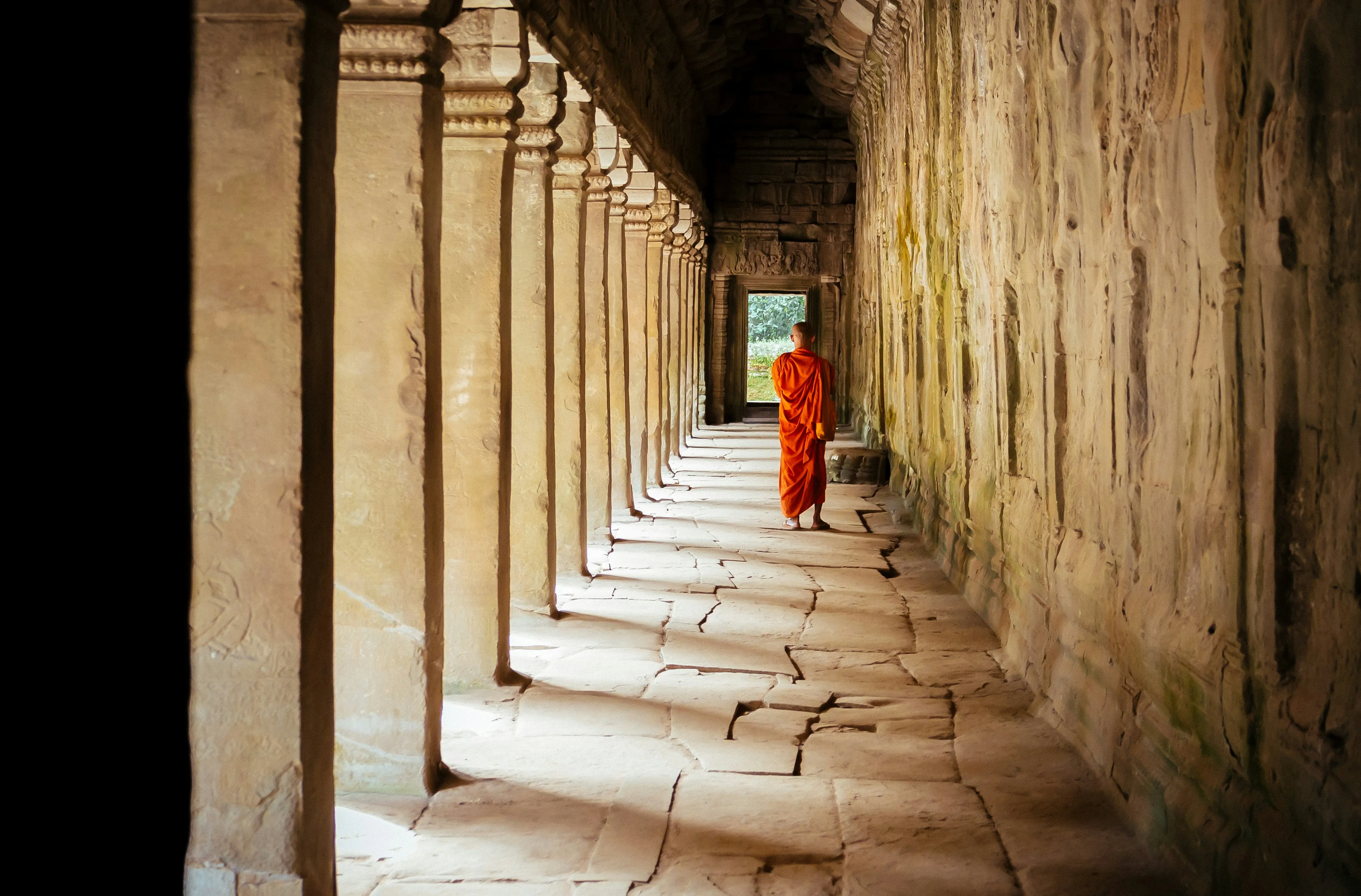
Not simply old — ancient. Temple stones worn smooth by centuries of rain. Banyan roots swallowing forgotten walls. Monks in saffron robes walking quietly past markets buzzing with scooters and street vendors. Sunrise arriving slowly over jungle temples while mist rises from surrounding forests. Somewhere between the Mekong River, the ruins of the Khmer Empire, tropical islands, and crowded city streets, Cambodia carries both beauty and memory with unusual intensity.
For many travelers, the country begins with Angkor Wat — one of the world’s greatest archaeological sites and the surviving heart of the Khmer Empire. But Cambodia reveals itself gradually beyond the temples. Floating villages drift across Tonlé Sap Lake. Colonial buildings remain in quiet provincial towns. Rice fields stretch endlessly beneath palm trees. Phnom Penh moves with restless energy beside the Mekong, balancing creativity, nightlife, history, and difficult reminders of the country’s past.
And throughout it all, there is the atmosphere people remember most: warmth.
Cambodian hospitality tends to feel gentle rather than performative — calm smiles, soft voices, patient conversations, and a pace of life that often slows visitors down without them fully realizing it.
Historically, Cambodia was once the center of one of Southeast Asia’s most powerful civilizations. Between the 9th and 15th centuries, the Khmer Empire controlled large parts of modern Thailand, Laos, and Vietnam, leaving behind monumental temple complexes unlike anything else in the region. Centuries later came colonial rule, civil war, and the devastating Khmer Rouge period of the 1970s — history still visible in memorials and museums today.
But modern Cambodia is not defined solely by tragedy. The country feels young, energetic, creative, and increasingly connected to the wider world while still deeply rooted in tradition.
Two weeks in Cambodia allows you to combine temples, rivers, cities, beaches, and rural landscapes into one remarkably varied journey.

Getting to Cambodia
By Air
Phnom Penh International Airport (PNH) and Siem Reap–Angkor International Airport (SAI) serve as Cambodia’s primary international gateways.
Direct flights connect Cambodia with Bangkok, Singapore, Kuala Lumpur, Ho Chi Minh City, Seoul, Hong Kong, Doha, and several major Asian hubs. Most long-haul visitors connect through Southeast Asia or the Middle East.
Worth knowing: Siem Reap is often the easiest arrival point for travelers primarily visiting Angkor temples.
By Land
Cambodia also connects overland with Thailand, Vietnam, and Laos through international border crossings popular among backpackers and regional travelers.
Arriving in Cambodia: What to Expect
Airports are generally manageable, though visa procedures can take time depending on arrival volume.
By Taxi & Tuk-Tuk
Tuk-tuks remain one of Cambodia’s defining transport experiences and are widely available in both Phnom Penh and Siem Reap.
By Private Transfer
A Kiwitaxi private transfer from Cambodian airports provides fixed pricing, direct hotel drop-off, and a smoother arrival experience — particularly valuable after long-haul flights, late-night arrivals, or transfers toward beach regions and smaller towns.
Getting Around Cambodia
Travel in Cambodia often takes longer than distances initially suggest, but the journeys themselves become part of the experience.
Tuk-Tuks
The country’s most iconic local transport — open-air, affordable, and ideal for shorter urban journeys or temple exploration.
Domestic Flights
Flights connect Phnom Penh, Siem Reap, and coastal areas quickly for travelers with limited time.
Buses & Minivans
Long-distance buses and vans connect major tourist routes throughout the country.
Private Drivers
Hiring private drivers becomes especially useful for temple circuits, countryside routes, and multi-stop itineraries.
Best Time to Visit Cambodia
November to February
The best overall season — dry weather, lower humidity, and comfortable temperatures for sightseeing and outdoor exploration.
March to May
The hottest period of the year, particularly around temple sites where midday heat can become intense.
June to October
Rainy season transforms the countryside into vivid green landscapes. Tropical showers arrive regularly but often briefly, and major sites become less crowded.

Where to Stay in Cambodia
Siem Reap
Gateway to Angkor temples — relaxed atmosphere, cafés, markets, nightlife, and easy access to archaeological sites.
Phnom Penh
Cambodia’s energetic capital — riverfront life, museums, nightlife, markets, and layered modern history.
Kep & Kampot
Slower coastal towns known for seafood, riverside cafés, pepper plantations, and relaxed atmosphere.
Koh Rong & Southern Islands
White-sand beaches, turquoise water, diving, and tropical island life off Cambodia’s southern coast.
Best Things to Do in Cambodia
Watch Sunrise at Angkor Wat
Angkor Wat remains one of the world’s most extraordinary religious monuments — enormous temple towers reflected in lotus ponds while sunrise gradually lights the stone carvings.
The scale feels almost impossible until you stand beneath it.
Explore Ta Prohm
Ta Prohm became famous for giant tree roots growing through temple ruins, creating one of Southeast Asia’s most cinematic landscapes.
Nature and architecture seem locked together permanently.
Visit Bayon Temple
Bayon is known for its massive stone faces watching silently from temple towers in every direction.
The expressions appear calm, mysterious, and slightly unsettling all at once.
Walk Phnom Penh’s Riverside
The Mekong and Tonlé Sap rivers shape life in Cambodia’s capital — cafés, markets, temples, ferries, and evening walks unfolding beside the water.
Visit the Royal Palace
Royal Palace of Cambodia combines Khmer architecture, golden rooftops, gardens, and ceremonial halls still used by the Cambodian royal family.
Learn Cambodia’s Modern History
Tuol Sleng Genocide Museum and the Choeung Ek memorial sites offer difficult but important insight into Cambodia’s recent past and the Khmer Rouge era.
Experience Cambodian Markets
Markets remain central to Cambodian daily life — textiles, spices, fruit, grilled seafood, silver jewelry, coffee, and street food all filling crowded aisles from morning until late evening.
Relax on Cambodia’s Islands
Southern islands like Koh Rong combine jungle interiors, bioluminescent water, diving, and quieter beaches than many neighboring Southeast Asian destinations.
Food & Drink in Cambodia
Cambodian cuisine often surprises visitors with its freshness and balance.
Amok curry, grilled river fish, green mango salad, noodle soups, fresh herbs, tropical fruit, and pepper crab from Kep represent some of the country’s most recognizable dishes.
French colonial influence still appears in baguettes, pastries, and café culture, especially in Phnom Penh and Kampot.
Street food culture remains deeply woven into daily life throughout the country.

Day Trips & Regional Routes with Kiwitaxi
Tonlé Sap Lake
Floating villages, stilt houses, fishing communities, and seasonal landscapes changing dramatically throughout the year.
Battambang
Colonial architecture, countryside temples, rice fields, and Cambodia’s slower rural atmosphere.
Kampot & Kep
Pepper plantations, seafood markets, riverside sunsets, and access to southern coastal landscapes.
Phnom Kulen National Park
Waterfalls, jungle temples, sacred rivers, and mountain scenery north of Siem Reap.
Kiwitaxi chauffeur hire service simplify longer regional routes significantly, especially when combining multiple Cambodian destinations or cross-border travel toward Thailand and Vietnam.
Practical Notes for Visiting Cambodia
The Cambodian riel (KHR) is the official currency, though US dollars are widely used throughout the country.
Cash remains important outside major hotels and upscale restaurants.
Temples require modest clothing — shoulders and knees should generally be covered.
Cambodia’s climate is tropical year-round, meaning heat and humidity remain part of daily travel life.
English is commonly spoken in major tourist areas, especially among younger Cambodians.
Cambodia leaves an impression that tends to linger longer than expected.
Partly because of the temples. Partly because of the history.
But mostly because the country feels deeply human — open, resilient, complicated, beautiful, and impossible to reduce to only one story.
Explore Cambodia Guides

Kiwitaxi Airport Transfers
Land. Meet your driver. Go. Skip taxi lines and travel stress after your flight. With Kiwitaxi, your airport transfer is already arranged. Fixed prices, professional drivers, and service in 100+ countries - so your trip starts smoothly from the moment you land.
Book a transferExplore All Guides
Barcelona Neighborhoods Guide: Where to Stay & What to Expect in Each Barrio

Discover Paris: A Guide to Iconic Landmarks, Historic Cafés & Legendary Stores

Osaka Travel Guide: Top Things to Do & Food Spots

First-Timer's Japan Handbook: 10 Essential Travel Tips + Etiquette FAQ

Rome in a Day & 3 Days in Rome: The Ultimate Itineraries for Every Traveler

Barcelona Airport to Gothic Quarter: Fastest Transfer Options, Prices & Travel Tips

Ultimate Japan Itineraries: Discover the Best of Japan in 7 or 14 Days

More than the Eiffel Tower: Best Things to Do In Paris

Best hotels in Albania: Tirana, Saranda, Vlorë & Durres

Rome: La Dolce Vita in Every Corner — travel guide by Olivia (@doinglifewithliv)

Barcelona Airport to Sagrada Família: Best Transfer Options, Prices & Travel Times

Paris Food Guide: Eiffel Tower View Restaurants & Rooftop Dining

18 Things You Need to Know Before Visiting Croatia

10 Unforgettable Day Trips from Rome, Italy: Ancient Towns, Best Beaches & Countryside Escapes
A Taste of Florence: Your Complete Food Guide

Best Day Trips from Milan with a Private Driver: Lake Como, Verona & Beyond

10 Best Holiday Alternatives to the Middle East for Spring 2026

Best Things to Do Around the Colosseum: Rome Attractions, Tours & Insider Tips

Barcelona vs Madrid: Which City Is Better to Visit in Spain?

Barcelona: Hidden Bites, Secret Sips & Sunshine Tips by Nancy Sevilla

Best eSIM for Japan 2026

Budapest Travel Tips: Beyond the Obvious

Best Hotels in Rome for Every Budget: Luxury, Boutique & Budget Stays

Cinque Terre Travel Guide: Best Villages & Trails

Best Wine Tours from Milan: Franciacorta, Valpolicella & Chauffeur Hire
Milan to Verona Day Trip with a Chauffeur

South Korea Travel Guide: Best Cultural, Beauty & Wellness Experiences in Seoul, Busan & Jeonju

Best Things to Do in Singapore: Food, Views & Hidden Gems

Free eSIM Trial: Where to Get Free Data

Hoi An Travel Guide: Hidden Gems, Spas & Local Experiences

Santorini Travel Guide: Sunsets, Cruises & Wine

3 Days in Northern Spain: Bilbao, the Cantabrian Coast & Santander

Best eSim for Europe: One Card for 30+ Countries

Best eSim for Mexico: Stay Connected on Your Trip

How to Get from Lisbon to Porto (2026): Train, Bus, Car, or Flight?

How to Get from London to Madeira: Complete Guide (2026)

How to Get from Beauvais Airport to Paris

Paris on a Budget: Affordable Hotels, Shopping & Free Things to Do

Top 12 Things to Do in Albania: Ultimate Travel Guide

Where to Stay in the Albanian Riviera: Best Hotels & Areas
Kyoto Travel Guide: Journey to the Heart of Old Japan
