'%3e%3cpath%20d='M43.073%200.00649261H15.0943V3.94346H43.073V0.00649261Z'%20fill='url(%23kiwitaxi-grad)'%20/%3e%3cpath%20d='M15.0828%203.94346C16.1928%203.94346%2017.0512%203.06513%2017.0512%201.97497C17.0512%200.874164%2016.1822%200.00649261%2015.0828%200.00649261C14.0362%200.00649261%2013.1379%200.851916%2013.1379%201.97497C13.1379%203.10916%2014.0478%203.94346%2015.0828%203.94346Z'%20fill='white'%20/%3e%3cpath%20d='M43.0614%203.94346C44.1715%203.94346%2045.0299%203.06513%2045.0299%201.97497C45.0299%200.874164%2044.1609%200.00649261%2043.0614%200.00649261C42.0149%200.00649261%2041.1166%200.851916%2041.1166%201.97497C41.1166%203.10916%2042.0265%203.94346%2043.0614%203.94346Z'%20fill='white'%20/%3e%3cpath%20d='M19.5921%2038.5052V39.828H23.1471V26.0491H19.5921V27.3446C18.895%2026.5789%2017.4549%2025.8841%2015.7339%2025.8841C11.8502%2025.8841%208.78975%2028.7578%208.78975%2032.939C8.78975%2037.1374%2011.8702%2039.9935%2015.7339%2039.9935C17.4938%2039.9935%2018.932%2039.2691%2019.5921%2038.5052ZM12.2892%2032.939C12.2892%2030.5715%2013.929%2029.1912%2015.9819%2029.1912C18.0106%2029.1912%2019.5647%2030.5845%2019.5647%2032.939C19.5647%2035.2579%2017.9768%2036.6869%2015.9823%2036.6869C13.9596%2036.6869%2012.2892%2035.264%2012.2892%2032.939Z'%20fill='white'%20/%3e%3cpath%20d='M44.7174%2026.0496H41.4289V39.8281H44.7174V26.0496Z'%20fill='white'%20/%3e%3cpath%20d='M32.2183%2035.7001L29.3455%2039.8281H24.94L30.044%2032.8552L25.1624%2026.0496H29.7075L32.3295%2029.8985L35.035%2026.0496H39.4405L34.5599%2032.7435L39.6361%2039.8281H35.1189L32.2183%2035.7001Z'%20fill='white'%20/%3e%3cpath%20d='M3.34504%2022.9604V26.0496H7.4039V29.0939H3.34504V34.2781C3.34504%2035.9866%204.33971%2036.7008%205.955%2036.7008C6.54504%2036.7008%207.16659%2036.5766%207.63241%2036.235V39.4341C7.04237%2039.7757%206.14133%2039.9931%204.89915%2039.9931C1.8243%2039.9931%200.0226746%2038.1293%200.0226746%2034.9298V22.96H3.34504Z'%20fill='white'%20/%3e%3cpath%20d='M36.2094%208.57428L33.307%2016.8723L30.43%208.57428H27.7621L24.8597%2016.8723L21.9828%208.57428H18.4884L23.2157%2021.4188H26.5037L29.084%2014.4093L31.6629%2021.4188H34.951L39.6782%208.57428H36.2094Z'%20fill='white'%20/%3e%3cpath%20d='M44.7174%208.57381H41.4289V21.4188H44.7174V8.57381Z'%20fill='white'%20/%3e%3cpath%20d='M16.7387%208.57381H13.4502V21.4188H16.7387V8.57381Z'%20fill='white'%20/%3e%3cpath%20d='M11.7001%208.57382L6.07922%2014.1326L12.1622%2021.4188H8.05929L3.92163%2016.28L3.3455%2016.8538V21.4188H0.0226746V3.94299H3.3455V12.7574L7.59764%208.57382H11.7001Z'%20fill='white'%20/%3e%3c/g%3e%3cdefs%3e%3clinearGradient%20id='kiwitaxi-grad'%20x1='15.0945'%20y1='1.97497'%20x2='43.073'%20y2='1.97497'%20gradientUnits='userSpaceOnUse'%3e%3cstop%20stop-color='%2300D2CD'%20stop-opacity='0'%20/%3e%3cstop%20offset='1'%20stop-color='%2300D2CD'%20/%3e%3c/linearGradient%3e%3cclipPath%20id='kiwitaxi-clip'%3e%3crect%20width='46'%20height='40'%20fill='white'%20/%3e%3c/clipPath%3e%3c/defs%3e%3c/svg%3e)

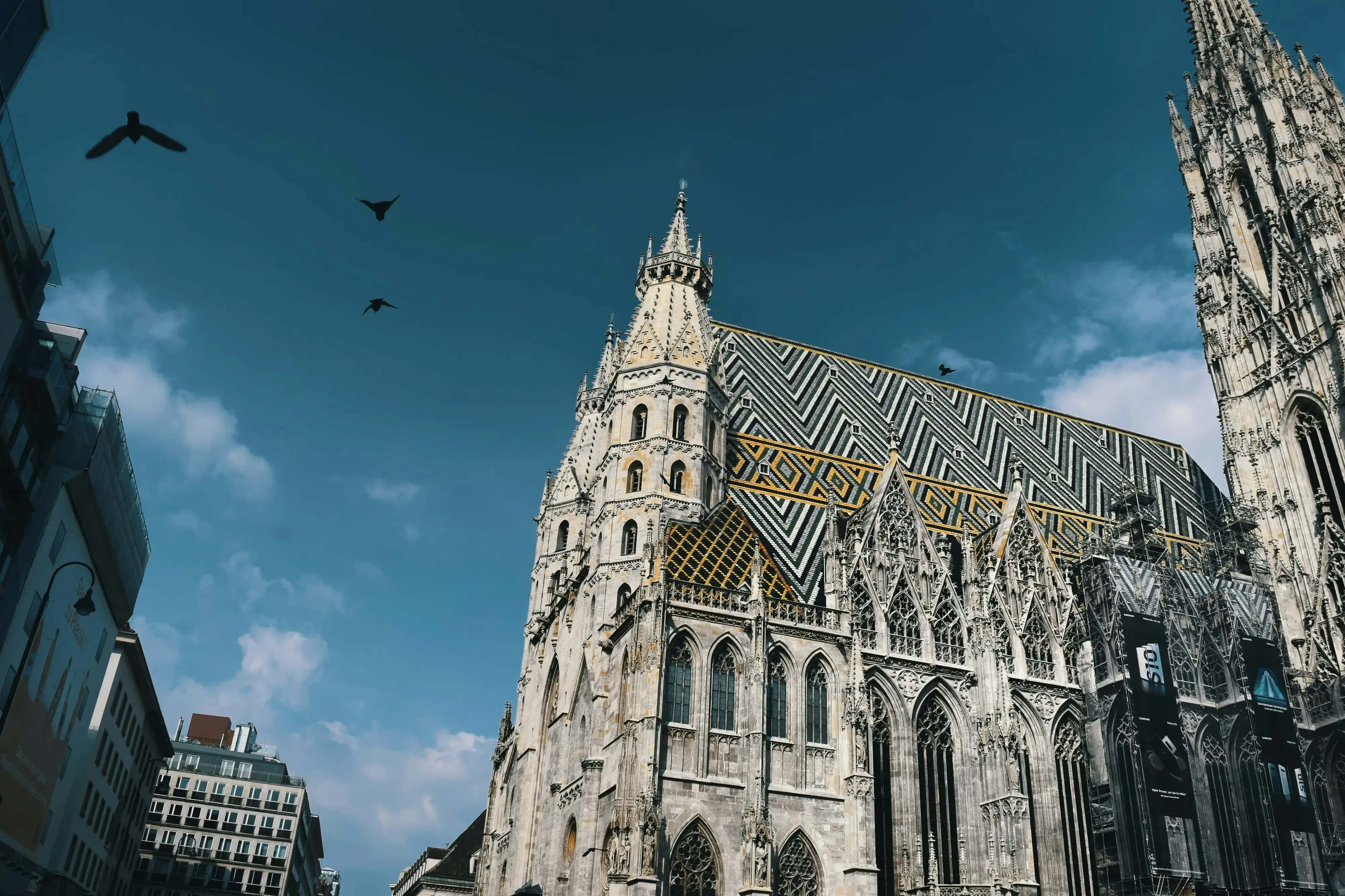
Vienna operates at its own frequency. Other European capitals rush; Vienna deliberates. It is a city of coffee consumed slowly, of concert halls taken seriously, of palaces that were built to impress and have not stopped. The Ringstrasse alone — the circular boulevard of museums, opera houses, and parliament buildings commissioned by Emperor Franz Joseph in the 1860s — would be enough to anchor most cities for a century. Vienna built it and then kept going.
But beneath the imperial grandeur is something more livable than the postcard suggests. The Naschmarkt fills with shoppers and conversation on Saturday mornings. The Heurigen wine taverns on the city's northern slopes fill with locals on summer evenings. The Prater park, with its ancient chestnut trees and the 1897 Ferris wheel rising above them, is simply where people go to walk. Vienna is one of the most consistently ranked cities in the world for quality of life — not because it performs well, but because it genuinely is.
It is also one of the best-positioned cities in Central Europe for leaving. The Alps, the Danube Valley, a Slovak capital, and a Hungarian one all sit within a few hours in different directions. Vienna is, almost uniquely among major European cities, as compelling to stay in as it is to use as a base.
Getting to Vienna
By Air
Vienna International Airport (VIE), also known as Schwechat, handles direct flights from across Europe, the Middle East, North America, and Asia. It sits approximately 18 km southeast of the city center. Austrian Airlines operates the majority of intercontinental routes alongside Lufthansa, British Airways, Emirates, Turkish Airlines, and most major European carriers. The airport is modern, well-organized, and straightforward to navigate.
By Train
Vienna Hauptbahnhof (Vienna HB) is Austria's primary rail hub and sits in the south of the city center, connected to the U-Bahn network. Fast Railjet services reach Salzburg in 2 hours 15 minutes, Graz in under an hour, and Innsbruck in 4 hours. International connections link Vienna to Munich (4h), Budapest (2h 30min), Prague (4h), and Warsaw (6h 30min). Nightjet sleeper trains connect Vienna to Paris, Rome, Hamburg, and Brussels — a civilized way to arrive.
By Road
Vienna connects to the Austrian motorway network and to neighboring Germany, Hungary, Slovakia, and the Czech Republic by road. Driving into the city center is manageable but rarely the most efficient choice — parking in the center is expensive and the public transport network makes a car largely unnecessary once you arrive. For airport arrivals or long-distance transfers with luggage, a pre-booked private transfer handles the 18 km to the center without the complications of parking or unfamiliar roads.

Arriving at Vienna Airport: What to Expect
VIE is well-signed and logistically smooth. Baggage claim is typically 20–30 minutes after landing. Three main options connect the airport to the city center.
By City Airport Train (CAT): The fastest option — a dedicated express service runs non-stop to Wien Mitte station in the city center in exactly 16 minutes. Tickets cost €14.90 one way. The CAT also offers city check-in at Wien Mitte for select airlines.
By S-Bahn (S7): The S7 regional train runs every 30 minutes between the airport and Wien Mitte, taking around 25 minutes and costing approximately €4.20 with a standard VOR ticket — the most economical public transport option.
By private transfer: For families, travelers with significant luggage, late-night arrivals, or anyone who wants to step off the plane and into a confirmed vehicle with a fixed price and a driver holding their name, a Kiwitaxi private transfer from Vienna Airport covers the full 18 km door to door. Child seats, pet-friendly vehicles, and larger vehicle classes are available on request.
Getting Around Vienna
Vienna's public transport network — operated by Wiener Linien — is one of Europe's most comprehensive. The U-Bahn (metro) has five lines covering the city center and most residential districts, running every few minutes during the day and every night on weekends. Trams cover the areas between metro stops with the same frequency and reliability. Night buses operate on all major routes until the U-Bahn resumes at 5 AM on weekdays.
A 24-hour ticket costs €8; a 72-hour ticket costs €17.10; the Vienna City Card (from €17 for 24 hours) adds museum discounts. For most visitors, a 72-hour ticket covers the entire stay and requires no further thought.
Walking is the best way to experience the Innere Stadt (the First District) and its immediate surroundings — the Ringstrasse, the Naschmarkt, the MuseumsQuartier, and the areas around the Belvedere. Distances are shorter than they appear on a map, and the streets between major landmarks reward the time spent in them.
For airport transfers, long-distance excursions, or day trips into the surrounding countryside where trains don't reach every destination, Kiwitaxi's private transfers and Chauffeur Hire service cover Vienna and the wider region with fixed pricing and flexible scheduling.

Best Time to Visit Vienna
Vienna has four genuinely distinct seasons, each with a reason to visit.
April to June is the most balanced time — mild temperatures between 15–22°C, the city's parks in full bloom, the Vienna Festival running through May and June with concerts and performances across the city, and hotel prices below the summer peak. The Prater's chestnut trees flower in April; the Schönbrunn gardens are at their best in May.
July and August is peak season: warm and occasionally hot, with temperatures reaching 28–32°C. The city is busiest and most expensive. The Vienna State Opera goes on summer break in July and August, which matters if classical music is the primary purpose of the visit — plan accordingly. That said, summer brings outdoor cinema, open-air concerts on the Rathausplatz, and long evenings that make sitting outside with a glass of Viennese white wine feel like exactly the right thing to do.
September and October is arguably the finest time of year. The opera and concert season restarts in September. The temperature drops to a comfortable 15–20°C. The Prater and Vienna Woods take on autumn color. Day trips to the Wachau Valley wine region are timed perfectly with the harvest season, when the Heurigen fill up and the new wine — Sturm, a semi-fermented young grape juice — appears in the city's wine taverns.
November to March brings cold temperatures and the city's legendary Christmas market season, which runs from mid-November through Christmas across multiple locations. New Year's Eve in Vienna — the Silvesterpfad concert route and the Vienna Philharmonic's New Year's Concert — is an institution. Winter outside the Christmas period is the city at its most intimate and least crowded.

Where to Stay in Vienna
Innere Stadt (First District) is the historic center — the Stephansdom, the Hofburg, the Ringstrasse, and the coffee houses that never entirely close. Staying here puts everything within walking distance and costs accordingly.
Leopoldstadt (Second District) sits across the Danube Canal from the First District and has shifted over the past decade from overlooked to genuinely desirable. The Prater is on the doorstep; the restaurants and bars along Praterstrasse are some of the city's most interesting; the neighborhood feels like Vienna without the tourist overlay.
Mariahilf and Neubau (Sixth and Seventh Districts) are the creative and commercial heart of the city west of the Ringstrasse — Mariahilfer Strasse for shopping, Neubau for independent boutiques, vintage stores, wine bars, and the MuseumsQuartier. Well connected and genuinely lively.
Josefstadt (Eighth District) is quieter and more residential — Biedermeier architecture, good independent restaurants, and a gentler pace. Preferred by returning visitors who have done the center.
Wieden (Fourth District) sits immediately south of the center with good access to the Naschmarkt, the Belvedere, and the U-Bahn. A practical and pleasant base without the First District prices.

Best Things to Do in Vienna
Visit Schönbrunn Palace The Habsburg summer residence sits at the western edge of the city and could absorb a full day without exhausting its contents. The palace itself — 1,441 rooms, though only a portion are open to visitors — is the obvious starting point, but the formal gardens stretching up the hill behind it to the Gloriette pavilion are equally worth the time. The view from the Gloriette back over the gardens, the palace, and Vienna beyond is one of the city's great panoramas. Go early on weekdays to avoid the worst of the crowds.
Walk the Ringstrasse The 5 km circular boulevard commissioned by Emperor Franz Joseph in 1857 lines up the Vienna State Opera, the Kunsthistorisches Museum, the Natural History Museum, the Parliament building, the City Hall, the Burgtheater, and the University in a single unbroken sequence of imperial ambition. Walking the full circuit takes around an hour and requires no ticket — the exterior architecture is the spectacle.
Explore the Kunsthistorisches Museum One of the great art museums of Europe, housed in a building that is itself a work of art. The collection centers on the Habsburg imperial collections — Bruegel, Vermeer, Raphael, Titian, Velázquez, and Caravaggio — alongside one of the world's finest collections of Egyptian antiquities and Greek and Roman artifacts. Allow at least three hours; more if the Egyptian collection interests you.
The Belvedere and Klimt's The Kiss The Upper Belvedere palace houses Austria's most visited artwork — Klimt's The Kiss — alongside a comprehensive collection of Austrian art from the Baroque through to early 20th century. The formal gardens between the Upper and Lower Belvedere are among the finest in Central Europe. The Lower Belvedere houses temporary exhibitions and the Orangery. Buy tickets in advance; queues for walk-ins are long in summer.
Spend a Morning at the Naschmarkt Vienna's main open-air market runs along the Wienzeile for over half a kilometer. On weekdays it is primarily a food market — cheese, olives, meat, fish, spices, and produce from Austria and the surrounding region. On Saturday mornings it expands into an antique and flea market that stretches back several hundred meters. Arrive before 11 AM for the best of it; the restaurants and Heurigen wine stands along the market operate from morning.
Attend a Performance at the Vienna State Opera The Staatsoper is one of the world's great opera houses and tickets, while expensive for premium seats, are available at accessible prices for standing room and certain upper-tier positions — a tradition the house takes seriously. The season runs September to June. Check the program at wiener-staatsoper.at and book well in advance for popular productions. Standing room tickets go on sale online 80 days before each performance.
Visit the MuseumsQuartier The former imperial stables converted into one of Europe's largest cultural complexes house the Leopold Museum (the world's largest collection of Egon Schiele), the Museum of Modern Art (mumok), the Kunsthalle, and a courtyard that fills with Viennese on warm evenings. The surrounding Neubau district — vintage shops, design studios, record stores, and independent restaurants — extends the day naturally once you leave the complex.
Sit in a Viennese Coffee House The Kaffeehauskultur of Vienna is not nostalgia — it is ongoing. The great coffee houses (Café Central, Café Landtmann, Café Schwarzenberg, Café Hawelka) are still operating as they have for over a century: marble tables, coat-hanging waiters, newspapers on wooden racks, and no expectation that you will leave before you are ready. Order a Melange (coffee with steamed milk), a slice of Apfelstrudel or Sachertorte, and allow the afternoon to happen around you.
Walk the Prater The Prater is a 3,000-hectare public park stretching east from the Danube Canal. Its main boulevard — the Hauptallee, a 4.5 km straight avenue of chestnut trees — is one of Vienna's great walks. The 1897 Riesenrad (the Giant Ferris Wheel) at the park's entrance has been turning for over 125 years. The Wurstelprater amusement park alongside it has been entertaining Viennese since the 18th century. The deeper Prater, away from the rides, is simply forest.
Explore the Hofburg The winter residence of the Habsburg emperors sprawls across the First District in a complex of connected wings, courtyards, and museums that took six centuries to accumulate. The Imperial Apartments, the Sisi Museum (devoted to Empress Elisabeth), and the Imperial Silver Collection are the most-visited sections. The Spanish Riding School — housed in the Hofburg's ceremonial Winter Riding Hall — runs training sessions and performances that can be booked in advance.

Day Trips from Vienna
Vienna's position at the center of Central Europe makes it one of the easiest cities on the continent to leave briefly and return to the same evening. The rail network connects to most major destinations efficiently; for countryside routes where the best places sit between stations, Kiwitaxi's Chauffeur Hire lets you set your own itinerary, stop when something earns it, and return to Vienna on your own schedule.
Bratislava, Slovakia — 60 minutes The Slovak capital is the most effortless international day trip from Vienna — an hour by regional train, a short walk from the station into an Old Town of pastel baroque buildings and pedestrianized squares. Bratislava Castle sits above the Danube with views across to Austria. The city is compact, walkable in a morning, and genuinely pleasant in a way that rewards taking it at face value rather than measuring it against larger expectations.
The Wachau Valley — 75 minutes The UNESCO-listed Danube Valley between Melk and Krems is the classic Vienna day trip for a reason. Vineyard terraces climb above the river, baroque monasteries crown the hilltops, and medieval towns line the banks. Melk Abbey is the centerpiece — a Benedictine monastery built on a river cliff that ranks among the great baroque buildings of Austria. Dürnstein, further east, offers a castle ruin above a river bend and one of the most photographed church towers in the country. The valley is best explored by car or private transfer — the key stops don't align with a single timetable, and the pleasure is in moving between them freely.
Salzburg — 2 hours 15 minutes Two and a quarter hours by fast train delivers one of Europe's most concentrated historic city centers. The Mirabell Gardens, the Hohensalzburg Fortress above the Old Town, the narrow Getreidegasse, and Mozart's birthplace occupy a compact area that rewards a full day of unhurried exploration. Pick two or three things rather than racing through everything — Salzburg is better slowly.
Hallstatt — 3 hours The alpine lake town that inspired a thousand photographs sits at the end of a longer journey than most day trips, but earns it. A village of painted houses on a thin strip of land between a steep mountain and a mirror-still lake, with the Dachstein glacier visible across the water. Go early, allow the full day, and consider staying overnight if the schedule permits — Hallstatt after the day-trip crowds depart is a different and considerably quieter experience.
Budapest, Hungary — 2 hours 30 minutes The Hungarian capital rewards an early start and honest prioritization. Choose the Buda Castle district and the Danube embankment, or the ruin bars and Great Market Hall of Pest — attempting both in a single day turns it into a march. Budapest is substantially more satisfying as an overnight, but a day visit still delivers an essential impression of one of Europe's genuinely great capitals.

Vienna on a Practical Note
Vienna uses the euro. Card payment is widely accepted, though some coffee houses and smaller restaurants remain cash-preferred — carry a small amount. The city is expensive by Central European standards but reasonable by Western European ones: a coffee in a café runs €3–5, a sit-down lunch €15–25, an opera ticket from €15 for standing room to €250 for premium seats.
Tipping works differently than in many countries — round up the bill or add around 10% for good service rather than leaving it on the table. Tell the server the total you want to pay when settling the bill.
Most major attractions require advance booking in summer — Schönbrunn, the Kunsthistorisches, the Spanish Riding School. Standing room for the opera goes on sale 80 days ahead. The Vienna Card offers discounts worth calculating if you plan to visit multiple museums.
German is the working language; English is spoken reliably across the tourist infrastructure and by most younger Viennese. A Grüß Gott (formal Austrian greeting) or Danke goes a long way with the generation that runs the coffee houses.

Landing in Vienna? Your Ride Is Ready
Pre-book your private driver, skip the taxi line, and get to your hotel with a fixed price and no surprises.
Book nowBest Picks: Europe

10 Unforgettable Day Trips from Rome, Italy: Ancient Towns, Best Beaches & Countryside Escapes

Discover Paris: A Guide to Iconic Landmarks, Historic Cafés & Legendary Stores

Best Day Trips from Milan with a Private Driver: Lake Como, Verona & Beyond

Swiss Alps Guide: Top Destinations & Things to Do

Budapest Travel Tips: Beyond the Obvious

How to Spend Your Munich Layover: Transport, Sights & Tips

Barcelona vs Madrid: Which City Is Better to Visit in Spain?

Best Wine Tours from Milan: Franciacorta, Valpolicella & Chauffeur Hire

18 Things You Need to Know Before Visiting Croatia

Venice Without the Crowds: An Escape Guide
1 Day in Tallinn: A Complete Itinerary With Hidden Gems & Local Spots

Private Chauffeur Service for Day Trips & Sightseeing
Your own driver, by the hour. No fixed routes. No surprises. Just a professional driver at your disposal - from 3 hours to multiple days.
Book a chauffeur