'%3e%3cpath%20d='M43.073%200.00649261H15.0943V3.94346H43.073V0.00649261Z'%20fill='url(%23kiwitaxi-grad)'%20/%3e%3cpath%20d='M15.0828%203.94346C16.1928%203.94346%2017.0512%203.06513%2017.0512%201.97497C17.0512%200.874164%2016.1822%200.00649261%2015.0828%200.00649261C14.0362%200.00649261%2013.1379%200.851916%2013.1379%201.97497C13.1379%203.10916%2014.0478%203.94346%2015.0828%203.94346Z'%20fill='white'%20/%3e%3cpath%20d='M43.0614%203.94346C44.1715%203.94346%2045.0299%203.06513%2045.0299%201.97497C45.0299%200.874164%2044.1609%200.00649261%2043.0614%200.00649261C42.0149%200.00649261%2041.1166%200.851916%2041.1166%201.97497C41.1166%203.10916%2042.0265%203.94346%2043.0614%203.94346Z'%20fill='white'%20/%3e%3cpath%20d='M19.5921%2038.5052V39.828H23.1471V26.0491H19.5921V27.3446C18.895%2026.5789%2017.4549%2025.8841%2015.7339%2025.8841C11.8502%2025.8841%208.78975%2028.7578%208.78975%2032.939C8.78975%2037.1374%2011.8702%2039.9935%2015.7339%2039.9935C17.4938%2039.9935%2018.932%2039.2691%2019.5921%2038.5052ZM12.2892%2032.939C12.2892%2030.5715%2013.929%2029.1912%2015.9819%2029.1912C18.0106%2029.1912%2019.5647%2030.5845%2019.5647%2032.939C19.5647%2035.2579%2017.9768%2036.6869%2015.9823%2036.6869C13.9596%2036.6869%2012.2892%2035.264%2012.2892%2032.939Z'%20fill='white'%20/%3e%3cpath%20d='M44.7174%2026.0496H41.4289V39.8281H44.7174V26.0496Z'%20fill='white'%20/%3e%3cpath%20d='M32.2183%2035.7001L29.3455%2039.8281H24.94L30.044%2032.8552L25.1624%2026.0496H29.7075L32.3295%2029.8985L35.035%2026.0496H39.4405L34.5599%2032.7435L39.6361%2039.8281H35.1189L32.2183%2035.7001Z'%20fill='white'%20/%3e%3cpath%20d='M3.34504%2022.9604V26.0496H7.4039V29.0939H3.34504V34.2781C3.34504%2035.9866%204.33971%2036.7008%205.955%2036.7008C6.54504%2036.7008%207.16659%2036.5766%207.63241%2036.235V39.4341C7.04237%2039.7757%206.14133%2039.9931%204.89915%2039.9931C1.8243%2039.9931%200.0226746%2038.1293%200.0226746%2034.9298V22.96H3.34504Z'%20fill='white'%20/%3e%3cpath%20d='M36.2094%208.57428L33.307%2016.8723L30.43%208.57428H27.7621L24.8597%2016.8723L21.9828%208.57428H18.4884L23.2157%2021.4188H26.5037L29.084%2014.4093L31.6629%2021.4188H34.951L39.6782%208.57428H36.2094Z'%20fill='white'%20/%3e%3cpath%20d='M44.7174%208.57381H41.4289V21.4188H44.7174V8.57381Z'%20fill='white'%20/%3e%3cpath%20d='M16.7387%208.57381H13.4502V21.4188H16.7387V8.57381Z'%20fill='white'%20/%3e%3cpath%20d='M11.7001%208.57382L6.07922%2014.1326L12.1622%2021.4188H8.05929L3.92163%2016.28L3.3455%2016.8538V21.4188H0.0226746V3.94299H3.3455V12.7574L7.59764%208.57382H11.7001Z'%20fill='white'%20/%3e%3c/g%3e%3cdefs%3e%3clinearGradient%20id='kiwitaxi-grad'%20x1='15.0945'%20y1='1.97497'%20x2='43.073'%20y2='1.97497'%20gradientUnits='userSpaceOnUse'%3e%3cstop%20stop-color='%2300D2CD'%20stop-opacity='0'%20/%3e%3cstop%20offset='1'%20stop-color='%2300D2CD'%20/%3e%3c/linearGradient%3e%3cclipPath%20id='kiwitaxi-clip'%3e%3crect%20width='46'%20height='40'%20fill='white'%20/%3e%3c/clipPath%3e%3c/defs%3e%3c/svg%3e)


Dubai shows you what the Gulf can build. Oman shows you what it already was.
The Sultanate of Oman occupies the southeastern corner of the Arabian Peninsula in a stretch of geography that encompasses everything from fjords that look like they were borrowed from Norway to sand dunes three stories high to mountain plateaus where roses bloom in February and the temperature drops below 10°C at night. It has a 3,000-kilometer coastline, a mountain range that runs the length of the country's spine, wadis with swimming holes so turquoise they appear digitally enhanced, and forts on nearly every hilltop that predate the British Empire, the Ottoman occupation, and in some cases the Islamic calendar.
It also has, with some consistency, been rated among the safest countries in the world for travelers. The hospitality is not a tourist-industry product — it's cultural infrastructure. The khanjar dagger worn on formal occasions, the dishdasha worn for everything, the small cups of qahwa (cardamom-spiced coffee) and dates offered at every entrance that matters — these are signals of a society that takes receiving guests with the same seriousness that it takes everything else.
What Oman requires that the Gulf's more heavily marketed neighbors do not: a rental car, enough time to actually drive somewhere, and the willingness to accept that the most interesting parts of the country are not in the brochure photograph.
The Grand Mosque is in the brochure photograph. But Wadi Shab — where you swim 50 meters through an emerald canyon to reach a waterfall hidden in a cave — is the photograph you'll still be talking about at dinner three years from now.

Getting to Oman
By Air
Muscat International Airport (MCT), formally named Haitham bin Tariq International Airport after its 2018 expansion, handles the vast majority of international arrivals. The airport is approximately 32 km west of the Muscat city center (Muttrah and Ruwi area) and serves direct routes from London, Frankfurt, Amsterdam, Paris, most Middle Eastern capitals, Mumbai, Delhi, Singapore, and Kuala Lumpur. Oman Air is the national carrier; flydubai, Air Arabia, IndiGo, and most Gulf carriers operate competitive routes. From London: approximately 8 hours direct on Oman Air. From Dubai: 1 hour. From Mumbai: 2.5 hours.
A second international airport at Salalah (SLL) in the southern Dhofar region handles seasonal and regional connections — Oman Air flies from Muscat (1 hour), and some Gulf carriers operate direct international routes in high season.
Visas
Most nationalities can obtain an Oman e-Visa through the Royal Oman Police visa portal (evisa.rop.gov.om) before arrival. The standard tourist visa is 10 or 30 days, extendable to 90 days, and costs approximately OMR 20 (approximately USD 52). GCC (Gulf Cooperation Council) nationals enter without a visa. Citizens of many countries including the UK, USA, EU nations, Australia, Japan, and South Korea are eligible for the online e-Visa — check current requirements as policy has been expanding to include more nationalities in recent years.
Arriving at Muscat Airport: What to Expect
MCT's terminal opened in 2018 and is modern, well-organized, and significantly less chaotic than Dubai or Abu Dhabi at peak times. Baggage claim typically runs 25–40 minutes after landing. Currency exchange is available in arrivals (Omani Rial only; the OMR is a closed currency not obtainable abroad in significant quantities), alongside ATMs.
By private transfer: For travelers heading directly from the airport to a specific hotel, resort, or address in Muscat or further afield — including those heading directly to Nizwa or the coast — a Kiwitaxi private transfer from MCT covers the full journey with fixed pricing, meet and greet, and flight monitoring. Particularly useful for late-night arrivals (Oman Air's London flight arrives past midnight in Muscat), for families with luggage, and for travelers heading to properties on the outskirts of Muscat's 60 km urban sprawl where the taxi negotiation on arrival can be complicated.

Getting Around Oman
This is the single most important practical piece of information about traveling in Oman: you need a car for anything outside Muscat's main neighborhoods.
Oman has no intercity rail. The public bus network (MWASALAT) operates routes between major cities — Muscat to Nizwa (2 hours, OMR 3), Muscat to Salalah (overnight, 12 hours) — but doesn't serve the wadis, mountain villages, desert camps, or the coastal stops that constitute the best experiences. The country is large (309,500 km²), the distances between key sites are significant, and the most rewarding destinations typically sit at the end of a road that no shared taxi serves.
Rental car The default and correct choice for independent exploration. 4WD is required for Jebel Akhdar (the checkpoint at the base of the mountain turns back standard 2WD vehicles) and recommended for Jebel Shams, the Wahiba Sands (if attempting self-drive), and any wadi with an unpaved approach road. For the main Muscat–Nizwa–Jebel circuit on paved roads, a standard 2WD suffices. Rental companies including Avis, Budget, Europcar, and local operators have desks at MCT. Book in advance during October–April high season.
The roads throughout Oman are excellent by regional standards — the main highways are well-maintained dual carriageways; the mountain roads to Jebel Akhdar and Jebel Shams are steep and narrow but paved; the desert and wadi approaches are where the 4WD requirement becomes real.
Driving notes: Speed limits are strictly enforced by cameras throughout the country — 120 km/h on main highways, 80 km/h on secondary roads, 60 km/h in urban areas. Seatbelts are mandatory for all passengers. Driving under the influence carries severe penalties. Fuel is inexpensive (approximately OMR 0.18/litre, some of the cheapest in the world). Petrol stations are available at regular intervals on main routes; carry a fuel reserve for remote mountain and desert drives.
Taxis within Muscat OTaxi (the local app) and metered taxis serve movement within the capital. Muscat is not a walkable city in the conventional sense — it stretches 60 km along the coast between Seeb (airport area) in the west and Quriyat in the east, with the old city of Muttrah and the government area of Ruwi in the middle, and the newer commercial districts of Qurum, Al Khuwair, and Madinat al Sultan Qaboos further west. Distances between areas require transport; the MWASALAT city bus runs main routes for OMR 0.10–0.30 but is not practical for most tourist itineraries.
Kiwitaxi for intercity transfers in Oman For travelers who don't want to navigate the car rental logistics — particularly families arriving with significant luggage, short-stay visitors focused on specific sites, or anyone doing a Muscat-only itinerary — Kiwitaxi covers private transfers between Muscat airport, Muscat hotels, Nizwa, the Jebel Akhdar plateau, the coast road to Wadi Shab, and Wahiba Sands camps. The Chauffeur Hire service is particularly appropriate for the Muscat-to-Nizwa circuit, which covers multiple sites in a single day most efficiently with a dedicated driver who handles navigation while you focus on looking out the window at the Hajar Mountains.
Best Time to Visit Oman
Oman's climate divides sharply between a Gulf version of "pleasant" and a Gulf version of "genuinely dangerous," and the calendar determines which version you're arriving into.
October to April — The Season The window when Oman operates at full capacity and reveals its best self. Temperatures in Muscat sit at 20–30°C, dropping noticeably in the evenings. The Hajar Mountains are 10–15°C cooler than the coast, making Jebel Akhdar and Jebel Shams genuinely cold at night from November through February — pack a warm layer regardless of what the forecast says. The wadis are full, the desert is accessible, the hiking is excellent.
December and January are the peak of peak season — European winter-escapers and the Gulf holiday crowd combine to fill the better-known camps and hotels. Book accommodation in Wahiba Sands and on Jebel Akhdar 2–4 weeks ahead during Christmas and New Year.
February and March are the finest months. Tourist volumes thin slightly from the January peak, temperatures remain ideal, and the Jabal Akhdar rose harvest begins in February — the mountain villages produce rose water from the Damask Rosa rose that grows on the terraced farms of the plateau, and the harvest season fills the village alleyways with the smell of distilling petals.
May to September — The Heat Temperatures in Muscat reach 42–46°C from June to September, with high humidity on the coast. The interior is dry but hotter still. This is not a comfortable or safe environment for outdoor activity; most outdoor attractions become inaccessible between 10 AM and 5 PM at minimum. Some wadis become flash flood risks during occasional summer storms. Not recommended except for travelers with specific reasons.
The Salalah Exception: June to September While the rest of Oman bakes, the Dhofar region around Salalah in the far south receives the khareef — the Arabian monsoon, a unique micro-weather phenomenon that brings cloud, mist, rain, and greenery to a coastal strip that spends the other nine months as dry as anywhere in Arabia. The khareef runs approximately June through September; the frankincense trees drip with sap in the mist; the waterfalls of Wadi Darbat run full; the hills turn green. Salalah during the khareef is one of the most unusual climate experiences in the Middle East, and the city fills with domestic tourists from the Gulf escaping the heat further north. If you're visiting Salalah, this is the time — the off-season version is a pleasant town with good frankincense and not much else.
Ramadan Oman's Islamic calendar means Ramadan affects travel logistics. Non-Muslims are not expected to fast, but eating, drinking, and smoking in public places during daylight hours is illegal during Ramadan. Most tourist restaurants and hotels serve food normally; local establishments may be closed during the day. The evenings of Ramadan — the iftar meal after sunset — are the most social and food-rich evenings of the Omani calendar. If your visit coincides with Ramadan, approach it as a cultural experience rather than an inconvenience.

Muscat: The Capital That Refuses to Be Monolithic
Muscat is a different kind of Gulf city. There are no skyscrapers — Sultan Qaboos (who ruled from 1970 to 2020 and transformed Oman from a medieval to a modern state in his 50-year tenure) maintained a building height restriction that kept the cityscape low and the Hajar foothills visible. The city is predominantly white or cream — a building color regulation that gives Muscat a visual coherence that Dubai gave up on decades ago. The effect is a Gulf capital that looks like it belongs to the landscape rather than imposed upon it.
Muttrah and the Old Town The oldest navigable part of Muscat for tourists — the Muttrah Corniche runs along the harbor with its traditional dhows and the fort towers above, the Mutrah Souq (one of the finest traditional markets in Arabia, largely unmodernized and still primarily serving local rather than tourist commerce) sits at the harbor end, and the old merchant quarter of Muttrah spreads behind it. The souq specializes in frankincense, silver khanjar daggers, woven textiles, and the specific smell of rose water and incense that constitutes Oman's olfactory signature. Come in the morning before the heat.
The Sultan Qaboos Grand Mosque Built between 1995 and 2001 as the personal gift of Sultan Qaboos to the people of Oman, the Grand Mosque accommodates 20,000 worshippers and contains the second-largest hand-loomed carpet in the world (4,343 m², woven by 600 Iranian craftspeople over four years) and a Swarovski crystal chandelier 14 meters high in the main prayer hall. Non-Muslims may visit Saturday through Thursday, 8 AM to 11 AM (closed Friday). Dress code is strict: women must wear an abaya (a full-length robe) covering hair and arms — abayas are available for rent at the mosque entrance. The architecture, the geometric precision of the courtyard, and the scale of the interior are consistently described by visitors as among the finest religious building experiences in the Islamic world. This is not overstated.
The Royal Opera House Sultan Qaboos built an opera house in the Shati Al Qurum district in 2011 — a statement about Oman's cultural ambitions that most neighboring Gulf states took note of. The building's Moorish-Omani architecture, the programming of world-class performances, and the botanical gardens surrounding the complex make it one of the most distinctive performance venues in Asia. Attending a performance requires advance booking; the exterior and gardens are accessible independently.
Oman's Regions: Where the Country Reveals Itself
The Hajar Mountains: Jebel Akhdar and Jebel Shams
The Al Hajar mountain range forms Oman's spine, running northwest to southeast and containing the country's two most dramatic highland destinations.
Jebel Akhdar (the Green Mountain) sits at approximately 2,000 meters on a plateau above Nizwa, reached by a checkpoint road that requires 4WD and a vehicle in good condition — this is enforced, not advisory. The plateau holds terraced rose farms, pomegranate orchards, ancient falaj (irrigation channel) systems, and the village of Al Ain carved into the cliff edge above a 1,000-meter drop. The rose water and rose jam produced here are the finest in the region. The viewpoints above the wadi terraces at Wadi Bani Habib are among the most photographed landscapes in Oman. Accommodation on the plateau ranges from camping to the Anantara Al Jabal Al Akhdar Resort, positioned literally on the cliff edge at 2,000 meters.
Jebel Shams (the Mountain of the Sun) is Oman's highest point at 2,997 meters and the gateway to Wadi Ghul — the "Grand Canyon of Arabia," a gorge 1,000 meters deep that the Balcony Walk traverses on a narrow path above the void. The Balcony Walk (approximately 7 km return) is one of the finest hiking experiences in the Middle East — the path passes abandoned village ruins perched on the canyon rim, with views across the canyon that have no guardrail between you and the 1,000-meter descent. Cool at night year-round (below 10°C from November to February), requiring layers regardless of the Muscat temperature you arrived from.
Nizwa and the Interior
Nizwa was Oman's capital for centuries and is the cultural heartland of the country's interior — the place where Omani traditional life is most accessible to visitors without requiring significant effort to find it.
Nizwa Fort is the largest fort in Oman — a massive round tower rising above the date palm oasis of the Nizwa valley, built in the mid-17th century as the political and religious center of the Ibadi Islamic state. The view from the tower top over the Nizwa souq, the date palms, and the Hajar range beyond is the classic Omani landscape. The fort complex connects to the souq below it.
Nizwa Souq is the most authentic traditional market accessible to first-time visitors — silver jewelry, pottery, woven goods, and frankincense in a working market context rather than a tourist reconstruction. On Friday mornings, the livestock market (Al Jum'ah) takes place behind the main souq from approximately 7 to 10 AM — goats, sheep, and cattle sold in the traditional auction format that has been operating weekly for centuries. This is not staged for visitors; it's the operational reality of Oman's interior economy.
The Wadis: Oman's Blue Water Landscapes
The wadi — a seasonal river valley that holds water in pools carved into the limestone and granite bedrock — is Oman's most distinctive natural landscape and one of the most photogenic environments in the Arabian Peninsula. The water is genuinely the color of a swimming pool company's most optimistic product brochure: turquoise, aquamarine, green, depending on mineral content and light.
Wadi Shab (approximately 2 hours south of Muscat on the coastal road) is the most famous and most visited. The trail begins with a short boat crossing (OMR 0.5 each way), then a 45-minute walk through the wadi canyon to the first swimming pools. The full experience requires a 50-meter swim through a narrow canyon passage to reach a hidden waterfall inside a cave — the kind of natural discovery that makes the hike feel disproportionately rewarding for the effort involved. Come early (before 9 AM) to beat the organized tour groups from Muscat.
Wadi Bani Khalid (approximately 3 hours from Muscat) is the most accessible wadi with facilities — parking, changing rooms, a café, and the clearest, most consistently full pools in Oman regardless of season. Less dramatically scenic than Wadi Shab but more accessible for families with children and visitors who want the wadi swimming experience without a technical hike.
Wadi Arbeieen is the least visited of the main accessible wadis — deeper into the Hajar range, requiring a more committed drive on rougher roads, and rewarding with near-total solitude in pools that are genuinely extraordinary. For visitors with a 4WD and the appetite for exploration over ease.
Wahiba Sands (Sharqiya Sands)
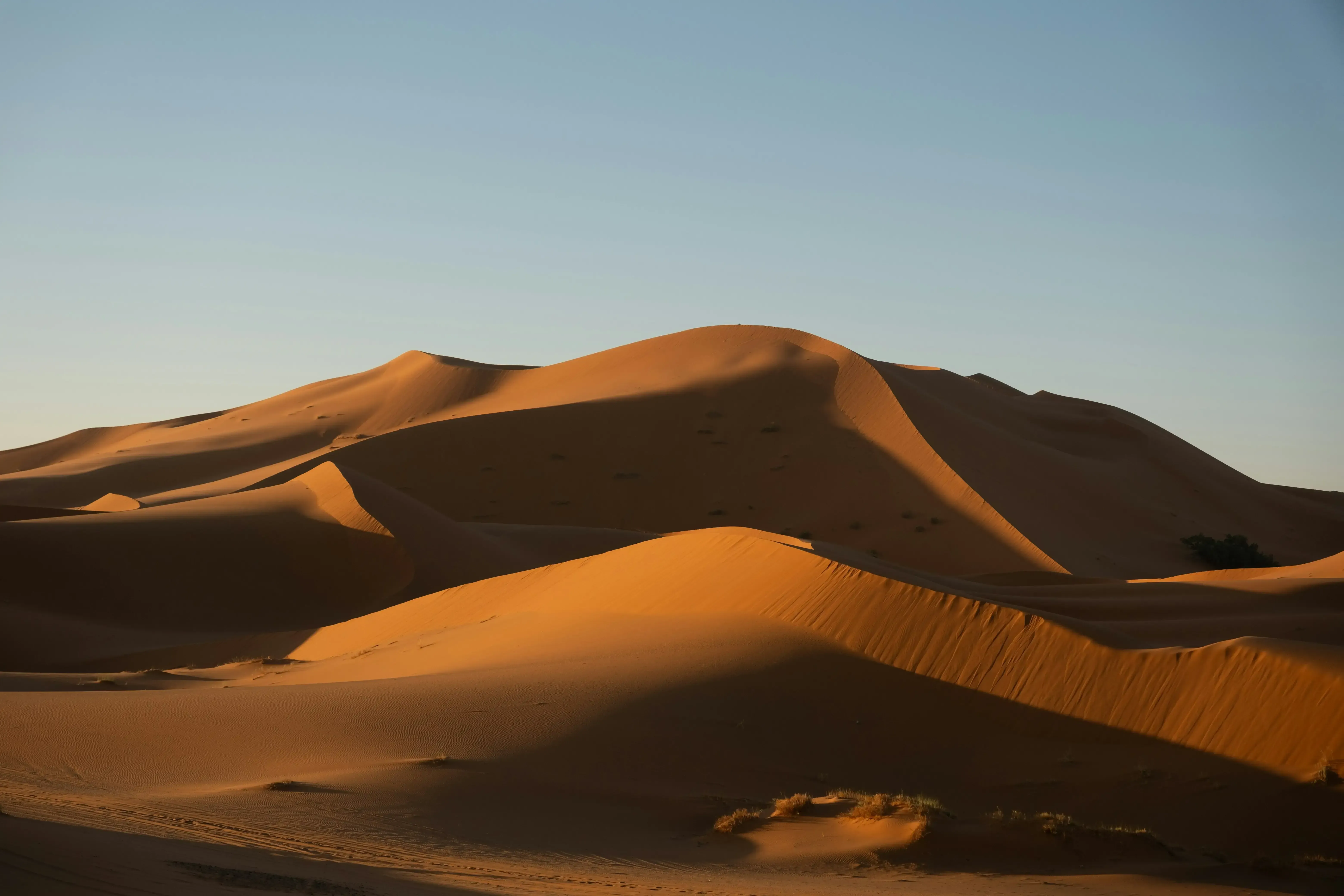
The desert of the Sharqiya region is Arabia's answer to Morocco's Sahara — approximately 12,500 km² of reddish-gold sand dunes rising to 100 meters, inhabited by Bedouin communities whose tents and camels appear between the dune ridges in ways that require no staging or imagination. The dune color changes from ochre to deep red as the afternoon light drops, and the stargazing from desert camps on clear nights — far from any urban light pollution — is among the finest in the Middle East.
Access to Wahiba requires either a fully equipped 4WD (with deflated tires, recovery gear, sand ladders, and the knowledge to use them — the dunes are serious and people get stuck regularly) or booking a guided camp with transport included. Most camps organize pickup from a desert-edge meeting point, transferring guests into the sands in their own vehicles.
Desert camp options range from budget (under OMR 30 per person) — basic tents, communal facilities, standard camel rides — to luxury glamping with private tents, gourmet dining, and professional stargazing programs. The midrange sweet spot is approximately OMR 50–80 per person with dinner, breakfast, and a sunset dune excursion included.
The Musandam Peninsula
The northernmost tip of Oman — geographically separated from the rest of the country by a strip of UAE territory — is the khasab (peninsula) where the Hajar mountains plunge directly into the Strait of Hormuz, creating khors (fjords) of extraordinary drama. The water is clear enough to snorkel directly from the boat; the rock faces above are vertical and enormous; the dolphins that follow the traditional dhow boats are the local version of a wildlife guarantee.
Musandam is a separate journey from the rest of Oman — you either cross the UAE (which requires a UAE visa for most nationalities, unless transiting straight through on the Omani border crossing) or fly directly to Khasab Airport (KHB). Day trips from Dubai are popular; overnight dhow stays are the finest way to experience the khasab. Not included in most Oman itineraries, worth planning separately.

Best Things to Do in Oman
Visit the Sultan Qaboos Grand Mosque at Opening Arrive at 7:45 AM before the 8:00 AM opening — the mosque is at its least crowded in the first 30 minutes, when the morning light comes low through the courtyard arcades and the scale of the carpet in the main prayer hall is most legible without hundreds of other visitors in the frame. The experience of walking through a religious space of this precision and ambition, in a country that builds its mosques as public gifts rather than commercial projects, is specific to Oman.
Drive the Hajar Mountain Circuit The route from Muscat south to Nizwa (2 hours on the main highway), then up to Jebel Akhdar (additional 30 minutes from the checkpoint in 4WD), then across to Jebel Shams (2 hours from Nizwa), then back to Muscat via Al Hamra (another hour to the main road) constitutes the finest road trip circuit in Oman and arguably one of the finest in the Arabian Peninsula. Allow two days minimum for the full circuit to do it justice — staying overnight on Jebel Akhdar or near Jebel Shams changes the morning light calculation entirely.
Swim Wadi Shab in Full The 50-meter swim to the cave waterfall at the end of Wadi Shab is the detail that separates travelers who followed the guidebook as far as the first pools from those who went the full distance. It requires leaving your dry bag on a rock, negotiating a narrow passage between canyon walls with water chest-high, and emerging into a cavern with a curtain of water pouring from above and a turquoise pool below it. It is extraordinary and achievable by any competent swimmer. Don't leave before you've done it.
Spend a Night in Wahiba Sands A single evening in a desert camp covers the camel ride at sunset, the dune landscape in the dying light, the temperature drop after dark (15°C in winter, which genuinely surprises visitors arriving from the 30°C coast), the dinner of Omani rice and slow-cooked lamb served on the floor of the communal tent, and the stars with no light competition for 80 kilometers in every direction. It is clichéd to describe a desert night as transformative; it is also accurate.
Explore Nizwa Fort and the Friday Livestock Market The two experiences are available independently but together constitute the single best day in Oman's interior. The Friday market runs from 7 to 10 AM; the fort opens at 8 AM. Arrive at the market first — the livestock auction in the circular animal yard, with Omani men in dishdashas conducting business in the pre-digital tradition, is an unmediated cultural encounter that requires only presence and the basic courtesy of watching without interference. Then cross to the fort for the view and the interior; the souq below it is quieter on Friday morning than weekdays because the animal market absorbs the attention.
Walk the Balcony Walk at Jebel Shams The 7 km return trail along the rim of Wadi Ghul is Oman's finest hike — the path is narrow, the drop is real, and the abandoned village ruins of Sap Bani Khamis perched on the canyon edge tell the story of a community that lived above this landscape for centuries before the logistics of water supply made it unsustainable. The walk requires reasonable fitness and complete absence of vertigo. The return view along the canyon in the afternoon light justifies the effort in both directions.
Sit in the Mutrah Souq at Dusk The covered souq at the Muttrah harbor end of the corniche is at its most atmospheric in the late afternoon — the light through the wooden lattice ceiling changes quality, the frankincense sellers are at their most active, and the silver shop owners are making tea. The souq sells real goods to real customers who actually live here, which gives it a honesty that purpose-built tourist markets lack. Buy frankincense if nothing else — the Omani boswellia sacra (sacred frankincense) is the finest grade available and is cheapest here, sold in resin lumps by weight for approximately OMR 2–5.
Drive the Coastal Road South to Salalah The 1,040 km road from Muscat to Salalah — the Muscat-Salalah Highway — is a two-day drive through Oman's interior desert, coastal cliffs, and the mountains of the Dhofar region. Most travelers fly (1 hour on Oman Air); the road trip is for those with time and the appetite for the vastness of the country at ground level. The overnight stop at Haima or Al Duqm breaks it sensibly. During the khareef (June–September), Salalah's waterfalls, frankincense trees, and green hills make the journey worthwhile; outside this season, the city itself is pleasant rather than essential.
Transfers Across Oman with Kiwitaxi
Oman's road network is excellent and the driving is straightforward — but the distances, the 4WD requirements on mountain roads, and the logistics of navigating unfamiliar routes while trying to locate a wadi trailhead on the first visit make a professional driver an efficient use of budget for specific legs of the journey.
Kiwitaxi covers private transfers across the main Oman tourism circuit:
Muscat Airport → Muscat City Hotels: 30–45 minutes, fixed pricing
Muscat → Nizwa: approximately 2 hours
Muscat → Wadi Shab: approximately 2 hours via the coastal road
Muscat → Wahiba Sands meeting points: approximately 2.5–3 hours
Nizwa → Jebel Akhdar: approximately 45 minutes to the plateau (4WD required above the checkpoint)
Muscat → Musandam (Khasab): approximately 4 hours via UAE border crossing (UAE visa conditions apply)
For the Hajar Mountain circuit (Muscat → Nizwa → Jebel Akhdar → Jebel Shams → back to Muscat), a Kiwitaxi Chauffeur Hire for 1–2 days with a knowledgeable driver is the most efficient arrangement for visitors who want professional navigation through the mountain roads without the 4WD rental logistics.

Oman on a Practical Note
Currency: Omani Rial (OMR). One of the highest-value currencies in the world — 1 OMR equals approximately USD 2.60. The OMR is divided into 1,000 baisa. Prices in Oman can initially seem very cheap numerically before the conversion is applied; OMR 5 for a restaurant meal is approximately USD 13. ATMs are available throughout Muscat and in major towns; carry cash for remote areas (wadis, mountain villages, desert camps). Most hotels and larger restaurants accept international cards.
Dress code: Oman is a conservative Muslim country. Shoulders and knees should be covered in public spaces, markets, and government buildings. At the Grand Mosque and religious sites, full modest dress is required. At beach resorts and hotels with pools, swimwear is acceptable in the designated areas. The abaya is not required for non-Muslim women outside specifically religious contexts, though wearing a headscarf in the interior is appreciated and noted positively.
Photography: Oman is photogenic almost everywhere and generally permissive about photography. Do not photograph military installations, police stations, government buildings, or people (particularly women) without explicit permission. In souqs and markets, asking before photographing vendors is correct protocol and usually warmly received.
Alcohol: Available in licensed hotels, restaurants, and bars in Muscat and major tourist areas. Not available in supermarkets or public establishments. Drinking in public or in any non-licensed venue is illegal. Bringing alcohol into the country requires customs declaration and specific quantity limits.
Frankincense: Buy it. The boswellia sacra frankincense from Dhofar (often labeled hojari — the finest grade, pale green, high oil content) is the world's best and is available throughout Oman at prices significantly below its export value. Burning it on a small majmar (charcoal incense burner) is the correct method; smaller pieces of resin burn for 20–30 minutes per light. It keeps indefinitely. Buy 200–500 grams and bring it home.
Safety: Oman consistently ranks among the safest countries in the world. Crime targeting tourists is extremely rare. The road conditions that create safety concerns are self-generated — excessive speed on mountain roads, underestimating wadi flash flood risk, attempting desert driving without preparation. Flash floods in wadis can arrive without local rain warning; check weather upstream before wadi hiking.
Oman is the country that the Gulf would be if it had decided to be itself rather than a projection. The frankincense is genuine. The forts have been there since before anyone thought to charge for viewing them. The Bedouin hospitality in the desert camps is not a tourism product — it's what Omanis do when someone arrives at their fire. The distinction is visible the moment you arrive and still visible when you leave, which is why people come back.
Explore Oman Guides

Kiwitaxi Airport Transfers
Land. Meet your driver. Go. Skip taxi lines and travel stress after your flight. With Kiwitaxi, your airport transfer is already arranged. Fixed prices, professional drivers, and service in 100+ countries - so your trip starts smoothly from the moment you land.
Book a transfer